
A modern Spanish living room should feel warm before it feels decorated.
That distinction matters. Many rooms described as Spanish style rely too heavily on obvious symbols: dark furniture, oversized chandeliers, patterned tiles, red walls, or decorative ironwork placed everywhere at once. The result can feel theatrical rather than lived in.
A more convincing room is quieter.
It may have limewashed walls, a broad plaster fireplace, thick timber, hand-finished ceramics, woven textiles, aged metal, and furniture with comfortable proportions. The room still carries the weight and craft associated with Spanish architecture, but it avoids clutter and unnecessary ornament.
This is the central idea behind a modern Spanish style living room: preserve the warmth, texture, and architectural character of traditional Spanish interiors while introducing cleaner lines, lighter visual weight, and a more practical layout.
This guide explains how to plan the room from the walls outward. You will learn how to choose colours, flooring, furniture, lighting, textiles, tiles, wood tones, accessories, and architectural details without turning the space into a theme.
Featured Snippet: What Is a Modern Spanish Style Living Room?
A modern Spanish style living room combines warm plaster or limewashed walls, natural wood, earthy colours, wrought-iron accents, handmade tiles, comfortable furniture, and layered lighting. The traditional materials remain, but the layout, colour balance, and furniture shapes are cleaner and less ornate.
The best rooms usually combine five elements:
- Warm, textured walls
- Natural or aged materials
- A restrained earthy palette
- Strong architectural features
- Comfortable modern furniture
Understanding the Style
Modern Spanish interior design grows from several connected traditions rather than one fixed formula.
It may borrow from:
- Spanish Colonial interiors
- Mediterranean architecture
- Andalusian courtyards
- Moorish decorative geometry
- California Spanish Revival homes
- Mexican and Southwestern craftsmanship
- Rustic European farmhouses
- Contemporary Mediterranean design
These influences overlap, but they are not identical.
A Spanish Colonial room may use dark beams, carved wood, iron hardware, and thick plaster walls. A Mediterranean room may feel brighter and more coastal. Andalusian interiors often include arches, courtyards, tilework, and intricate pattern. California Spanish Revival homes frequently combine stucco, terracotta roofs, rounded openings, and indoor-outdoor living.
The modern version does not need to reproduce any one of these traditions exactly. It should understand their shared principles:
- Honest materials
- Visible craftsmanship
- Softened architecture
- Natural light
- Textural contrast
- A close relationship with the outdoors
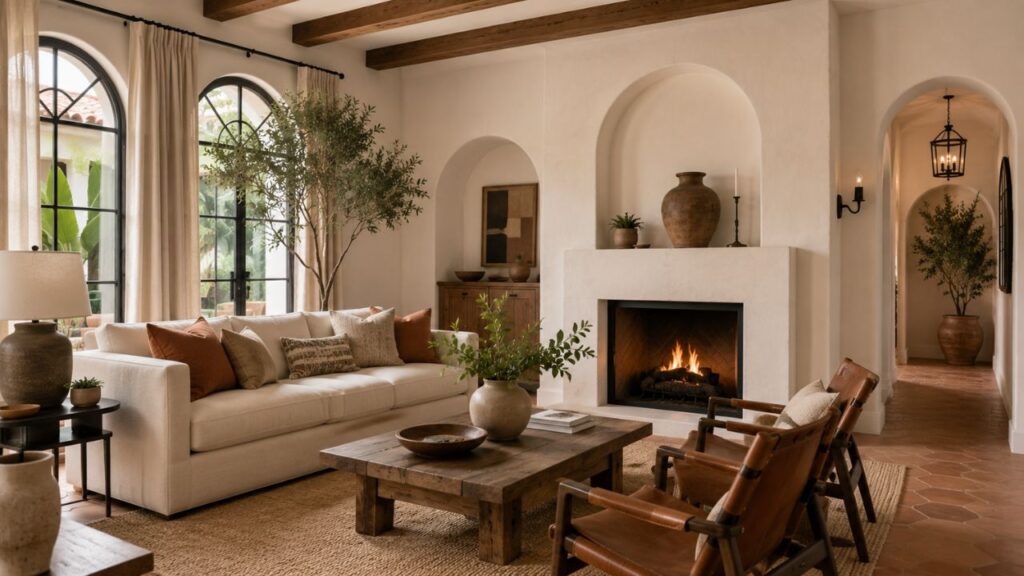
Start With Architecture Before Decoration
The most successful Spanish-style rooms feel convincing because the architecture carries the design.
Accessories help, but they cannot fully compensate for flat walls, weak proportions, or a generic fireplace.
Begin by asking which architectural features already exist.
Look for:
- Arched openings
- Deep window reveals
- Exposed beams
- Stucco or plaster walls
- Terracotta flooring
- A fireplace
- Ceiling height
- Built-in niches
- French doors
- Courtyard or garden views
If the room has none of these features, you do not need to rebuild the house. A few carefully selected architectural changes can create the right foundation.
Use Arches With Restraint
Arches are one of the clearest Spanish architectural references, but they should look structural rather than decorative.
Suitable places include:
- A doorway between the living and dining rooms
- A fireplace opening
- A built-in bookcase
- A wall niche
- An opening into a hallway
- A recessed drinks cabinet
Avoid adding several small arches simply to announce the style. One broad, well-proportioned opening is more persuasive than multiple decorative cut-outs.
A shallow arched niche with a plaster finish can hold a ceramic vessel, lamp, or small artwork without making the room feel busy.
Choose the Right Wall Finish
Flat, bright-white walls often feel too crisp for this style.
Spanish-inspired interiors usually benefit from a finish with visual movement.
Limewash
Limewash creates soft tonal variation and a chalky surface. It works particularly well in rooms with changing natural light because the wall colour shifts gently throughout the day.
Good colours include:
- Warm ivory
- Sand
- Mushroom
- Chalky beige
- Pale clay
- Muted putty
- Soft stone
Limewash is not always suitable for every wall surface, so follow the manufacturer’s preparation instructions.
Venetian or Mineral Plaster
Plaster finishes can range from rough and rustic to polished and refined.
For a modern living room, choose subtle movement rather than dramatic faux finishing. The wall should look naturally aged or hand-worked, not artificially distressed.
Matte Paint
Matte paint is the easiest route when plaster or limewash is not practical.
Choose a warm off-white rather than a blue-based white. The goal is to create a quiet background for wood, leather, linen, iron, and terracotta.
Build an Earthy Colour Palette
Traditional Spanish rooms can be dark and intense. A modern interpretation usually benefits from more breathing room.
Start with a soft neutral base, then add grounded colours through furniture, rugs, cushions, ceramics, and artwork.
Core Neutrals
- Warm white
- Oatmeal
- Sand
- Putty
- Stone
- Mushroom
- Taupe
- Soft brown
Earth Accents
- Terracotta
- Burnt sienna
- Rust
- Ochre
- Olive
- Tobacco
- Deep clay
- Faded paprika
Cooler Balancing Tones
- Dusty blue
- Slate
- Sage
- Muted teal
- Charcoal
- Aged black
A room does not need every shade. Choose one warm accent and one quieter counterpoint.
For example:
- Warm ivory walls
- Medium oak
- Tobacco leather
- Rust cushions
- Olive ceramics
- Aged black metal
That combination feels layered without becoming colourful in a restless way.
Avoid the Red-and-Brown Trap
A common mistake is combining dark brown furniture, red walls, orange tile, and black iron.
Each of those elements can belong in Spanish design, but together they may make the room feel heavy.
Use contrast strategically.
If the floor is dark, keep the walls pale. If the beams are substantial, choose lighter upholstery. If the fireplace tile is colourful, keep nearby fabrics quiet.
The room should feel sun-warmed, not dim.
Select Flooring That Adds Age and Texture
Flooring covers a large area, so it strongly influences the room’s character.
Terracotta Tile
Terracotta is closely associated with Spanish and Mediterranean homes.
Its appeal comes from variation. Handmade or hand-finished tiles may differ slightly in tone, edge, and surface texture.
Terracotta works well with:
- Plaster walls
- Oak furniture
- Linen upholstery
- Iron lighting
- Woven rugs
- Olive and clay accents
It must be sealed and maintained correctly, particularly in high-traffic areas.
Limestone and Travertine
Natural stone creates a softer, more refined base.
Tumbled finishes usually suit Spanish interiors better than highly polished surfaces because they feel less formal and reflect less glare.
Wood Flooring
Wood can make a modern Spanish room feel warmer and more residential.
Good options include:
- Wide oak boards
- Smoked oak
- Reclaimed timber
- Medium walnut tones
- Matte-finished engineered wood
Avoid overly grey stains and highly glossy finishes.
Patterned Cement Tile
Patterned cement tile can work beautifully in a small zone, such as:
- A fireplace hearth
- An entry area
- A window seat
- A bar niche
- A border
Using it across the entire living room may compete with rugs, furniture, and artwork.
Add a Rug to Soften Hard Surfaces
Spanish-style rooms often contain stone or tile, which can create echo and visual hardness.
A large rug helps define the seating area.
Choose:
- Flatwoven wool
- Vintage-style rugs
- Faded geometric patterns
- Natural jute
- Muted kilim designs
- Soft Berber-inspired textures
The rug should be large enough for at least the front legs of the sofa and chairs to sit on it.
Tiny rugs make the room look fragmented.
Make the Fireplace the Architectural Anchor
A fireplace is often the strongest focal point in a Spanish living room.
Suitable designs include:
- Smooth plaster surround
- Rounded firebox opening
- Timber mantel
- Stone hearth
- Handmade tile inset
- Full-height chimney breast
For a modern look, simplify the outline.
A broad plaster fireplace with one thick timber beam often looks stronger than a heavily carved surround.
Tile can be added inside the firebox border, along the hearth, or within a recessed niche. Keep the pattern controlled so it does not compete with the room.
Use Ceiling Beams Carefully
Exposed beams add depth and age, but scale matters.
Beams should relate to:
- Ceiling height
- Room width
- Fireplace size
- Window proportions
- Furniture weight
Dark beams can make a low ceiling feel even lower. In that situation, consider:
- Medium oak
- Whitewashed timber
- Narrower beams
- Beams matched closely to the ceiling
- A single structural-looking beam
Faux beams can work, but they should have realistic grain, spacing, and end details.
Choose Sofas With Relaxed, Simple Shapes
The sofa should be comfortable and visually substantial without looking overstuffed.
Good choices include:
- Linen-covered sofas
- Slipcovered designs
- Low-profile modular seating
- Bench-seat sofas
- Leather sofas with clean arms
- Deep neutral upholstery
Suitable colours include:
- Natural linen
- Oatmeal
- Warm grey
- Tobacco
- Camel
- Cream
- Olive
Avoid excessive buttoning, rolled arms, and ornate carved feet unless the room leans strongly traditional.
The modern Spanish look depends on contrast: old-world materials paired with straightforward furniture.
Mix Furniture Rather Than Buying a Matching Suite
A room assembled from one matching range tends to feel staged.
Mixing materials creates a more collected appearance.
Try combining:
- Linen sofa
- Leather armchair
- Oak coffee table
- Iron side table
- Woven stool
- Antique cabinet
- Plaster lamp
- Hand-thrown ceramics
The pieces should share proportion or colour, but they do not need to match exactly.
Coffee Table Ideas
The coffee table should feel grounded and tactile.
Suitable materials include:
- Solid oak
- Reclaimed wood
- Travertine
- Limestone
- Aged iron
- Plaster
- Dark-stained timber
Round or softly rectangular tables suit the curved architectural language of Spanish interiors.
If the sofa is large and plain, a chunky timber table adds texture. If the floor and fireplace are already visually heavy, a lighter stone or slim wood design may work better.
Use Side Tables as Material Accents
Side tables offer an easy way to introduce contrast.
One could be:
- Carved wood
- Travertine
- Blackened steel
- Ceramic
- Plaster
- Woven rattan
Do not use too many tiny tables. One beside each major seat is usually enough.
A compact bedside table may even be repurposed as a living-room side table when its height and finish suit the sofa.
A pair of vintage nightstands can sometimes work at either end of a long sofa, especially when they are simple enough to avoid looking like bedroom furniture.
A narrow night stand with a stone or timber top can function as a lamp table in a reading corner.
A nightstand with drawers is useful when the living room needs hidden storage for remotes, charging cables, coasters, or small electronics.
Matching night stands can frame a sofa, but styling them differently prevents the arrangement from feeling too formal.
Slim side tables for bedroom use may also suit small living rooms where deeper furniture would restrict movement.
A coordinated nightstand set can be separated and used beside two different chairs, creating balance without obvious symmetry.
Blend Bedroom and Living-Room Design in Open Plans
Studio apartments and open-plan homes often need furniture styles to flow between sleeping and living zones.
A bed frame with nightstands in oak can relate to the living room through a coffee table or ceiling beam in a similar tone.
The visual connection between the bed and nightstand area and the lounge should come from shared materials rather than identical furniture.
A nightstand next to bed furniture can repeat the living room’s ceramic lamp shape or aged-brass hardware.
In a compact studio, a nightstand bed arrangement may sit close to the sofa, making a consistent wall colour especially important.
An ikea nightstand can be customized with new handles or a limewash-inspired paint colour to coordinate with the Spanish living area.
An ikea bedside table in pale wood may work naturally with oak beams, woven textiles, and neutral upholstery.
A complete bed frame and nightstand set can be softened with linen bedding so it does not compete with the living room’s heavier wood and iron details.
A bed frame with side tables should repeat only one or two living-room finishes, such as timber tone and aged black metal.
A bed with side tables in an open-plan room looks more intentional when the rug, curtains, and wall finish connect both zones.
A dark bedframe and nightstand set can balance a black iron chandelier or dark window frames in the living area.
A simple bed nightstand set may echo the clean-lined sofa while the architectural Spanish character comes from plaster, tile, and timber.
A bed frame and side table set with rounded corners can relate subtly to arched doorways and curved furniture.
A bedroom set with 2 nightstands should not force every living-room piece to match. Variation keeps the home from feeling like a furniture showroom.
Choose Lighting in Layers
A single central fixture rarely creates enough warmth.
Plan at least three layers:
- Ambient lighting
- Task lighting
- Accent lighting
Ambient Lighting
This may come from:
- Iron chandelier
- Plaster pendant
- Aged-brass ceiling fixture
- Recessed lighting
- Indirect cove lighting
A chandelier can provide character, but avoid styles with excessive scrollwork unless the architecture is equally ornate.
Task Lighting
Use floor lamps and table lamps beside seating.
Suitable lamp bases include:
- Ceramic
- Stone
- Turned wood
- Plaster
- Aged metal
Linen or parchment-style shades soften the light.
Accent Lighting
Accent lighting can highlight:
- Artwork
- Arched niches
- Fireplace texture
- Ceiling beams
- Built-in shelves
- Large plants
Warm colour temperature generally suits the materials better than very cool white lighting.
Introduce Iron Without Overusing It
Wrought iron is strongly associated with Spanish interiors, but too much can feel harsh.
Use it in controlled details:
- Curtain rods
- Fireplace tools
- Chandelier
- Cabinet handles
- Side-table frame
- Mirror frame
- Door hardware
- Stair railing
Choose aged black, dark bronze, or hand-forged finishes rather than glossy black.
One or two strong iron elements usually have more impact than repeating black metal everywhere.
Add Handmade Tile in Focused Areas
Tile provides colour, pattern, and craft.
Good applications include:
- Fireplace surround
- Hearth
- Drinks cabinet
- Window ledge
- Stair riser
- Small tabletop
- Built-in niche
Styles may include:
- Zellige
- Talavera-inspired patterns
- Geometric Moorish motifs
- Terracotta
- Hand-painted floral tile
- Muted encaustic patterns
Choose tile that looks slightly irregular rather than digitally perfect.
For a modern room, limit the palette. Blue and white, olive and cream, or terracotta and charcoal are easier to integrate than a highly multicoloured pattern.
Select Curtains That Feel Soft and Generous
Heavy dark drapery can make a Spanish room feel dated.
Better choices include:
- Linen
- Linen blend
- Cotton
- Lightweight wool
- Textured neutral fabric
Mount curtains high and wide to make windows feel larger.
Suitable colours include:
- Warm white
- Oatmeal
- Flax
- Mushroom
- Soft olive
- Dusty clay
Woven shades can add privacy and texture behind the curtains.
Plan the Layout Around Conversation
A modern Spanish living room should feel social.
Traditional Spanish and Mediterranean homes often place emphasis on gathering, hospitality, shared meals, and long conversations. The furniture layout should support that feeling.
Instead of pointing every seat toward the television, arrange the room so people can see one another comfortably.
A strong layout may include:
- One main sofa
- Two armchairs angled inward
- A central coffee table
- One or two side tables
- A large rug connecting the seating
- A clear view of the fireplace
- Open movement toward the dining room or courtyard
Keep the main walkway outside the centre of the seating group. People should not have to step between the sofa and coffee table to cross the room.
Use the Fireplace as the Main Focal Point
When the room includes a fireplace, let it lead the arrangement.
Place the sofa opposite or perpendicular to it, then angle chairs toward the centre. The television can sit in a built-in niche, on a side wall, or within cabinetry designed to blend with the architecture.
Avoid mounting an oversized screen above a delicate plaster fireplace unless the scale genuinely works. A black television can overpower pale plaster, handmade tile, and a rustic mantel.
A better approach may be:
- Recessing the screen into a dark niche
- Placing it inside built-in cabinetry
- Using an art-display television
- Positioning it on a secondary wall
- Choosing a screen size that respects the fireplace
The room should still feel architectural when the television is switched off.
Small Modern Spanish Living Room Ideas
A compact room can carry this style beautifully because it relies on material quality rather than excessive furniture.
The key is editing.
Choose One Strong Architectural Feature
In a small room, use one dominant feature:
- Plaster fireplace
- Arched doorway
- Timber beam
- Terracotta floor
- Built-in niche
Do not combine all five unless they are original to the house.
Use Light Walls
Warm ivory, pale sand, and soft putty reflect light while keeping the room warm.
Dark walls can work, but they require strong daylight and disciplined furniture choices.
Select Fewer, Larger Pieces
Several small chairs, stools, and tables may make the room feel crowded.
A compact sofa, one substantial chair, and one well-scaled coffee table often create a calmer result.
A repurposed bedside table can work as an occasional table, but its top should be large enough for a lamp and drink without feeling crowded.
A pair of compact nightstands may be separated across the room rather than placed symmetrically beside the sofa.
A simple night stand can be refinished in warm walnut or muted clay paint to suit the living area.
A nightstand with drawers gives a small living room valuable concealed storage without requiring a wide cabinet.
Two matching night stands should not sit too close to the sofa arms. Leave enough space for curtains, lamps, and comfortable movement.
Narrow side tables for bedroom layouts can be useful beside compact armchairs where a full living-room table would feel too deep.
A small nightstand set can also be divided between a reading corner and the main seating area.
Modern Spanish Living Room Layout Guide
| Room shape | Recommended layout | Main design focus |
|---|---|---|
| Square room | Sofa with two facing chairs | Conversation and symmetry |
| Long room | Sofa along one wall with chairs angled inward | Breaking up the tunnel effect |
| Open-plan room | Floating sofa with console behind | Defining zones |
| Small room | Compact sofa and one statement chair | Preserving floor space |
| Fireplace room | Seating grouped around hearth | Architectural focal point |
| TV room | Screen on secondary wall | Balancing technology and character |
Create Flow in an Open-Plan Home
Modern homes often combine the living room, dining area, kitchen, and sometimes a visible sleeping zone.
The spaces should relate without looking identical.
Repeat a limited material palette:
- Warm plaster
- Medium-tone wood
- Aged black metal
- Terracotta
- Linen
- Stone
- Olive or clay accents
The connection between a bed frame with nightstands and the living room might come from the same oak tone used in the coffee table.
The relationship between the bed and nightstand area and the lounge can also be reinforced with matching curtain fabric or wall colour.
A nightstand next to bed may use aged brass hardware that repeats in the living-room lighting.
In a studio, a compact nightstand bed layout can sit behind a linen curtain or open shelving unit that visually separates the sleeping area.
An ikea nightstand can be painted in a mineral-style finish so it feels less mass-produced beside textured walls and rustic wood.
An ikea bedside table may also be upgraded with ceramic knobs, a timber top, or aged-metal pulls.
A complete bed frame and nightstand set should remain visually quieter when the living area contains a strong fireplace or patterned tile.
A bed frame with side tables in pale wood can connect naturally with a modern Spanish room that uses oak and woven materials.
A bed with side tables may share the same linen tones as the sofa without repeating every accent colour.
A dark bedframe and nightstand set can relate to iron lighting, fireplace tools, or black window frames.
A clean bed nightstand set works well when the architectural character comes from plaster, arches, terracotta, and timber rather than ornate furniture.
A rounded bed frame and side table set can repeat the soft lines of arched niches and curved lounge chairs.
A bedroom set with 2 nightstands should be treated as a separate furniture group rather than a template for the whole home.
Style the Walls Without Overdecorating
Modern Spanish rooms benefit from negative space.
A large empty plaster wall is not necessarily unfinished. Its texture, shadows, and warm tone may already provide enough visual interest.
Choose wall decor selectively.
Suitable options include:
- Large abstract artwork in earthy colours
- Vintage landscape painting
- Handwoven wall textile
- Iron-framed mirror
- Carved wood panel
- Ceramic wall plates
- Black-and-white architectural photography
- Simple religious or cultural artwork where personally meaningful
One large piece usually looks more confident than many unrelated small frames.
Choose Artwork With the Right Mood
The artwork does not need to depict Spain.
Focus instead on colour, material, and atmosphere.
Look for pieces that include:
- Ochre
- Clay
- Olive
- Tobacco
- Sand
- Charcoal
- Muted blue
- Soft black
Textured paintings, faded landscapes, abstract forms, and handmade prints often suit the room better than bright digital art.
The frame matters too. Consider:
- Aged wood
- Blackened iron
- Dark walnut
- Unfinished oak
- Antique brass
- Frameless canvas
Avoid glossy frames that feel overly formal.
Decorate With Ceramics
Ceramics add craft and irregularity.
Use:
- Large floor vessels
- Handmade bowls
- Unglazed clay pots
- Olive jars
- Textured lamps
- Small sculptural objects
- Glazed serving pieces
Vary height and shape, but keep the colour palette controlled.
A cluster might include:
- One large terracotta vessel
- One small cream bowl
- One dark glazed object
Three well-chosen pieces create more impact than a shelf filled with small ornaments.
Bring in Plants With Mediterranean Character
Plants help connect the room to courtyards, terraces, and garden living.
Suitable choices include:
- Olive tree
- Fiddle-leaf fig
- Rubber plant
- Rosemary
- Bay tree
- Citrus tree
- Snake plant
- Trailing ivy
- Large palm in bright rooms
Place plants in:
- Terracotta pots
- Limewashed planters
- Woven baskets
- Aged ceramic vessels
- Stone-look containers
Do not place plants in every corner. One large tree and one or two smaller plants are often enough.
Use Mirrors to Increase Light
Mirrors can brighten a room and reference traditional ironwork.
Suitable styles include:
- Arched iron mirror
- Round aged-brass mirror
- Carved wood mirror
- Simple black-framed mirror
- Antique-style glass
Position a mirror where it reflects a window, courtyard, fireplace, or artwork.
Avoid placing it directly opposite clutter or a television.
Modern Technology Without Losing Character
A modern Spanish room still needs power outlets, speakers, routers, lighting controls, and television storage.
The key is integrating them quietly.
Television
Use:
- Built-in plaster cabinetry
- Dark recessed niches
- Low timber consoles
- Art-display screens
- Sliding panels
- Custom doors where ventilation allows
Speakers
Choose architectural speakers, compact wireless units, or finishes that blend with the room.
Avoid placing large black electronics on every open shelf.
Cables
Hide cables through:
- Built-in channels
- Furniture backs
- Floor outlets
- Wall conduits
- Paintable covers
- Cord sleeves
Electrical changes should be completed by a qualified professional.
Smart Lighting
Smart dimmers and bulbs can improve the atmosphere without changing the visible design.
Program lighting for:
- Daytime
- Evening
- Reading
- Entertaining
- Television viewing
Warm, dimmed light is particularly effective with plaster, timber, and terracotta.
Budget-Friendly Ways to Get the Look
A modern Spanish living room does not require a full architectural renovation.
Start with high-impact changes.
Paint the Walls a Warm Neutral
A soft plaster-inspired colour can change the room immediately.
Avoid cold grey and brilliant white.
Replace Small Hardware
Change shiny chrome handles for:
- Aged brass
- Blackened iron
- Dark bronze
- Ceramic knobs
- Antique-style pulls
Add Linen-Look Curtains
Long neutral curtains add softness and height.
Choose simple fabric over ornate patterns.
Use Second-Hand Wood Furniture
Vintage cabinets, stools, and tables often have more character than new budget furniture.
Look for solid construction, good proportions, and surfaces that can be refinished.
Introduce Terracotta Carefully
Add terracotta through:
- Planters
- Bowls
- Lamps
- Cushion colour
- Small tiles
- Artwork
You do not need to replace the entire floor.
Upgrade Lighting
A ceramic lamp, iron pendant, or plaster wall light can establish the style quickly.
Where to Spend More
Some purchases deserve a larger share of the budget.
Spend more on:
- A comfortable sofa
- A large wool rug
- Quality lighting
- Natural stone
- Solid timber
- Well-made curtains
- Architectural plaster work
- Professional tile installation
- Skilled electrical work
These are highly visible or used every day.
Where You Can Save
You can often save on:
- Ceramic accessories
- Cushion covers
- Decorative bowls
- Second-hand side tables
- Simple curtain rods
- Small mirrors
- Woven baskets
- Framed prints
- Terracotta planters
Mixing high and low pieces makes the room feel more natural.
Modern Spanish Style Comparison
| Element | Traditional Spanish | Modern Spanish |
|---|---|---|
| Walls | Deep colour or heavy texture | Pale plaster and limewash |
| Furniture | Ornate dark wood | Clean lines with natural materials |
| Ironwork | Decorative and repeated | Used selectively |
| Tile | Strong pattern across large areas | Focused accents |
| Lighting | Heavy chandeliers | Sculptural but simplified |
| Textiles | Rich and patterned | Linen, wool, and muted motifs |
| Colour | Red, brown, gold | Sand, clay, olive, rust, charcoal |
| Layout | Formal and symmetrical | Relaxed and conversational |
| Accessories | Numerous decorative objects | Fewer handmade pieces |
| Technology | Often visually separate | Quietly integrated |
Common Design Mistakes
Using Too Much Dark Brown
Dark wood, brown leather, and black iron can quickly overwhelm the room.
Balance them with pale walls, linen upholstery, and lighter stone.
Adding Too Many Arches
Arches should feel structural.
Several decorative arch shapes in shelving, mirrors, furniture, and doorways can become repetitive.
Overusing Patterned Tile
Pattern works best as an accent.
When the floor, fireplace, table, cushions, and walls all compete, the room loses calm.
Buying a Matching Furniture Suite
Matching sofa sets, tables, and storage pieces can make the room feel generic.
A collected mix suits this style better.
Choosing Cold White Lighting
Blue-white light can make terracotta, wood, and plaster look flat.
Warm lighting creates a softer atmosphere.
Treating Rustic as Rough
Spanish-inspired interiors may include aged surfaces, but they should still feel cared for.
Splintered furniture, damaged tile, and poorly finished walls do not create authenticity.
Ignoring Comfort
Beautiful furniture is not useful if guests avoid sitting on it.
Test seat depth, back support, fabric durability, and coffee-table height.
Filling Every Surface
Leave space on tables, shelves, walls, and the mantel.
The room needs visual pauses.
Real-Room Scenario 1: Small Apartment Living Room
The room has white walls, laminate flooring, a compact sofa, and little architectural character.
A practical plan:
- Paint walls warm ivory
- Add one limewash-style feature wall
- Use a large faded rug
- Replace the coffee table with oak
- Add a ceramic lamp
- Hang an arched mirror
- Use linen curtains
- Add one olive tree
- Introduce rust and olive cushions
This creates the mood without structural work.
Real-Room Scenario 2: Large Open-Plan Home
The room opens into the kitchen and dining area.
A practical plan:
- Repeat plaster wall colour across all zones
- Use one timber tone throughout
- Add a large seating rug
- Position the sofa to define the lounge
- Use an iron pendant above dining
- Add terracotta only in selected accents
- Repeat aged brass in small hardware
- Keep kitchen cabinetry simple
The result feels connected without making each zone identical.
Real-Room Scenario 3: Traditional Home With Dark Furniture
The room already contains dark wood and leather.
A practical plan:
- Keep the best wood pieces
- Replace heavy curtains with linen
- Paint walls soft sand
- Add pale upholstery
- Use a lighter wool rug
- Remove excess iron decor
- Introduce cream ceramics
- Add olive and muted blue accents
The style becomes lighter without discarding quality furniture.
Real-Room Scenario 4: Rental Property
Permanent architectural changes are not possible.
A practical plan:
- Use removable limewash-effect wallpaper
- Hang long neutral curtains
- Add a freestanding arched mirror
- Use terracotta planters
- Bring in vintage wood tables
- Change removable cabinet handles
- Layer a faded rug
- Use ceramic and plaster-style lamps
- Store original fittings safely
The room can still feel cohesive without altering the property.
Frequently Asked Questions
What defines a modern Spanish style living room?
It combines traditional Spanish materials and forms—such as plaster, wood, terracotta, iron, arches, and handmade tile—with cleaner furniture, lighter colours, simpler layouts, and restrained decoration.
What colours work best?
Warm white, sand, clay, terracotta, olive, tobacco, rust, muted blue, charcoal, and aged black all work well. Use pale neutrals as the base and deeper colours as accents.
Can modern Spanish design work in a small room?
Yes. Use light walls, one strong architectural feature, fewer furniture pieces, a large rug, and limited pattern.
Do I need terracotta flooring?
No. Wood, limestone, travertine, and neutral tile can also work. Terracotta can be introduced through planters, accessories, or a small tiled area.
What type of sofa should I choose?
Look for linen, cotton, leather, or textured neutral upholstery. Clean-lined, deep, comfortable sofas work better than heavily ornate styles.
Is black furniture suitable?
Black can work in small amounts, particularly through iron lighting, frames, hardware, and occasional tables. Too much black may make the room feel harsh.
Can I use grey?
Warm greige, mushroom, and stone can work. Cool blue-grey often feels disconnected from terracotta, timber, and warm plaster.
What kind of rug fits this style?
Choose wool, jute, kilim, faded vintage, geometric, or Berber-inspired rugs in muted colours.
Should the furniture match?
No. A mix of wood, stone, linen, leather, and iron usually looks more authentic than a complete matching suite.
How do I modernize a traditional Spanish room?
Lighten the walls, simplify the furniture, reduce pattern, edit accessories, improve lighting, and keep only the strongest architectural details.
What lighting works best?
Use layered lighting with an iron, plaster, ceramic, or aged-brass ceiling fixture, plus floor lamps, table lamps, and subtle accent lighting.
How can I add Spanish style on a budget?
Start with warm paint, linen curtains, second-hand wood furniture, terracotta pots, ceramic lamps, aged-metal hardware, and earthy cushions.
Are patterned tiles necessary?
No. They are optional. When used, they are most effective around a fireplace, niche, hearth, bar, or tabletop.
Can this style work with modern technology?
Yes. Hide cables, use built-in cabinetry, choose art-display televisions, and keep electronic equipment visually quiet.
What is the biggest mistake to avoid?
Using too many obvious Spanish elements at once. Restraint creates a more believable and comfortable room.
Final Takeaway
A successful modern Spanish style living room is built through restraint, not excess.
The strongest rooms begin with a warm architectural base: plaster or limewashed walls, natural flooring, soft curves, deep openings, timber, stone, and carefully placed iron. Furniture should feel comfortable and current, allowing traditional materials to provide character without making the room feel formal or dated.
Use colour in measured layers. Warm ivory, clay, olive, tobacco, muted blue, and aged black create depth without overwhelming the room. Bring in pattern through one or two focused elements, such as a rug, fireplace tile, cushion, or ceramic piece.
The room should also work for real life. Arrange seating for conversation, preserve clear walkways, integrate technology discreetly, and choose pieces that are comfortable enough for everyday use.
Authenticity does not come from copying every recognizable Spanish feature. It comes from understanding the design principles behind the style: natural materials, visible craftsmanship, softened architecture, warmth, hospitality, and a strong connection to light and landscape.
When those principles guide the choices, the room feels calm, distinctive, and genuinely lived in rather than staged around a decorative theme.