
Choosing wood furniture sounds easy until three different shades of brown are sitting in the same bedroom.
The bed may be called walnut. The dresser may be labeled dark oak. Your flooring could lean golden, while the small cabinet beside the bed has a reddish finish. Individually, every piece can look attractive. Together, they may either create a layered, collected room or look as though the furniture was bought without any plan.
That is why understanding wood colors matters.
Wood is not simply light, medium, or dark brown. Natural timber can carry golden, yellow, orange, reddish, chocolate, gray, olive, and even subtle purple undertones. Black walnut, for example, can range from pale brown to dark chocolate brown and may show gray, purple, or reddish casts. American black cherry develops a deeper reddish-brown appearance as it ages. Natural variation is part of the material rather than a manufacturing defect.
Bedroom furniture makes these differences especially visible because several wooden pieces often sit close together: a bed, dresser, wardrobe, bench, bedside table, and a pair of nightstands may all appear within one view.
The good news is that they do not have to match perfectly.
In fact, trying to force every piece into exactly the same brown can sometimes produce a flatter, showroom-like room. A more convincing approach is to understand undertones, repeat selected finishes, separate competing woods, and use textiles and wall colors to connect the furniture.
This guide explains how.
What Are Wood Colors?
Wood colors are the visible natural or finished tones found in timber, veneer, engineered wood, and wood-look furniture.
They can come from several sources:
- the natural species
- heartwood and sapwood
- grain structure
- age
- exposure to light
- stain
- oil
- lacquer
- paint or tinted finish
- manufacturing processes
- veneer selection
The U.S. Forest Service’s Wood Handbook treats wood as a variable natural engineering material rather than a perfectly uniform manufactured surface. That distinction is important in interior design because two boards from the same general wood category may not look identical.
This is why furniture shoppers should treat product names such as “walnut,” “oak,” “espresso,” and “cherry” as starting points rather than precise color codes.
A walnut-look laminate from one company may be warmer than a genuine walnut veneer from another.
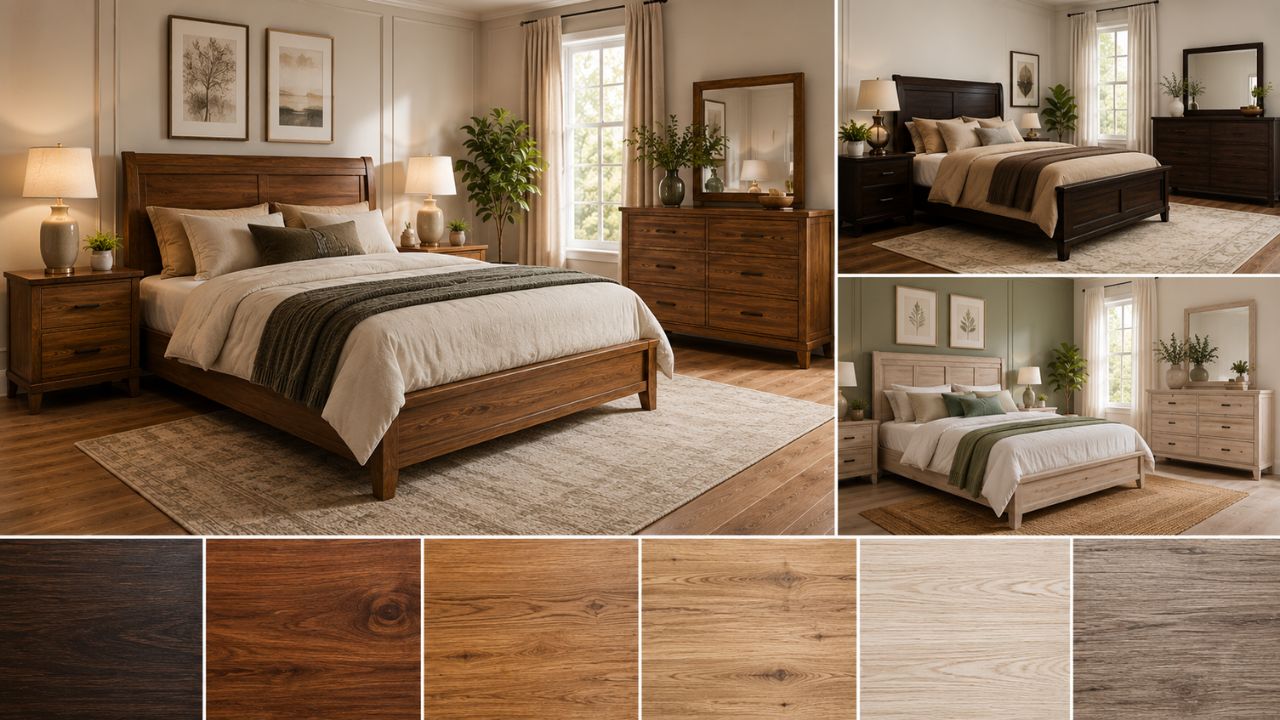
Quick Answer: Which Wood Colors Work Best in Bedrooms?
For most bedrooms, wood tones fall into four practical groups.
| Wood color family | Typical appearance | Bedroom feeling | Pairs well with |
|---|---|---|---|
| Light wood | Pale beige, blonde, honey | Airy, calm, casual | White, sage, blue, beige |
| Medium wood | Golden brown, warm brown | Balanced, welcoming | Cream, olive, terracotta |
| Dark wood | Chocolate, espresso, deep brown | Rich, grounded | Ivory, green, muted blue |
| Red-toned wood | Cherry, mahogany-like, reddish brown | Warm, traditional | Cream, green, navy, warm gray |
The easiest bedroom isn’t necessarily the one with a single wood finish. It is the one where the woods share a visual relationship.
Why Wood Undertones Matter More Than Furniture Labels
Imagine two bedside cabinets marked “medium brown.”
One contains yellow and golden undertones.
The other contains red.
Placed side by side, they can feel surprisingly different even though both technically belong to the same depth category.
This is where people often misdiagnose a furniture problem. They think the issue is that one piece is darker. In reality, the undertones are fighting.
Wood undertones commonly fall into these families:
Yellow or Golden
Common in many oak, pine, maple-look, honey, and natural finishes.
Orange
Seen in some aged woods, warm stains, teak-like finishes, and mid-century furniture.
Red
Common in cherry-toned finishes, mahogany-inspired furniture, red oak finishes, and some walnut pieces.
Brown
The most flexible category and common in walnut, medium brown, and neutral stains.
Gray or Taupe
Frequently found in contemporary washed oak, driftwood, greige wood, and weathered finishes.
Once you identify the undertone, matching becomes much easier.
Natural Wood Color vs Stained Wood Color
One of the most useful distinctions is the difference between species and finish.
A piece sold as “walnut color” may not be solid walnut.
It might be:
- walnut veneer
- engineered wood with walnut-look laminate
- another timber stained brown
- printed wood grain
- solid walnut
This matters because a furniture color name is not always a material description.
A dark night stand might be labeled walnut because of its appearance, while a genuine walnut nightstand with drawers may show greater natural variation across the drawer fronts.
If exact matching is important, compare physical samples, product photographs taken in similar lighting, and manufacturer finish names.
Light Wood Colors
Light woods have become popular in bedrooms because they reflect more light visually and rarely overpower bedding or wall colors.
Common appearances include:
- pale oak
- blonde wood
- natural ash
- light maple
- pale pine
- whitewashed wood
Light woods are particularly effective in compact rooms.
A pair of light night stands can provide storage without creating the visual heaviness of two bulky dark cabinets. The same principle makes pale side tables for bedroom layouts appealing in rooms with limited wall width.
Light wood pairs especially well with soft whites, warm gray, sage, muted blue, clay, oatmeal, and beige.
Oak Wood Colors
Oak is not one single shade.
Different species, cuts, stains, and finishes produce substantial variation. Some oaks lean golden, some reddish, and others slightly olive or brown.
Wood-reference material notes that oak color can vary considerably, which is one reason color alone is not a reliable method for identifying a specific oak type.
For bedroom design, think of oak in broader visual families.
Natural Light Oak
Best with:
- white
- cream
- sage
- dusty blue
- charcoal
- muted terracotta
Honey Oak
Best with:
- warm white
- olive
- soft green
- warm navy
- camel
- rust
Medium Oak
Best with:
- beige
- cream
- deep green
- muted blue
- warm gray
Dark Oak
Best with:
- ivory
- oatmeal
- light gray
- dusty green
- pale blue
A matching nightstand set in light oak can keep the area around the bed visually organized without forcing you to buy every bedroom piece from the same furniture collection.
Walnut Wood Colors
Walnut is one of the most versatile darker wood families for bedroom interiors.
American black walnut heartwood can range from relatively light brown through deep chocolate brown and may contain darker streaks. Gray, reddish, and even subtle purple casts can appear naturally.
That variation explains why two pieces both described as walnut may not look identical.
Walnut works particularly well with:
- cream
- ivory
- forest green
- olive
- muted blue
- burgundy
- camel
- warm gray
- black accents
- aged brass
A walnut bed frame with nightstands can establish a strong visual foundation in a bedroom without requiring dark walls.
If you prefer a lighter room, combine the dark frame with cream bedding and pale walls.
Cherry Wood Colors
Cherry deserves special attention because its appearance can change over time.
American black cherry is widely used for cabinetry and fine furniture, and reference material notes that it develops a richer reddish-brown patina as it ages.
That means an older cherry dresser may not perfectly match a recently purchased cherry bed and nightstand combination.
This is not necessarily a problem.
Instead of trying to make the pieces identical, repeat the reddish warmth elsewhere through:
- rug patterns
- warm leather
- terracotta accents
- bronze
- warm picture frames
The repeated undertone makes the room feel intentional.
Espresso Wood
Espresso is usually a finish description rather than a specific wood species.
It commonly refers to very dark brown furniture that may appear almost black from a distance.
Espresso furniture works best when the rest of the room provides contrast.
Try:
- ivory walls
- pale bedding
- beige carpet
- warm white curtains
- sage upholstery
A dark nightstand next to bed can frame a light upholstered bed effectively, but placing espresso furniture against a very dark wall may make the separate shapes difficult to distinguish.
Black Wood Furniture
Black-stained wood sits between wood furniture and painted furniture visually.
It is useful when a bedroom already contains several different timber tones because black can act almost like a neutral punctuation mark.
For example, an oak bed, walnut dresser, and black bedside cabinets can sometimes look more cohesive than introducing a fourth brown.
This technique works especially well in contemporary and Scandinavian-influenced rooms.
Gray and Weathered Wood
Gray wood had a strong presence in contemporary furniture for years and still appears in weathered, coastal, rustic, and industrial designs.
Its strength is neutrality.
Its weakness is that very cool gray wood can feel disconnected from strongly orange flooring.
If your floor is warm, consider greige or brown-gray wood instead of icy gray.
A gray nightstand bed arrangement works best when the textiles repeat either the warm or cool undertones found elsewhere in the room.
Should Your Bed and Nightstands Be the Same Wood Color?
No.
They can match, but they do not have to.
This is one of the most important bedroom furniture rules to understand.
Matching pieces create:
- symmetry
- consistency
- simplicity
Mixed pieces create:
- depth
- individuality
- a collected appearance
- greater flexibility
Suppose you own a medium oak bed. You could use:
- matching oak nightstands
- cream-painted cabinets
- darker walnut bedside tables
- black side tables
- woven or cane pieces
The decision should depend on the overall room, not on an imaginary rule that all furniture must match.
An integrated bed frame and nightstand set works beautifully in minimalist rooms, but a mixed combination may suit traditional, eclectic, transitional, or relaxed interiors better.
How to Mix Wood Colors Without Making the Bedroom Look Random
Mixing wood tones is easier when you follow a few visual principles.
1. Pick a Dominant Wood
Usually this will be the largest wood surface in the room.
It might be:
- flooring
- bed
- wardrobe
- built-in cabinetry
Let that wood establish the primary direction.
2. Add One Supporting Wood
The second wood should provide either subtle contrast or intentional depth.
3. Repeat Each Major Wood at Least Once
A single walnut cabinet in a room filled with pale oak may look accidental.
Repeat walnut in a frame, bench leg, mirror, or smaller accessory.
4. Pay Attention to Undertones
Golden woods generally coordinate more easily with other warm woods.
Cool gray woods usually pair more comfortably with neutral or cooler finishes.
5. Use a Buffer
Textiles can separate woods that would otherwise sit directly beside one another.
Rugs, upholstered headboards, bedding, and painted surfaces are excellent buffers.
Mixing Light and Dark Woods
Light and dark woods can look excellent together because the difference is obvious enough to appear intentional.
Problems often arise when two medium browns are almost—but not quite—the same.
For example:
Better contrast: pale oak + dark walnut
Harder match: medium golden oak + slightly reddish medium walnut
A clear contrast tells the eye that the difference was planned.
This technique is particularly useful with a bed frame with side tables. A pale upholstered or light-oak bed can sit between darker tables without looking mismatched.
Can You Mix Oak and Walnut?
Yes.
Oak and walnut are one of the easiest mixed-wood combinations when their proportions are controlled.
Oak usually creates the lighter layer.
Walnut creates visual weight.
One approach is:
- light oak flooring
- walnut bed
- cream rug
- light walls
- walnut or black bedside tables
Another is:
- oak bed
- dark walnut dresser
- oak bedside furniture
- dark frames or lighting to repeat the walnut depth
A bed with side tables does not have to repeat the floor exactly. In fact, a small amount of contrast often makes each furniture piece easier to see.
Can You Mix Cherry and Walnut?
Yes, but pay closer attention to warmth.
Cherry tends to become reddish and warm, while walnut often leans chocolate brown.
Use a common bridge color such as:
- cream
- burgundy
- olive
- aged brass
- warm beige
Avoid adding several unrelated orange-brown finishes unless the room is intentionally eclectic.
Can You Mix Wood Furniture With Wood Flooring?
Absolutely.
Trying to match furniture exactly to flooring can actually make a room feel flat.
Imagine medium oak flooring with a medium oak bed of nearly identical color. The furniture may visually disappear into the floor.
Contrast can be more useful.
Light Floor
Try medium or dark furniture.
Dark Floor
Try light oak, pale upholstered furniture, or medium walnut.
Warm Floor
Choose furniture with compatible warmth or deliberately contrast it with a neutral painted finish.
Gray Floor
Use neutral oak, black, charcoal, or balanced walnut rather than strongly orange furniture.
A bedframe and nightstand set should be judged against the flooring before purchase, especially when both furniture and floor occupy large visual areas.
Matching Wood Colors With Wall Paint
Wall color can either connect your wood furniture or expose every mismatch.
Warm White
Works with nearly every warm wood.
Excellent for:
- walnut
- oak
- cherry
- teak-like finishes
- espresso
Cool White
Works better with:
- pale ash
- gray oak
- black wood
- cool contemporary finishes
Beige
Ideal for medium and dark brown wood.
Sage Green
Excellent with oak and walnut.
Blue
Muted blue can balance orange and red undertones.
Terracotta
Works well with pale oak and medium walnut but may create too much warmth beside strongly red cherry.
Dark Green
Beautiful with walnut, oak, and black wood when the room has adequate lighting.
Matching Wood Furniture With Bedding
Bedding has one major advantage: it can correct the visual balance of a room without changing the furniture.
If the furniture looks too warm, introduce:
- muted blue
- sage
- gray-green
- cool cream
If it looks too dark, use:
- white
- ivory
- oatmeal
- pale beige
If the room feels too pale, add:
- forest green
- rust
- burgundy
- navy
- charcoal
A dark bed nightstand set becomes much less visually heavy when surrounded by ivory bedding and a light rug.
How to Choose the Best Wood Color for a Small Bedroom
Small bedrooms do not automatically require white furniture.
Dark wood can work.
The real issue is how many heavy surfaces are competing for attention.
If you use a dark wooden bed, try lighter:
- walls
- bedding
- curtains
- rug
If the wardrobe is also dark, bedside furniture may need to become visually lighter.
A compact bed frame and side table set can work well when proportions are appropriate, but measure the full wall width rather than estimating from an online product image.
Light oak is particularly forgiving in small bedrooms because it visually recedes more than espresso.
Best Wood Colors for Large Bedrooms
Large bedrooms can support stronger furniture.
Walnut, espresso, cherry, dark oak, and black-stained wood can give large spaces enough visual weight.
The danger in a large room is the opposite of the small-room problem: undersized light furniture can appear lost.
A substantial bedroom set with 2 nightstands may provide useful symmetry in a large primary bedroom, especially when the headboard wall is wide.
Use a large rug and appropriately scaled lamps so the furniture does not appear isolated.
Matching Bedside Furniture: Height Comes Before Color
People often spend hours debating walnut versus oak and forget the practical measurements.
Bedside furniture needs to work with mattress height.
Ideally, frequently used objects should be easy to reach without awkward stretching.
The exact height depends on:
- frame
- foundation
- mattress
- sleeper preference
Measure from the floor to the top of your mattress, then compare that number with the furniture dimensions.
A beautiful nightstand with drawers is still the wrong purchase if the top sits so low that reaching your lamp becomes annoying every night.
Open Bedside Tables vs Drawer Storage
Color is only one part of bedside furniture selection.
Open tables look lighter.
Closed cabinets hide visual clutter.
If you keep books, charging cables, glasses, tissues, remotes, or personal objects beside the bed, drawers can make the entire bedroom appear calmer.
A simple bedside table in natural oak may suit a minimalist bedroom, while a larger cabinet with closed storage may be more useful in a room with limited dresser space.
The IKEA Question: Can Affordable Furniture Fit a Mixed-Wood Bedroom?
Yes.
The key is not the price point. It is the finish, scale, and relationship with the surrounding furniture.
An ikea nightstand in a neutral finish can act as a bridge when the bed and flooring already have noticeable wood grain.
An ikea bedside table can also work in a more expensive bedroom if the proportions, hardware, and styling feel connected to the surrounding pieces.
Avoid judging furniture only by brand.
Look at:
- dimensions
- construction
- finish
- grain direction
- storage
- hardware
- weight
- visual scale
Solid Wood, Veneer, and Wood-Look Furniture: Does It Affect Color?
Yes.
Solid wood commonly shows natural variation.
Veneer can also display genuine wood grain, but manufacturers may arrange sheets for a more controlled appearance.
Laminate or printed finishes can be more consistent because the pattern is manufactured.
None of these categories automatically determines whether furniture looks good.
The question is what you expect
If you want visible natural variation, genuine wood or veneer may appeal to you.
If exact repetition across several furniture pieces matters more, a manufactured surface may produce greater consistency.
Why Two Pieces of Real Wood May Never Match Perfectly
Trees are biological materials.
Growth conditions, grain, heartwood, sapwood, mineral streaks, age, cut, finishing, and exposure all influence appearance.
This is why expecting two separate pieces of timber to behave like two identical painted metal panels is unrealistic.
Walnut alone can vary from lighter brown through dark chocolate and may carry different casts. Cherry changes as it ages. Oak can vary considerably within its broader color range.
Instead of demanding perfect sameness, aim for compatibility.
That small change in thinking makes mixed furniture much easier to design.
Wood Stains: What They Actually Change
Stain modifies the visible color of the wood while often allowing grain to remain visible.
Common stain families include:
- natural
- honey
- golden oak
- provincial brown
- walnut
- dark walnut
- espresso
- cherry
- mahogany-like red-brown
- gray
- whitewash
The same stain can look different on different woods because the base color, grain, and absorption are different.
Never assume a stain name guarantees a precise finished color.
If refinishing furniture, test the stain on an inconspicuous area or sample of the same material first.
Does Wood Furniture Change Color With Age?
Some species do.
Cherry is a well-known example, developing a richer reddish-brown patina as it ages.
Light exposure can also influence how furniture changes.
This matters when adding a new piece beside furniture that has been in the room for years.
A brand-new cherry night stand may appear noticeably lighter than older cherry furniture at first.
Trying to correct that difference with a poorly chosen dark stain can create a bigger problem later.
Allow for natural variation when appropriate.
A Practical Wood-Matching Method Interior Designers Use
You don’t need a professional color scanner.
Use this simple process.
Step 1: Photograph the Entire Room
Do not evaluate furniture as isolated product shots.
Step 2: Identify the Largest Wood Surface
Usually flooring, bed, wardrobe, or built-in cabinetry.
Step 3: Identify Its Undertone
Is it yellow, orange, red, brown, gray, or neutral?
Step 4: Decide Between Harmony and Contrast
Do you want the next furniture piece to blend or intentionally stand apart?
Step 5: Compare Samples in the Room
Daylight matters.
Step 6: Check at Night
Artificial lighting can make golden wood more orange and cool finishes more gray.
Step 7: Repeat the New Tone
If you introduce a clearly different wood, repeat its depth or undertone somewhere else.
Scenario 1: Light Oak Bedroom
Imagine a bedroom with natural light-oak flooring and warm-white walls.
A common mistake is buying every piece in nearly identical light oak.
Instead, try:
- cream upholstered bed
- light-oak nightstands
- medium walnut dresser
- black-framed mirror
- oatmeal rug
The oak repeats through the bedside furniture, while the walnut introduces depth.
If you prefer a coordinated nightstand set, repeat the darker dresser color through small frames or lamp bases so it doesn’t look isolated.
Scenario 2: Walnut Bed With Pale Flooring
A walnut bed already provides strong visual weight.
Pair it with:
- pale flooring
- cream bedding
- warm-white walls
- medium or dark night stands
- beige rug
- green or muted blue accents
Here, the dark bedside pieces strengthen the bed rather than competing with it.
A nightstand next to bed should still be evaluated for height and width; visual matching does not compensate for poor proportions.
Scenario 3: Cherry Furniture With Beige Carpet
Cherry’s reddish warmth works beautifully with beige because the carpet softens the contrast.
Try:
- cherry bed
- cream bedding
- soft green wall
- cherry or dark-brown side tables for bedroom
- brass lamps
- muted patterned rug
A matching bed and nightstand arrangement works well here because the carpet already provides a large neutral surface between the furniture pieces.
Scenario 4: Gray Flooring and Warm Furniture
Gray flooring can make orange wood look stronger.
If your existing bed is warm honey oak, avoid introducing several more highly orange surfaces.
Instead, use:
- warm-white walls
- neutral bedding
- black bedside furniture
- greige rug
- restrained oak accessories
A black or taupe nightstand bed combination can create the visual bridge needed between cool flooring and a warm bed.
Scenario 5: The Mixed-Furniture Bedroom
Suppose you already own:
- oak bed
- walnut dresser
- painted wardrobe
There is no need to replace everything.
Choose bedside pieces that repeat one existing finish.
A walnut nightstand with drawers would connect to the dresser.
An oak pair would reinforce the bed.
Painted bedside cabinets could connect to the wardrobe.
The wrong choice would be introducing yet another unrelated reddish-brown wood without repeating it anywhere else.
Scenario 6: Buying a Complete Bedroom Set
Complete sets offer convenience.
A bed frame with nightstands gives you predictable coordination, while a bed frame and nightstand set reduces decisions during furnishing.
The risk is visual sameness.
Break it up with:
- upholstered bench
- contrasting rug
- ceramic lamps
- fabric headboard
- painted wall
- textured bedding
The furniture provides structure. The surrounding materials provide personality.
Integrated Beds With Side Tables
A bed frame with side tables can look particularly clean in contemporary bedrooms because the horizontal lines remain consistent.
A bed with side tables also reduces the risk of choosing bedside furniture that feels too tall, short, narrow, or bulky.
There is a trade-off: integrated furniture is less flexible.
If your needs change, replacing just one bedside surface may be difficult.
Choose this style when long-term consistency matters more than rearranging furniture.
Matching Bedframes and Nightstands
A bedframe and nightstand set is often marketed as the easiest route to a coordinated room, and in many cases it is.
Still, check the finish in your actual lighting.
A product described as dark walnut might appear much warmer under yellow lighting than it did on a cool computer display.
A bed nightstand set should also be compared with flooring, doors, built-ins, and wardrobes rather than evaluated on its own.
Your bedroom contains more wood than the pieces included in the set.
Bed Frame and Side Table Packages
A bed frame and side table set can make sense for new homeowners or anyone furnishing an empty room because the major proportions are decided at once.
Later, introduce a second wood through a bench, dresser, or chair if the room feels too uniform.
If you prefer complete symmetry, a bedroom set with 2 nightstands can provide a strong foundation, particularly for beds centered on a wide wall.
The goal is not to avoid matching furniture. It is to prevent matching furniture from becoming the only visual idea in the room.
IKEA Furniture in an Existing Wood Scheme
Imagine you already own a walnut bed but need inexpensive bedside storage.
A pale ikea nightstand could intentionally contrast with the bed instead of trying unsuccessfully to imitate walnut.
Likewise, an ikea bedside table in black or neutral wood-look finish can connect mixed furniture by creating a visual pause.
This is often a smarter approach than chasing an almost-match.
Almost matching wood can look like a mistake.
Clearly contrasting wood looks deliberate.
Three Reliable Wood Color Palettes for Bedrooms
Palette 1: Light and Relaxed
Main wood: Natural oak
Secondary wood: Pale ash
Walls: Warm white
Bedding: Oatmeal
Accent: Sage
Metal: Black
Best for Scandinavian-inspired, modern, casual, and smaller bedrooms.
Palette 2: Warm and Sophisticated
Main wood: Walnut
Secondary wood: Medium oak
Walls: Cream
Bedding: Ivory
Accent: Forest green
Metal: Aged brass
Best for transitional, luxury, and hotel-inspired bedrooms.
Palette 3: Traditional and Rich
Main wood: Cherry
Secondary wood: Dark brown
Walls: Warm beige
Bedding: Cream
Accent: Olive or navy
Metal: Bronze
Best for classic, traditional, and heritage-influenced bedrooms.
Wood Color Comparison Table
| Wood color | Undertone tendency | Visual weight | Best wall partners | Best design use |
|---|---|---|---|---|
| Pale oak | Yellow-neutral | Light | White, sage, blue | Small rooms, modern interiors |
| Honey oak | Golden | Medium | Cream, olive | Warm traditional rooms |
| Walnut | Brown, sometimes red/gray | Medium-dark | Ivory, green | Sophisticated bedrooms |
| Cherry | Reddish brown | Medium-dark | Cream, green | Traditional furniture |
| Espresso | Very dark brown | Heavy | White, beige | High-contrast rooms |
| Black | Neutral-dark | Heavy | Almost any light wall | Modern accents |
| Gray wood | Cool gray/taupe | Light-medium | White, muted blue | Contemporary interiors |
| Whitewashed wood | Pale neutral | Very light | Soft color | Coastal and cottage rooms |
Common Wood-Color Mistakes
Trying to Match Every Brown Exactly
Natural and manufactured furniture vary too much for this to be reliable.
Aim for coordination instead.
Mixing Too Many Similar Medium Browns
Three nearly identical brown finishes can appear more accidental than one light and one dark wood.
Ignoring Flooring
Flooring may be the largest wood-colored surface in the room.
Always include it in the palette.
Shopping From Screen Color Alone
Phone and monitor settings affect appearance.
Room lighting does too.
Forgetting Grain
Color is only half of the visual equation.
Strong rustic grain and smooth fine-grain furniture can feel very different even when their colors are similar.
Using Only One Texture
A room containing wood bed, wood dresser, wood tables, wood floor, and wood wall panels may need textile contrast.
Use upholstery, wool, linen, cotton, ceramic, glass, or metal to provide relief.
How Many Wood Colors Can You Mix in One Bedroom?
Two main wood tones are easy.
Three can work.
More than three becomes increasingly dependent on repetition and styling skill.
There is no strict design law, but a useful hierarchy is:
Dominant wood → supporting wood → small accent wood
For example:
- light oak floor
- walnut furniture
- cane accents
That feels layered.
By comparison:
- light oak floor
- orange pine bed
- cherry dresser
- gray bedside cabinet
- espresso wardrobe
may feel scattered unless another strong design strategy ties everything together.
Are Matching Bedroom Sets Outdated?
No.
What can look dated is the way a matching set is styled.
A matching bed, dresser, and bedside tables can look contemporary if the room contains contrasting materials and restrained accessories.
The problem occurs when every visible object comes from the same collection:
- bed
- bedside cabinets
- tall dresser
- wide dresser
- mirror
- wardrobe
The eye receives no variation.
Use the set as the framework, then introduce different textiles, lighting, artwork, and smaller pieces.
Sustainability and Wood Furniture
Color should not be the only consideration when buying furniture.
Source and material claims matter too.
The Forest Stewardship Council explains that its labels identify products using forest-based materials from certified, recycled, and/or controlled sources depending on the label type. FSC 100%, FSC Recycled, and FSC Mix have different sourcing meanings.
When sustainability matters to you, check what a product is actually made from rather than assuming “wood look” or “natural finish” explains its sourcing.
Useful questions include:
- Is it solid wood, veneer, or engineered board?
- What species is used?
- Is the sourcing certification stated?
- Can parts be repaired or replaced?
- Is the finish durable enough for long-term use?
Furniture that stays useful for years often makes more practical sense than something replaced simply because its color follows a short-lived trend.
How to Choose Wood Colors That Won’t Feel Dated Quickly
Trend-resistant wood schemes usually have three characteristics.
First, the main furniture uses recognizable natural or neutral wood tones.
Second, stronger color trends appear through easier-to-change elements such as paint and bedding.
Third, there is enough contrast to keep the room from feeling tied to one furniture collection.
Natural oak, medium walnut, warm brown, and restrained dark finishes have broad compatibility.
Extremely gray washed finishes, very orange stains, or unusual artificial colors may require more careful coordination.
That does not mean you should avoid them. It means you should choose them because you genuinely like them, not simply because they happen to be fashionable.
Featured Snippet: How Do You Match Different Wood Colors in a Bedroom?
Choose one dominant wood tone, identify its undertone, and add one or two supporting woods that either share that undertone or contrast clearly. Repeat each important wood color at least once, and use rugs, upholstery, bedding, or painted furniture to separate finishes that clash when placed directly together.
This strategy works because the room gains both consistency and variation.
Frequently Asked Questions
What are the most common wood colors for bedroom furniture?
The most common groups are pale oak, honey or golden wood, medium brown, walnut, cherry or reddish brown, espresso, black, gray, and whitewashed finishes. Furniture names do not always identify the actual wood species, so read the material description as well.
Which wood color is best for a bedroom?
There is no single best choice. Light oak feels airy, walnut feels warm and sophisticated, cherry feels traditional, and espresso provides strong contrast. Choose according to the room size, flooring, wall color, natural light, and furniture style.
Can I mix light and dark wood furniture?
Yes. Light and dark woods often work especially well because the contrast appears intentional. Pale oak with walnut is a reliable example.
Should all bedroom furniture match?
No. Matching furniture creates order, but mixed furniture often produces more visual depth. Repeat woods or undertones so the combination still looks connected.
Does walnut match oak?
Yes. Oak and walnut can work very well together. Light oak paired with deeper walnut creates a clear contrast without requiring every furniture piece to match.
Does cherry wood get darker with age?
American black cherry is known for developing a richer reddish-brown patina as it ages. Light exposure can influence this change.
What wall color works with dark wood furniture?
Warm white, ivory, cream, beige, sage green, muted blue, and some warm grays can all work. Light wall colors create useful contrast with dark furniture.
What wood color makes a small bedroom look larger?
Light oak, ash, pale maple-like finishes, and other blonde woods generally create less visual weight. Dark wood can still work if the walls, textiles, and floor provide enough contrast.
Can bedroom furniture be a different wood color from the floor?
Yes. It often should be slightly different. Exact matching can make furniture blend into the flooring, while controlled contrast helps define each piece.
Is espresso a type of wood?
Usually, espresso describes a very dark brown finish rather than a specific species.
Is walnut always dark brown?
No. Black walnut can range from relatively pale brown to dark chocolate and can display gray, reddish, or purple casts.
What is the safest way to mix three wood colors?
Use one dominant wood, one secondary wood, and a third only as a smaller accent. Repeat the first two elsewhere so none looks accidental.
Practical Buying Checklist
Before ordering bedroom furniture, check:
- The actual material, not just the finish name.
- The dominant wood already in the room.
- Flooring undertones.
- Wall color.
- Furniture dimensions.
- Mattress and bedside-table height.
- Natural daylight.
- Nighttime artificial light.
- Grain pattern.
- Storage needs.
- Whether the finish is natural or stained.
- Whether a sample is available.
- How the new furniture color will be repeated elsewhere.
- Certification or sourcing information if responsible forestry matters to you.
A five-minute color check before buying can prevent years of looking at furniture that never quite seems to belong together.
Final Design Takeaway
The best wood colors are not determined by a chart alone.
A wood finish has to work with the floor, wall color, light, textiles, furniture size, grain, and existing pieces.
Start with the largest permanent wood surface.
Identify whether it feels golden, reddish, neutral brown, gray, or dark.
Then decide whether new furniture should harmonize or provide obvious contrast.
Do not chase perfect matches across unrelated furniture collections. Natural wood varies, stains behave differently on different materials, and online photographs can make finishes appear more consistent than they really are.
Instead, build relationships.
Repeat walnut.
Echo oak.
Separate competing woods with upholstery.
Use wall paint to cool excessive warmth.
Use bedding to lighten dark furniture.
Let one finish lead and the others support it.
That approach gives a bedroom something that perfectly matched furniture cannot always provide: character without chaos.