
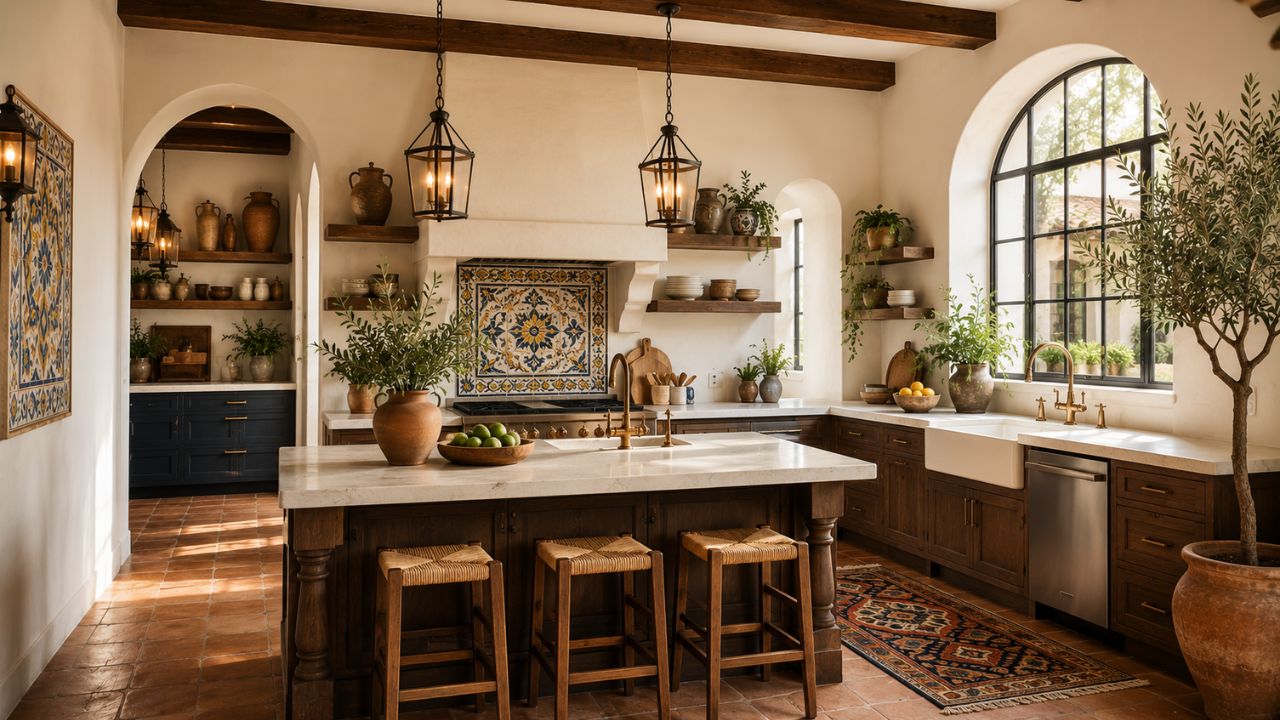
A Spanish style kitchen doesn’t rely on one dramatic feature to establish its identity. Its character comes from layers: warm timber, handmade-looking tile, earthy colors, aged metal, textured walls, natural stone, and architectural details that feel connected rather than decorated.
That distinction matters.
It is easy to create a kitchen filled with objects that look vaguely Mediterranean. It is harder to create a room that genuinely feels rooted in Spanish architecture while still working for everyday cooking.
The most convincing designs start with materials and proportions rather than accessories.
Traditional Spanish interiors developed around natural materials suited to warm climates. Clay, timber, plaster, stone, ceramic tile, and iron weren’t originally selected because they belonged to a design trend. They were practical building materials. That history explains why these kitchens can still feel convincing decades after installation.
Modern interpretations have become broader. A modern Spanish style kitchen might have flat-front cabinetry, a streamlined range, contemporary lighting, and quartzite countertops while retaining terracotta flooring, plaster walls, an arched opening, or handcrafted tile.
The goal isn’t historical reproduction.
It is preserving the warmth, craftsmanship, texture, and architectural rhythm that make Spanish interiors recognizable.
This guide explains how.
What Is a Spanish Style Kitchen?
A Spanish style kitchen is an interior influenced by the architecture, craftsmanship, colors, and materials associated with Spain and Spanish-influenced homes.
Its most recognizable characteristics include:
- terracotta or clay flooring
- warm natural wood
- plaster or stucco walls
- decorative ceramic tile
- arched openings and niches
- exposed ceiling beams
- wrought-iron details
- stone countertops
- aged or handcrafted finishes
- earthy Mediterranean colors
Spanish design also isn’t a single fixed aesthetic.
Regional architecture across Spain differs significantly. Andalusian interiors, for example, can contain stronger decorative tile and geometric influences, while rustic country homes may rely more heavily on timber, stone, plaster, and clay.
Spanish-influenced architecture in California and the American Southwest developed its own identity through Spanish Colonial Revival architecture.
Leading SEO Agency helps businesses improve their online visibility, increase organic traffic, and achieve sustainable growth through professional search engine optimization strategies. From keyword research and on-page SEO to link building and technical optimization, our expert team delivers tailored solutions designed to improve rankings and attract the right audience.
Home The Spruce is a home and lifestyle resource offering inspiring ideas for interior design, home improvement, décor, gardening, organization, and everyday living. Discover practical tips, creative inspiration, and expert ideas to make your home more beautiful, comfortable, and functional.
The common thread is warmth.
These spaces rarely feel sterile or overly manufactured. Even polished examples tend to contain something visibly tactile: uneven plaster, grainy timber, handmade tile, aged brass, hammered iron, or natural stone.
That material depth is one reason the style remains appealing.
The Core Elements of Spanish Kitchen Design
Before choosing cabinet colors or backsplash patterns, understand the visual hierarchy.
A strong Spanish kitchen design usually consists of three layers:
Architecture → Materials → Decoration
Many unsuccessful rooms reverse that order.
They begin with patterned tiles, colorful pottery, ornate lights, and decorative accessories while leaving the underlying room completely contemporary.
The result can feel themed.
Instead, establish the architectural language first.
Think about arches, wall texture, flooring, ceiling treatment, cabinetry proportions, and the relationship between the cooking area and surrounding rooms.
Then introduce decorative details.
1. Start With an Earthy Spanish Kitchen Color Palette
Color sets the emotional temperature of the room.
The traditional Spanish kitchen color palette draws heavily from landscapes and natural materials.
Think:
Terracotta
Burnt orange
Warm beige
Cream
Sand
Ochre
Clay red
Olive green
Deep brown
Muted mustard
Mediterranean blue
You don’t need all of them.
In fact, using too many saturated colors can make the room visually exhausting.
A more sophisticated approach is selecting one dominant neutral, one natural material color, and one controlled accent.
For example:
Cream plaster walls + walnut cabinetry + terracotta flooring.
Or:
Warm white cabinetry + oak beams + blue patterned tile.
Or:
Sand-colored walls + dark timber cabinetry + aged brass.
A restrained Spanish kitchen color palette lets texture become part of the design rather than forcing color to carry the entire room.
2. Terracotta Tile Creates an Immediate Connection
Few materials communicate Spanish and Mediterranean architecture as clearly as terracotta kitchen tile.
Terracotta literally refers to fired earth, and the slight tonal differences between tiles give floors visual movement that factory-perfect materials struggle to reproduce.
Colors range from pale peach and dusty orange to deeper red-brown.
Common shapes include:
- square
- rectangular
- hexagonal
- octagonal
- star-and-cross patterns
Terracotta works particularly well as flooring because its warmth creates a foundation for timber, plaster, stone, and iron.
There is a practical consideration, though.
Traditional unglazed terracotta is porous. Proper sealing and maintenance are important in kitchens where spills are inevitable.
For homeowners who love the appearance but want easier maintenance, porcelain terracotta kitchen tile can recreate much of the visual warmth with lower porosity.
Authenticity isn’t automatically determined by using the oldest material available.
A kitchen has to function.
3. Spanish Tile Backsplashes: Use Pattern With Discipline
Decorative tile is probably the feature most people associate with Spanish interiors.
A Spanish tile backsplash can introduce geometry, color, craftsmanship, and a strong focal point without requiring major architectural work.
Patterns may reference:
- floral motifs
- geometric forms
- Moorish influences
- hand-painted ceramics
- blue-and-white combinations
- yellow and cobalt
- green and terracotta
The challenge is knowing when to stop.
If the flooring is patterned, cabinetry is heavily carved, countertops contain strong veining, and every wall is covered with decorative tile, none of those elements gets enough visual space.
A better approach is identifying one focal zone.
The wall behind a range is an obvious candidate.
A decorative Spanish tile backsplash behind the stove can act almost like artwork while quieter handmade tiles cover surrounding walls.
This approach also answers a common design problem: how do you make a Spanish kitchen expressive without making it feel theatrical?
Control the pattern.
4. Handmade Tile Makes Imperfection an Asset
Perfect alignment isn’t always the goal.
Handmade Spanish tiles often have slight differences in glaze, edges, thickness, or tone. Those variations create movement once light passes across the wall.
This is particularly effective in kitchens where cabinetry is simple.
Imagine creamy plaster walls, medium-tone oak cabinets, limestone countertops, and a backsplash made from slightly irregular green glazed tiles.
Nothing needs to shout.
The changing surface does the work.
When selecting handmade Spanish tiles, request several physical samples if possible. A single tile rarely tells you how the material will appear across 30 or 40 square feet.
Variation should look intentional when viewed collectively.
5. Spanish Style Kitchen Cabinets
Cabinetry occupies a huge percentage of the visual field, so getting it wrong can overpower every other decision.
Traditional Spanish style kitchen cabinets often use natural wood or painted timber with substantial proportions.
Suitable woods include:
- oak
- walnut
- alder
- chestnut
- reclaimed timber
Dark brown cabinetry can create an Old World atmosphere, but it isn’t mandatory.
Medium oak and lightly aged woods often work better in smaller rooms because they preserve warmth without absorbing as much light.
Painted cabinetry is another option.
Warm cream, olive, dusty blue, muted green, or mushroom can work beautifully.
For a contemporary interpretation, simplify the door profile.
Instead of ornate carvings across every cabinet, modern Spanish style kitchen cabinets might use restrained Shaker-style or slim-frame doors combined with expressive hardware and textured surroundings.
That creates character without visual heaviness.
6. Natural Wood Brings Necessary Warmth
Wood provides visual relief from stone, tile, and plaster.
A Spanish kitchen with wood cabinets feels grounded because the grain introduces natural variation.
The wood doesn’t have to be dark.
This is an important distinction because older interpretations of Mediterranean design sometimes relied heavily on espresso-brown finishes. That can make kitchens feel considerably darker than necessary.
Contemporary Spanish interiors often benefit from warmer mid-tone timber.
White oak, character oak, walnut, and reclaimed wood can all work depending on the surrounding palette.
If you’re designing a Spanish kitchen with wood cabinets, avoid matching every wooden surface exactly.
Slight variation between cabinetry, beams, stools, and furniture tends to look more natural.
7. Exposed Wood Beams Add Architectural Weight
A ceiling is often ignored during kitchen planning.
Spanish architecture gives you a reason to reconsider it.
Exposed wood beams create rhythm overhead while making the room feel structurally grounded.
Historically, beams were functional structural elements. In contemporary renovations, they may be structural, reclaimed, or decorative.
Either can work visually.
The important issue is scale.
Thin decorative strips attached to a large ceiling can look artificial. Properly proportioned exposed wood beams should feel believable within the architecture.
In a low-ceiling kitchen, consider lighter timber or fewer beams.
Dark timber across a compact ceiling can visually lower the room.
8. Plaster and Stucco Walls Matter More Than People Think
Paint color gets plenty of attention.
Wall texture gets less.
Yet plaster walls are one of the most effective ways to give a Spanish kitchen depth.
Unlike perfectly flat drywall, plaster catches light unevenly. Small changes across the surface create softness without requiring obvious decoration.
Warm white, cream, limestone, sand, and pale clay work particularly well.
Limewash can produce a related effect.
The beauty of plaster walls is that they allow simpler cabinets and countertops to feel more interesting.
You don’t need decoration everywhere when the building surfaces already have character.
9. Arches Establish the Architecture
An arch can communicate Spanish influence before someone notices a single tile.
Arched doorways soften the geometry of kitchens dominated by rectangular cabinets, appliances, doors, and countertops.
They can appear between the kitchen and dining room, around windows, over cooking alcoves, or within built-in shelving.
But restraint matters here too.
Adding decorative arches to every available opening can become forced.
One or two well-positioned arched doorways usually have more impact than repeated ornamental curves.
When architecture leads, decoration can become quieter.
10. The Range Hood Can Become the Main Feature
The range is a natural visual center.
That makes a Spanish style range hood an excellent place to establish character.
Traditional examples might use:
- plaster
- stucco
- stone
- copper
- aged metal
- timber trim
A plaster hood with a softly curved profile works especially well because it references Spanish architecture without requiring elaborate ornament.
Modern versions are often cleaner.
Picture a broad cream Spanish style range hood, handmade tile below it, warm oak cabinets on either side, and a simple stone worktop.
The form becomes the decoration.
11. Wrought Iron Adds Contrast
Spanish interiors need contrast.
Without it, cream plaster, warm timber, and terracotta can blend into one continuous field of warm brown and beige.
Wrought iron kitchen lighting solves part of that problem.
Black or aged iron gives the eye a darker anchor.
Iron can appear in:
- pendant lights
- chandeliers
- cabinet pulls
- pot racks
- shelving brackets
- stools
- window details
A large kitchen with high ceilings can support heavier wrought iron kitchen lighting, while smaller rooms benefit from simpler silhouettes.
The objective isn’t medieval drama.
It is controlled contrast.
Spanish Style Kitchen Materials at a Glance
| Element | Traditional Choice | Modern Alternative | Visual Effect |
|---|---|---|---|
| Flooring | Terracotta | Terracotta-look porcelain | Warm and earthy |
| Walls | Lime plaster | Textured mineral paint | Soft and aged |
| Cabinets | Dark timber | Natural oak or painted wood | Warm and substantial |
| Backsplash | Hand-painted tile | Handmade-look ceramic | Decorative focal point |
| Countertop | Natural stone | Quartzite or subtle quartz | Durable visual balance |
| Hardware | Wrought iron | Aged bronze | Dark contrast |
| Lighting | Iron chandelier | Simple black pendant | Architectural definition |
| Ceiling | Timber beams | Decorative reclaimed beams | Rustic structure |
The strongest designs rarely use the traditional option in every category.
Mixing old and new makes the room easier to live with.
Spanish Colonial Kitchen vs Mediterranean Kitchen
These terms are often used interchangeably online, but they’re not identical.
A Spanish Colonial kitchen generally draws from Spanish Colonial and Spanish Colonial Revival architecture, particularly as those traditions developed in places such as California, Florida, Mexico, and the American Southwest.
Common characteristics include:
- white stucco
- clay roof tiles
- heavy timber
- arches
- ironwork
- decorative tile
- courtyards
- dark wooden doors
A Mediterranean kitchen, by comparison, is a broader category.
Mediterranean design may draw from Spain, Italy, Greece, southern France, Morocco, and neighboring regions.
That means a Mediterranean room can look Spanish without being specifically Spanish.
A Spanish Colonial kitchen tends to have stronger architectural cues, while a generic Mediterranean kitchen may rely more heavily on color and materials.
Spanish Revival Kitchen: Respect the House First
A Spanish Revival kitchen works best when it responds to the architecture around it.
If your home already has:
- curved openings
- clay roofing
- original ironwork
- textured stucco
- timber doors
- historic tile
use those features as your design vocabulary.
Don’t replace them with generic trends and then attempt to reintroduce Spanish character through accessories.
A thoughtful Spanish Revival kitchen should look as though it belongs to the building.
That principle is useful even when you’re working with a newer home.
Ask:
“What would make architectural sense here?”
It’s a better question than:
“What Spanish decorations can I add?”
Modern Spanish Style Kitchen Ideas
Traditional Spanish design can adapt surprisingly well to contemporary architecture.
The secret behind a successful modern Spanish style kitchen is simplification rather than elimination.
Keep the materials.
Reduce the ornament.
For example:
Choose warm white plaster instead of heavily textured faux stucco.
Use clean oak cabinetry instead of ornate carved doors.
Install one dramatic tiled wall instead of multiple competing patterns.
Choose a simple plaster range hood instead of a heavily decorated metal canopy.
Use black iron pendants with clean lines.
The kitchen still feels Spanish because the underlying material language remains intact.
Modern Spanish Kitchen Design Formula
A practical combination could look like this:
Walls: warm limewash
Cabinets: natural oak
Island: muted olive
Countertops: creamy quartzite
Floor: terracotta
Backsplash: handmade glazed ceramic
Hardware: aged bronze
Hood: plaster
Lighting: black iron
Accessories: ceramic bowls and timber boards
This kind of modern Spanish kitchen design works because no single element has to prove the theme.
They support one another.
The second benefit is longevity.
If you later change stools, pendants, or cabinet hardware, the architecture remains relevant.
That’s what separates lasting design from trend-driven decorating.
Spanish Kitchen Flooring Options
Flooring should visually ground the room and tolerate everyday kitchen use.
Popular Spanish kitchen flooring options include:
Terracotta
The classic choice.
It offers warmth and natural variation but usually requires more maintenance than porcelain.
Limestone
Excellent for quieter Spanish interiors.
Its subtle variation pairs well with patterned backsplashes.
Travertine
Suitable for Mediterranean-inspired rooms when the finish and color are carefully chosen.
Wood
Especially effective when the surrounding home already contains timber flooring.
Porcelain
A practical alternative that can imitate stone or clay.
For busy households, porcelain Spanish kitchen flooring may offer the best balance between appearance, cleaning, durability, and maintenance.
Material authenticity matters, but so does daily life.
Spanish Kitchen Countertops: Keep Them Visually Balanced
One of the easiest mistakes is combining expressive cabinetry, patterned tile, dramatic floors, and heavily veined countertops.
Something needs to be quiet.
Suitable Spanish kitchen countertops include:
- limestone
- marble
- soapstone
- quartzite
- honed granite
- subtle engineered quartz
Natural stone works particularly well because variation feels consistent with the handcrafted nature of the style.
Quartzite can be useful when you want stronger durability with natural movement.
For heavily patterned backsplash designs, quieter Spanish kitchen countertops generally produce a more sophisticated result.
If your countertop is dramatic, simplify the backsplash.
Design is often less about finding more interesting things and more about knowing which interesting thing gets priority.
Spanish Kitchen Island Ideas
A Spanish kitchen island should feel like part of the room rather than an oversized cabinet dropped into its center.
Furniture-inspired islands work especially well.
Consider:
- turned timber legs
- natural wood
- a contrasting cabinet color
- stone countertops
- open shelving
- aged hardware
A muted green or blue island can add controlled color to an otherwise neutral kitchen.
In larger spaces, the Spanish kitchen island can also become a social hub.
That’s particularly appropriate because Spanish and Mediterranean interiors traditionally place strong emphasis on communal dining and gathering.
Give seating enough room to function comfortably rather than squeezing stools into every possible side.
Spanish Kitchen Lighting: Layer It
Lighting is where atmosphere and functionality meet.
Good Spanish kitchen lighting should include three categories:
Ambient lighting
Provides general illumination.
Task lighting
Illuminates counters, sinks, ranges, and preparation areas.
Decorative lighting
Adds visual character.
An iron chandelier can look beautiful, but it shouldn’t be responsible for lighting an entire working kitchen.
Combine it with recessed lighting and discreet under-cabinet illumination.
That layered approach allows Spanish kitchen lighting to feel atmospheric in the evening while remaining practical during cooking.
Warm light temperatures tend to complement terracotta, timber, plaster, and stone better than extremely cool lighting.
Small Spanish Style Kitchen Ideas
You don’t need a villa-sized room.
A small Spanish style kitchen can actually benefit from the warmth and texture of the aesthetic if you control scale.
Try this combination:
- warm white walls
- medium-tone wood cabinets
- one patterned backsplash
- simple bronze hardware
- small-format terracotta-look flooring
- one distinctive pendant
Avoid placing a decorative feature on every surface.
In compact rooms, visual competition makes the kitchen feel smaller.
Open shelving can work, but only if it serves a practical purpose.
A small Spanish style kitchen often looks stronger with one beautifully styled shelf than several walls filled with open storage.
Rustic Spanish Kitchen Ideas
A rustic Spanish kitchen celebrates age, texture, and visible craftsmanship.
Suitable materials include:
Reclaimed wood
Rough plaster
Terracotta
Handmade ceramics
Aged bronze
Natural stone
Woven materials
The challenge is avoiding artificial distressing.
Cabinets intentionally scratched or painted to look centuries old rarely have the depth of naturally textured materials.
Instead, choose honest surfaces.
A timber board with visible grain looks convincing because that’s what timber naturally does.
The best rustic Spanish kitchen doesn’t look artificially aged.
It looks comfortable with imperfection.
White Spanish Style Kitchen
Can Spanish kitchens be white?
Absolutely.
A white Spanish style kitchen can be especially effective in homes with limited natural light.
The difference between Spanish white and clinical contemporary white is usually texture and temperature.
Choose:
- warm white rather than icy white
- plaster rather than perfectly flat walls
- natural timber accents
- terracotta flooring
- bronze or iron hardware
- handmade ceramic tile
These details stop white from feeling sterile.
A white Spanish style kitchen also gives decorative tiles more breathing room.
Instead of competing against dark cabinets, the pattern becomes a controlled focal point.
Spanish Kitchen Decor Without Overdoing It
Once the architectural and material choices are established, decoration should be relatively easy.
Useful Spanish kitchen decor includes:
- ceramic bowls
- pottery
- wooden cutting boards
- woven baskets
- linen textiles
- vintage vessels
- copper cookware
- herbs in clay pots
Open shelves are good places for useful objects that happen to be beautiful.
That’s preferable to filling surfaces with objects that exist purely to reinforce a theme.
The best Spanish kitchen decor feels collected rather than purchased as a matching set.
Leave some empty space.
Visual breathing room makes handcrafted pieces more noticeable.
Spanish Kitchen Backsplash Ideas
There are several ways to approach Spanish kitchen backsplash ideas without automatically covering every wall in pattern.
Option 1: Pattern Behind the Range
Use decorative tile as a framed focal point.
Option 2: Single-Color Handmade Tile
Emerald, blue, cream, or terracotta glazes can provide texture without heavy pattern.
Option 3: Full Patterned Wall
Works best when cabinetry and countertops are restrained.
Option 4: Stone
Natural stone can produce a quieter Old World appearance.
Option 5: Mixed Treatment
Use simple handmade tile across most walls and decorative tile in one strategic area.
Among these Spanish kitchen backsplash ideas, the best choice depends on everything around it.
Never choose backsplash tile in isolation.
Bring cabinet, countertop, floor, paint, and tile samples together before committing.
Spanish Kitchen Cabinet Colors
Choosing Spanish kitchen cabinet colors doesn’t mean choosing brown.
Some of the strongest options include:
| Cabinet Color | Best Pairing | Overall Mood |
|---|---|---|
| Natural oak | Cream plaster + terracotta | Warm and relaxed |
| Walnut | Limestone + warm white | Traditional |
| Olive green | Cream stone + bronze | Earthy |
| Dusty blue | Terracotta + oak | Mediterranean |
| Warm white | Patterned tile + timber | Bright |
| Mushroom | Dark iron + limestone | Understated |
| Deep green | Brass + pale stone | Rich |
Color should respond to natural light.
Dark Spanish kitchen cabinet colors can look beautiful in large, sunny rooms but heavy in compact kitchens with limited windows.
Always test samples vertically because cabinet colors respond differently to light than horizontal countertop samples.
Spanish Kitchen Hardware
Small details have disproportionate influence.
Spanish kitchen hardware traditionally includes black iron, aged bronze, and other dark metals.
Good forms include:
- simple knobs
- forged pulls
- drop handles
- latches
Avoid mixing too many finishes unless there is a clear hierarchy.
For example, bronze cabinet pulls can coexist with black iron lighting because each occupies a different visual scale.
Quality Spanish kitchen hardware should feel substantial in the hand.
It’s one of those details people interact with dozens of times each day, so function matters just as much as appearance.
How to Avoid Making a Spanish Kitchen Look Themed
This deserves its own section because it’s the most common design failure.
A convincing Spanish inspired kitchen doesn’t require every stereotypical feature.
You don’t need:
patterned tiles + dark carved cabinets + terracotta + iron chandeliers + decorative plates + arches + copper + painted ceramics all competing at once.
Instead, select three or four primary signals.
For example:
Terracotta floor
Plaster hood
Oak cabinetry
Iron lighting
That’s enough.
Another Spanish inspired kitchen might use:
Limestone floor
Warm white cabinetry
Patterned tile
Wood ceiling beams
Also enough.
Architecture benefits from restraint.
Budget-Friendly Spanish Kitchen Ideas
A full renovation isn’t always necessary.
Several Spanish kitchen ideas can be introduced without replacing cabinetry or flooring.
Start with high-impact, low-area changes.
Replace generic chrome cabinet pulls with bronze or dark metal hardware.
Introduce handmade-look tile behind the range.
Change cool gray paint to warm mineral white.
Install timber shelves.
Replace overly contemporary pendants.
Add pottery and functional wooden accessories.
These Spanish kitchen ideas work best when you identify what currently makes the kitchen feel disconnected from the desired style.
Change that first.
Don’t buy accessories to compensate for a foundational mismatch.
Designing a Spanish Kitchen by Budget
Lower Budget
Focus on:
- paint
- hardware
- lighting
- styling
- selected backsplash tile
Mid-Range Budget
Consider:
- new backsplash
- countertops
- cabinet refinishing
- flooring
- plaster hood treatment
Major Renovation
Address:
- layout
- cabinetry
- arches
- flooring
- structural beams
- windows
- lighting plan
- custom range hood
- stone surfaces
The larger the renovation, the more important architectural planning becomes.
Practical Design Example: A 12 × 14-Foot Kitchen
Imagine a moderately sized rectangular kitchen with one exterior window.
Instead of installing dark cabinetry everywhere, use natural oak perimeter cabinets.
Paint the walls a warm mineral white.
Install terracotta-look porcelain flooring for easier maintenance.
Use creamy quartzite countertops.
Behind the range, introduce blue-and-cream handmade tile.
Build a simple plaster hood above it.
Place a muted olive island in the center with three stools.
Finish with aged bronze hardware and two restrained iron pendants.
The result reads immediately as Spanish influenced, but no individual feature feels costume-like.
That’s the balance worth pursuing.
What Makes Spanish Kitchen Design Timeless?
Trends usually depend on recognizable novelty.
Spanish interiors rely more heavily on materials that have been used for generations.
Wood doesn’t need to trend.
Stone doesn’t need to trend.
Clay doesn’t need to trend.
Plaster doesn’t need to trend.
The exact way those materials are combined will change, but the materials themselves remain visually familiar.
This gives the style an advantage.
Instead of asking, “What will kitchens look like next year?” ask:
“Will this material still look beautiful after it has aged?”
That’s a more useful design test.
Common Spanish Kitchen Design Mistakes
Too Many Patterns
Choose one dominant pattern and let supporting surfaces remain quieter.
Fake Architectural Details
An arch or beam should look proportionate to the room.
Everything Is Dark Brown
Spanish design is earthy, not necessarily dark.
Excessive Distressing
Natural texture looks more convincing than manufactured damage.
Ignoring Function
A beautiful kitchen still needs appropriate storage, work surfaces, lighting, ventilation, and circulation.
Copying Mediterranean Features Randomly
Spanish, Tuscan, Moroccan, Greek, and Mexican influences overlap but aren’t interchangeable.
Understand the source of the design elements you’re using.
Following Trends Over Architecture
The kitchen should belong to the house.
Featured Snippet: How Do You Make a Kitchen Look Spanish?
To make a kitchen look Spanish, combine warm natural materials with restrained architectural details. Use terracotta or stone flooring, natural wood cabinets, plaster walls, handmade ceramic tile, arches, exposed beams, wrought-iron accents, and an earthy color palette. Keep patterns controlled and prioritize authentic-looking materials over themed accessories.
Is Spanish Kitchen Design Still Popular in 2026?
Spanish and Mediterranean influences continue to appear in current interior-design coverage, particularly through warm woods, terracotta, handcrafted finishes, ironwork, and more relaxed alternatives to highly polished minimalist kitchens.
The broader shift makes sense.
After years of very white, gray, and highly streamlined interiors, many homeowners are looking for rooms with texture and visible material character.
Spanish design naturally provides both.
That doesn’t mean recreating a 1990s Tuscan kitchen.
Current interpretations are generally lighter, simpler, and more selective.
Think fewer ornate details and better materials.
Spanish Style Kitchen Checklist
Before approving your design, check the following:
- Does the palette contain warm rather than icy undertones?
- Is there at least one genuine-looking natural material?
- Is decorative pattern controlled?
- Do the cabinets suit the architecture?
- Does the lighting provide task illumination?
- Are arches and beams proportionate?
- Does the backsplash coordinate with the countertop?
- Is the floor practical for your household?
- Are there enough quiet surfaces?
- Does the kitchen feel comfortable rather than staged?
If the answer is yes across most of these points, you’re probably moving in the right direction.
Frequently Asked Questions
What defines a Spanish style kitchen?
A Spanish kitchen typically combines warm natural materials, terracotta or stone flooring, wood cabinetry, ceramic tile, plaster or stucco walls, wrought iron, arches, and earthy Mediterranean colors.
What colors work best in a Spanish kitchen?
Warm white, cream, terracotta, ochre, olive, brown, muted yellow, dusty blue, and deep green are reliable choices. Use saturated colors selectively rather than placing them everywhere.
What cabinets work in Spanish kitchens?
Natural oak, walnut, alder, reclaimed wood, warm white, olive green, and muted blue cabinetry can all work. Traditional rooms can support heavier profiles, while contemporary interpretations benefit from simpler cabinet doors.
What flooring is best for Spanish kitchens?
Terracotta is the most recognizable choice. Limestone, travertine, wood, and porcelain tile are practical alternatives depending on maintenance requirements and the architecture of the home.
Can a Spanish kitchen have white cabinets?
Yes. Warm white cabinetry works especially well with timber beams, patterned ceramic tile, bronze hardware, terracotta floors, and textured plaster walls.
What backsplash works with Spanish kitchen design?
Hand-painted ceramic tile, patterned geometric tile, glazed handmade tile, terracotta, or natural stone can all work. When the countertop or flooring is visually busy, choose a quieter backsplash.
What is the difference between Spanish and Mediterranean kitchens?
Spanish design specifically references Spanish architectural traditions and their later regional interpretations. Mediterranean design is broader and may incorporate Spanish, Italian, Greek, French, Moroccan, and other coastal influences.
Can Spanish kitchen design look modern?
Yes. Use simplified cabinetry, clean stone countertops, understated iron lighting, warm plaster walls, and one or two traditional elements such as terracotta flooring or handmade tile.
How do I create Spanish style on a budget?
Start with paint, cabinet hardware, lighting, selected backsplash tile, timber shelves, pottery, and warm natural accessories. Focus on a few meaningful changes rather than buying many themed decorations.
Does a Spanish kitchen need terracotta flooring?
No. Terracotta is strongly associated with the style, but limestone, wood, stone, and suitable porcelain can work just as well when the remaining architecture and materials support the design.
Are Spanish style kitchens suitable for small homes?
Yes. Use lighter walls and cabinetry, introduce texture through a small backsplash, limit heavy patterns, and choose appropriately scaled lighting and architectural details.
What countertop works with Spanish tile?
Quiet limestone, marble, soapstone, granite, quartzite, or subtle engineered stone usually works well. If the tile is strongly patterned, avoid a countertop with equally aggressive movement.
Final Design Principle
The most successful Spanish kitchen isn’t necessarily the one containing the most Spanish-looking objects.
It is the one where the materials make sense together.
Start with architecture. Add natural materials. Choose one or two expressive features. Let timber show its grain, clay show tonal variation, plaster catch changing daylight, and handmade tile retain small imperfections.
Then make the room work.
Storage should be convenient. Counters should survive real cooking. Lighting should illuminate preparation areas. Flooring should suit the household. Ventilation should perform properly.
When those practical requirements are combined with warm wood, earthy clay, stone, iron, ceramic craftsmanship, and restrained architectural references, the kitchen develops something far more valuable than a recognizable theme.
It develops character.
And that’s why well-designed Spanish kitchens tend to age so gracefully.