
For years, the safest kitchen formula was easy to recognize: white cabinets, pale counters, stainless appliances, perhaps a little timber on the floor or chopping boards.
Wood is moving back toward the center of the room.
Not the glossy orange cherry cabinetry many people associate with early-2000s kitchens. Today’s wood-forward rooms are quieter, more tactile, and far more intentional. White oak sits beside honed stone. Walnut is balanced with warm plaster. Natural grain replaces decorative molding. Appliances disappear behind timber panels.
A thoughtfully planned all wood kitchen can feel contemporary, calm, and surprisingly light.
The challenge is restraint.
When cabinetry, flooring, shelving, furniture, and an island all contain visible grain, small choices suddenly matter. The wrong combination can make the space resemble a furniture showroom. The right combination creates something much harder to fake: warmth, depth, and material character.
This guide explains how to get that balance right.
What Is an All-Wood Kitchen?
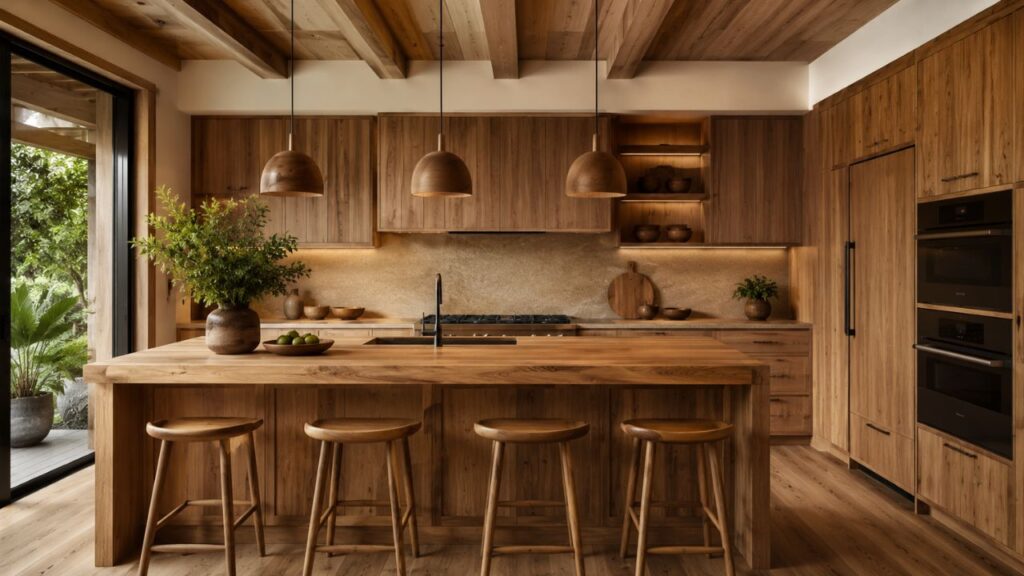
An all-wood kitchen is a kitchen where natural wood becomes the dominant visual material, usually through cabinetry, wall panels, shelving, flooring, islands, or furniture.
That does not mean every visible surface must be timber.
A successful natural wood kitchen normally includes contrast from materials such as stone, stainless steel, plaster, ceramic tile, glass, or painted surfaces. Wood provides the visual foundation while the other materials give the eye somewhere to rest.
There is another distinction worth making early.
“All wood” is a design description. It is not automatically a technical description of cabinet construction.
A kitchen can look completely wooden while its cabinet boxes use high-quality plywood, veneered panels, or other engineered substrates. Likewise, solid wood kitchen cabinets may use solid hardwood doors and frames while incorporating plywood into cabinet boxes or panels for dimensional stability.
That is not necessarily a compromise. In some applications, it is good cabinet engineering.
Why Wood Kitchens Are Back in Focus
The renewed interest in timber is not merely a social-media aesthetic.
The National Kitchen & Bath Association’s 2026 Kitchen Trends Report found that 59% of surveyed industry respondents saw wood-grain cabinetry growing in popularity. White oak was identified as the most popular wood type by 51% of respondents. The same report found strong interest in organic and natural kitchen styles.
That helps explain why wood kitchen design now appears across very different interiors: quiet contemporary homes, Scandinavian kitchens, mountain properties, minimalist apartments, Mediterranean houses, mid-century renovations, and luxury urban projects.
The attraction is easy to understand.
Wood brings three qualities into a kitchen at once:
- visible texture
- natural color variation
- physical warmth
Paint can provide color, but it cannot reproduce grain. Stone provides movement, but usually feels harder and cooler. Metal gives precision, though rarely softness.
Wood sits somewhere between architecture and furniture.
That makes it unusually effective in a room people use every day.
“All Wood” Does Not Mean “Solid Wood Everywhere”
This is one of the most important points to understand before shopping for cabinetry.
Consumers often hear terms such as:
- solid wood
- hardwood
- plywood
- furniture board
- MDF
- wood veneer
- engineered wood
- all-plywood construction
Those descriptions are not interchangeable.
Solid Wood vs Plywood vs Veneer
| Material | Typical Kitchen Use | Main Strength | Main Consideration |
|---|---|---|---|
| Solid hardwood | Door frames, drawer fronts, rails, trim | Natural grain and repairability | Expands and contracts with moisture |
| Hardwood plywood | Cabinet boxes, shelves, panels | Stable and strong | Edge treatment matters |
| Wood veneer | Slab doors, decorative panels | Consistent grain with good stability | Surface layer is thinner |
| MDF | Painted doors and panels | Smooth, stable surface | Less suited to visible natural grain |
| Particleboard/furniture board | Cabinet boxes and panels | Economical and dimensionally consistent | Quality varies greatly |
The USDA Forest Products Laboratory explains that wood changes dimension as its moisture content changes below the fiber-saturation point. Swelling and shrinking can contribute to warping, checking, gaps, or splitting when moisture variation is not considered in design.
This is one reason well-made solid wood kitchen cabinets do not need to be constructed from thick pieces of solid lumber in every location.
A wide solid slab door can move considerably with seasonal humidity. A properly engineered veneered panel may stay flatter.
Material quality matters, but material placement matters just as much.
The Best Wood Species for an All-Wood Kitchen
There is no single “best” timber.
The right choice depends on grain, color, budget, availability, finish, and how much visual movement you want.
Wood Species Comparison
| Wood Species | Appearance | Best For | Design Character |
|---|---|---|---|
| White oak | Pale tan to medium brown, visible grain | Cabinets, islands, flooring | Calm, architectural, versatile |
| Walnut | Rich brown with darker variation | Feature cabinetry, islands | Sophisticated, dramatic |
| Maple | Light, relatively subtle grain | Minimal kitchens | Clean and understated |
| Cherry | Warm reddish-brown that deepens with age | Traditional or transitional kitchens | Rich and classic |
| Ash | Pale with pronounced grain | Contemporary cabinetry | Light and graphic |
| Rift-cut oak | Straight, controlled grain | Slab-front cabinets | Refined and modern |
| Quarter-sawn oak | Distinctive grain pattern | Craftsman-inspired cabinetry | Textural and characterful |
1. White Oak: The Versatile Choice
There is a reason white oak kitchen cabinets are appearing in so many contemporary projects.
White oak has enough grain to read as natural wood without becoming visually noisy. Depending on the cut and finish, it can move from rustic to highly architectural.
Rift-sawn or rift-cut oak gives a straighter grain pattern that works particularly well with slab doors.
Flat-sawn oak shows more cathedral-like movement.
Neither is automatically better. They simply create different rooms.
The current popularity of white oak kitchen cabinets is also reflected in NKBA’s 2026 forecast, where white oak ranked as the preferred wood type among surveyed respondents.
For a quieter result, avoid stains that push oak heavily toward yellow or orange. Clear or lightly toned finishes usually allow the grain to do more of the visual work.
2. Walnut: Richer and More Dramatic
If oak whispers, walnut speaks in a lower voice.
Walnut kitchen cabinets have naturally deep brown tones, often with considerable movement between lighter and darker sections.
That variation is part of their appeal.
Walnut works especially well when you want cabinetry to feel like fitted furniture rather than background storage.
It can become heavy if used everywhere, though.
A room covered in walnut kitchen cabinets from floor to ceiling may need pale stone, lighter flooring, generous daylight, or soft plaster walls to prevent the visual weight from becoming oppressive.
In smaller rooms, walnut often works beautifully as a feature material: an island, tall pantry bank, breakfast cabinet, or run of lower units.
3. Maple: Quiet and Clean
Maple tends to have less dramatic grain than oak.
That makes it useful in kitchens where the architecture should take priority over the cabinetry.
Natural maple can work well with:
- stainless steel
- pale limestone
- terrazzo
- off-white plaster
- muted green
- dark bronze
Its light color can also be useful in smaller kitchens where deep timber might absorb too much light.
How to Stop an All-Wood Kitchen From Looking Too Woody
Here is the simplest design rule in this entire guide:
Do not give every wood surface the same visual importance.
A weak wood-heavy kitchen often has grain everywhere.
Cabinet doors show grain. Floors show heavy grain. Counter stools show grain. Ceiling beams show grain. Open shelving shows grain. The dining table adds another grain pattern.
The eye has nowhere to rest.
A better all wood kitchen uses hierarchy.
Choose one dominant wood expression, then let secondary surfaces become quieter.
For example:
Dominant: rift-cut oak cabinets
Secondary: simple oak flooring with lower contrast
Resting surfaces: pale quartzite counters and warm plaster walls
Or:
Dominant: walnut cabinetry
Secondary: restrained stone floor
Accent: pale oak stools
The goal is not perfect matching.
It is controlled variation.
Match Undertones, Not Just Wood Species
Two pieces of oak can look completely different once finished.
One may read yellow.
Another may feel pink.
A smoked finish may turn oak brown-gray. A white-pigmented oil can push it toward pale beige.
That is why samples should be viewed together under the actual lighting planned for the kitchen.
When developing a warm wood kitchen, pay attention to undertones across:
- cabinetry
- flooring
- wall paint
- stone
- metals
- upholstery
- artificial lighting
A warm brown cabinet paired with icy gray flooring can feel disconnected even if both products looked attractive separately.
A coherent warm wood kitchen usually repeats related undertones without making every finish identical.
Think cousins, not twins.
Modern Wood Kitchen Design Is About Proportion
Wood does not make a room traditional.
Door style, layout, hardware, proportions, and detailing determine much of the character.
A modern wood kitchen often uses:
- slab-front cabinetry
- minimal visible hardware
- integrated appliances
- full-height cabinet runs
- large-format backsplashes
- recessed toe kicks
- narrow reveals
- concealed lighting
- simple stone countertops
- fewer open shelves
The grain provides decoration, so extra detailing is often unnecessary.
That is why a modern wood kitchen can actually look simpler than a painted shaker kitchen. When the cabinet surface itself has texture and movement, you can remove moldings, ornate handles, applied trim, and decorative panels.
The Cabinet Finish May Matter More Than the Species
Homeowners tend to spend a great deal of time choosing between oak, walnut, maple, or cherry.
Then the finish is treated almost as an afterthought.
That is a mistake.
Wood cabinet finishes affect color, sheen, stain resistance, cleanability, tactile quality, and how strongly the grain appears.
Common options include:
Clear Coat
Preserves much of the natural color while providing a protective film.
Oil Finish
Often gives timber a softer, more tactile appearance, although maintenance requirements depend on the specific product.
Stain
Changes the color while allowing the grain to remain visible.
Toned or Pigmented Finish
Can reduce yellowing, mute red undertones, or create a paler appearance.
Painted Finish
Covers most or all visible grain and therefore serves a different aesthetic purpose.
Before approving wood cabinet finishes, ask the cabinetmaker for a finished sample using the exact species, veneer cut, stain or oil, and sheen level being specified.
Never approve an expensive kitchen from a tiny unfinished timber chip.
Cabinet Quality: Look Beyond the Door Front
A beautiful door does not guarantee a durable cabinet.
Check:
- box construction
- shelf thickness
- joinery
- drawer construction
- hinges
- runners
- finish quality
- edge treatment
- warranty
- installation method
The Kitchen Cabinet Manufacturers Association’s ANSI/KCMA A161.1 certification program tests cabinet structural performance, doors, drawers, and finishes. Among its tests, wall cabinets are gradually loaded to 600 pounds, while doors and drawers undergo 25,000 operating cycles. Finish tests expose surfaces to heat, humidity, and common kitchen substances.
The useful lesson is not that every homeowner must buy one particular certification.
It is that wood kitchen cabinets should be evaluated as working equipment, not just furniture.
Cabinet doors will be touched thousands of times. Drawers will carry cookware. Steam, oil, coffee, citrus, cleaning products, and changing humidity are part of normal kitchen life.
Good wood kitchen cabinets must be attractive after installation and capable of handling that routine.
What Countertops Work Best With Wood Cabinets?
Wood-on-wood can work, but stone usually provides more useful contrast.
Strong Countertop Pairings
White Oak + Quartzite
Natural but visually crisp.
Walnut + Light Limestone
Rich cabinetry is balanced by a softer mineral tone.
Oak + Dark Soapstone
A strong contrast that suits both contemporary and farmhouse-influenced spaces.
Maple + Stainless Steel
Clean, practical, and slightly industrial.
Dark-Stained Oak + Pale Quartz
Useful when you want the cabinetry to carry most of the visual texture.
A heavily veined countertop beside strongly figured timber can become competitive.
One surface should usually lead.
If the cabinets are expressive, consider calmer stone.
If the cabinets have very quiet grain, the countertop can take more visual attention.
Designing a Wood Kitchen Island
A wood kitchen island does not need to match the perimeter cabinets.
In fact, allowing it to differ slightly can make the room feel more intentional.
An oak perimeter can take a walnut island.
Painted perimeter cabinets can take an oak island.
Walnut cabinets can work with a lighter ash or oak island if undertones are handled carefully.
The wood kitchen island is also a good place to use end-grain detailing, fluted timber, thicker panels, furniture-style legs, or a different veneer direction.
Because the island sits in the center of the room, it can carry a little more personality than the wall cabinets.
Just remember that islands are working surfaces.
Design should never interfere with knee space, electrical access, seating comfort, appliance clearances, storage, or circulation.
Should the Floor Be Wood Too?
Yes—but this is where restraint becomes especially important.
Wood kitchen flooring can create a continuous, welcoming surface, particularly in open-plan homes where kitchen, dining, and living areas connect.
The difficulty is matching it with cabinetry.
An exact match can sometimes look flat.
A severe mismatch can look accidental.
Try changing one variable:
- grain size
- board width
- direction
- tone
- sheen
- species
For example, medium oak cabinetry can sit over a slightly paler, wider oak floor.
If the cabinets have strong grain, choose calmer wood kitchen flooring.
NKBA’s 2026 kitchen forecast also reported strong designer interest in wood flooring, showing that timber underfoot remains relevant alongside the renewed preference for wood-grain cabinetry.
Backsplash Ideas for Wood-Heavy Kitchens
The backsplash is a valuable place to create relief.
Good options include:
- honed limestone
- marble
- quartzite
- handmade ceramic tile
- zellige-style tile
- stainless steel
- warm white plaster in suitable protected areas
- slab backsplash matching the countertop
If the cabinetry is visually active, the backsplash should usually become quieter.
Tiny patterned tiles beside dramatic walnut grain can quickly make the room restless.
Large surfaces give the timber room to breathe.
Lighting Makes or Breaks Natural Wood
Wood changes dramatically under different color temperatures and light sources.
A sample viewed in a bright showroom may look duller, redder, or more yellow once installed at home.
Plan three lighting layers.
Ambient Lighting
General illumination for movement and cleaning.
Task Lighting
Focused light for countertops, sinks, ranges, and preparation areas.
Accent Lighting
Low-level or directional lighting that reveals grain and architectural detail.
Under-cabinet lighting is especially useful because dark cabinetry can reduce reflected light over counters.
Daylight matters too.
Before choosing deep walnut or smoked oak, study how much natural light actually reaches the kitchen in the morning and afternoon.
Hardware for a Natural Wood Kitchen
Hardware should complement wood rather than fight it.
Strong choices include:
- aged brass
- bronze
- blackened steel
- stainless steel
- nickel
- wooden pulls
- integrated finger pulls
A natural wood kitchen with expressive grain often benefits from simpler hardware.
Brands such as Blum and Häfele are widely associated with cabinet hardware systems, including hinges, runners, and fittings. The visible handle may get the attention, but concealed hardware has a much greater effect on how a kitchen feels in daily use.
Soft-close action, drawer stability, adjustment, and access are practical details people notice every morning.
Mixing Two Wood Species Without Creating Chaos
Yes, you can mix woods.
The safest approach is to give them different roles.
Try:
- oak cabinets + walnut stools
- walnut island + oak perimeter
- maple cabinets + oak floor
- oak cabinetry + reclaimed timber dining table
Avoid adding several woods with equally strong grain and unrelated undertones.
A good wood kitchen design usually contains a clear primary species.
Secondary woods should read as supporting materials rather than accidental substitutions.
One useful designer trick is to repeat the secondary wood at least once elsewhere. Walnut stools beside an oak island may feel random; walnut stools plus a walnut pendant detail or nearby dining table feel intentional.
Sustainability and Responsible Wood Sourcing
Wood is renewable, but “wood” and “sustainable” are not automatically the same claim.
Forest management and sourcing matter.
The Forest Stewardship Council states that FSC certification supports responsible forest management, including measures related to deforestation, biodiversity, workers, and community rights. FSC-certified products are available across furniture, cabinetry, panels, veneers, and construction materials.
When specifying timber, ask suppliers:
- What species is this?
- Where was it sourced?
- Is certification available?
- Is the wood solid, veneered, or engineered?
- Is reclaimed timber an option?
- How repairable is the finish?
- Can replacement panels be ordered later?
Responsible material decisions are easier when the supply chain is transparent.
What Does an All-Wood Kitchen Cost?
There is no credible universal price because the phrase covers everything from stock cabinetry with wood fronts to bespoke architectural millwork.
Cost is influenced by:
- wood species
- veneer grade
- solid vs engineered components
- cabinet construction
- drawer hardware
- custom sizing
- interior accessories
- finish system
- countertop choice
- installation complexity
- local labor rates
Walnut and highly selected veneers often cost more than common oak or maple options.
Custom grain matching also adds labor and material waste.
If budget is limited, spend money where it is visible and touched.
A well-built plywood cabinet box with carefully selected wood-veneer fronts may deliver more design value than insisting on solid lumber in areas nobody sees.
A Practical Material Formula That Rarely Fails
If you are worried about wood overload, use this starting point:
50–60% Wood
Cabinetry, island, or flooring.
20–30% Mineral Surface
Stone, quartz, plaster, or ceramic.
10–15% Metal and Glass
Appliances, lighting, hardware, windows.
5–10% Soft Elements
Upholstery, rugs in adjacent spaces, window treatments, plants, art.
This is not a design law.
It is a useful editing framework.
The point is to make wood dominant without allowing every surface to compete.
Small-Kitchen Strategy
A small kitchen can handle wood beautifully.
The trick is controlling contrast and visual weight.
Use:
- lighter timber
- simple slab fronts
- fewer upper cabinets
- integrated appliances
- continuous flooring
- restrained hardware
- under-cabinet lighting
- pale countertops
- one consistent wood direction
A small room with pale oak cabinetry can often feel calmer than the same room broken into several contrasting colors.
Avoid too many decorative breaks.
Every change in material creates another visual boundary.
Large-Kitchen Strategy
Large kitchens have the opposite problem.
Too much identical cabinetry can resemble a wall of wardrobes.
Break the mass with:
- a stone backsplash
- appliance niches
- glass-front sections
- open wall space
- contrasting tall units
- a different island material
- recessed workstations
- display shelves
- framed views
Large rooms can also support deeper timbers more comfortably because there is usually more daylight and distance from which to read the grain.
Common All-Wood Kitchen Mistakes
1. Matching Every Wood Exactly
The room can look like it was purchased as a furniture set.
Controlled differences add depth.
2. Mixing Too Many Undertones
Red cherry, gray oak, orange pine, and yellow maple rarely become more coherent simply because they are all wood.
3. Choosing Samples Under the Wrong Lighting
Always check finished samples in the actual space.
4. Ignoring Moisture
Wood moves.
Sink areas, dishwashers, steam, leaks, and humidity deserve careful detailing.
5. Using Too Much Strong Grain
Texture needs quiet surfaces around it.
6. Choosing Appearance Over Cabinet Engineering
A beautiful front attached to a weak box is still a poor cabinet.
7. Forgetting Repairability
Ask what happens when a door is scratched five years from now.
Can it be refinished? Can a matching replacement be ordered?
8. Making Everything Brown
Wood already contributes warm color.
Use stone, plaster, metal, vegetation, and light to give that warmth definition.
A Real-World Design Scenario
Imagine a medium-sized open-plan kitchen with good daylight.
The homeowners want warmth but dislike rustic interiors.
A strong solution could look like this:
Cabinetry: rift-cut white oak slab fronts
Tall units: full-height oak with integrated refrigerator panels
Island: same species, slightly deeper tone
Countertop: quiet pale quartzite
Backsplash: matching stone slab
Floor: lightly toned oak, wider boards than the cabinet grain
Hardware: minimal bronze pulls
Lighting: warm pendant lights plus concealed task lighting
Walls: soft mineral off-white
Furniture: darker walnut dining chairs
Notice what is missing.
No barn doors.
No distressed finishes.
No decorative corbels.
No artificial “rustic” texture.
The wood itself provides enough character.
That is how an all-timber concept can feel architectural rather than themed.
How to Maintain Wood Cabinets
The exact care method depends on the finish, so the cabinetmaker’s instructions should take priority.
General habits are simple:
- wipe spills promptly
- avoid leaving wet cloths against cabinet faces
- use non-abrasive cleaners approved for the finish
- run ventilation while cooking
- address plumbing leaks quickly
- avoid prolonged steam exposure
- protect cabinetry from extreme humidity swings where possible
- repair damaged finishes before moisture reaches exposed timber
Do not assume a natural-looking finish is unfinished.
High-quality cabinetry should have a protective system appropriate for kitchen use.
Featured Snippet: Is an All-Wood Kitchen a Good Idea?
Yes. An all-wood kitchen can be durable, timeless, and visually warm when wood species, grain, finish, moisture movement, lighting, and contrasting surfaces are planned carefully. The best designs use wood as the dominant material without covering every surface in identical timber.
FAQ
Are all-wood kitchens outdated?
No.
Current industry trend research points in the opposite direction. NKBA’s 2026 report found growing interest in wood-grain cabinetry and organic or natural kitchen styles.
What looks dated is usually a specific combination of stain color, door style, hardware, and detailing—not wood itself.
What is the best wood for kitchen cabinets?
White oak, walnut, maple, cherry, and ash can all work well.
The best choice depends on the desired color, grain, construction method, budget, finish, and local availability.
Is solid wood better than plywood for cabinets?
Not in every application.
Solid wood is valuable for doors, frames, and visible furniture-like components. Quality plywood can be a strong, dimensionally stable choice for cabinet boxes, panels, and shelves.
A well-designed kitchen may use both.
What color countertop looks best with wood cabinets?
Light quartzite, limestone, marble, warm quartz, soapstone, stainless steel, and other restrained surfaces can all work.
Choose the counter based on the wood’s undertone and grain strength rather than following a universal color rule.
Can you have wood cabinets and wood floors?
Yes.
They do not need to match exactly. Slight differences in tone, board scale, grain, or sheen often create a more layered result.
What wood makes a kitchen look modern?
Rift-cut white oak, walnut, ash, and pale maple are particularly effective with slab-front cabinetry.
The modern appearance comes from detailing and proportion as much as species.
How do you make a wood kitchen look lighter?
Use pale countertops, warm off-white walls, reflective backsplashes, good task lighting, fewer upper cabinets, lighter timber species, and generous daylight.
Can I mix oak and walnut in the same kitchen?
Yes.
Give each wood a clear role. Oak can serve as the main cabinetry while walnut appears on an island, dining furniture, or smaller accents.
Are wood cabinets difficult to maintain?
Quality finished cabinets are not inherently difficult to maintain.
They do need sensible protection from standing water, steam, harsh cleaners, and extreme moisture variation.
Do wood kitchens increase home value?
There is no universal percentage that applies to every property.
Kitchen value depends on local real estate conditions, installation quality, layout, material choices, condition, and how well the design suits likely buyers. Durable, well-built cabinetry has broader appeal than a trend-driven finish installed poorly.
Final Design Takeaway
The most successful timber kitchens are not the ones using the most wood.
They are the ones that understand wood best.
They account for grain direction, scale, undertones, humidity, cabinet construction, finish performance, natural light, artificial light, stone, hardware, and the way people actually move through a kitchen.
A good room lets timber be warm without becoming rustic, expressive without becoming busy, and natural without looking unfinished.
That is the difference between covering a kitchen in wood and designing one with it.