
A beautifully wallpapered room can feel finished before a single picture goes up. Then you unpack a favorite print, painting, family photograph, or framed textile and face an awkward question: will hanging it make the wall better, or will one bad fixing method leave a tear you notice forever?
That tension explains why hanging art on wallpaper receives so much attention from homeowners, renters, decorators, and interior-design enthusiasts. Wallpaper is not simply another version of paint. It is a finished decorative layer attached to a substrate, and damage to that layer can be harder to disguise than a nail hole in a painted wall.
The good news is that artwork and wallpaper can work beautifully together. The less convenient truth is that there is no universal “damage-free” hanger for every wallpaper, frame, and wall construction.
The safest solution depends on four things:
- the wallpaper material and condition;
- the wall behind it;
- the total weight of the framed object;
- how permanent you want the display to be.
That last point matters more than most guides acknowledge. A method that leaves no hole can still pull off the face of the wallpaper. A tiny mechanical puncture, meanwhile, may be easier to disguise later than a peeled patch several inches wide.
That is the central principle of this guide: the smallest visible intervention is often safer than the strongest adhesive intervention.
The Wallcoverings Association recommends keeping extra wallpaper because spare material can be useful when a installed wallcovering is damaged and needs repair. It also notes that patterned wallpapers normally have a repeat, which matters when a patch has to be aligned later.
If you have been searching for how to hang art on wallpaper, start by forgetting the idea that the hanger alone determines success. Your wallpaper, underlying wall, frame weight, placement, and future repair options all matter.
Quick Answer: Can You Hang Art on Wallpaper?
Yes. Artwork can be mounted over wallpaper, but the fixing should ultimately be supported by the wall rather than relying on the decorative paper itself.
For lightweight pieces, a small mechanical picture hook may create less long-term risk than adhesive applied directly to wallpaper. For medium and heavy frames, use wall-rated hardware appropriate for the substrate. If absolutely no wall contact is acceptable, consider a picture rail, ledge, shelf, or freestanding display instead.
Be cautious with adhesive products. In particular, 3M currently states that its Command Picture Hanging Strips should not be used on wallpaper.
Why Wallpaper Changes the Rules of Picture Hanging
Painted drywall is relatively forgiving. A small hole can often be filled, sanded, touched up, and forgotten.
Wallpaper behaves differently.
Depending on the product, you may be dealing with:
- traditional paper wallpaper;
- vinyl-coated wallpaper;
- solid vinyl;
- non-woven wallpaper;
- peel-and-stick wallpaper;
- grasscloth;
- textile wallcovering;
- embossed wallpaper;
- metallic or foil finishes;
- murals;
- hand-printed or expensive designer wallcoverings.
Each reacts differently to pressure, punctures, moisture, adhesive, and removal.
A wallcovering may also hide problems underneath it. The Wallcoverings Association stresses that a sound wallpaper installation depends on a clean, dry, structurally stable substrate. Existing weakness beneath the wallcovering can affect how the finished surface performs later.
That is why hanging pictures on wallpaper should begin with inspection, not a hammer.
Look closely at the intended location. Are any seams lifting? Is the paper bubbling? Does the surface feel brittle? Is the wallpaper already separating from the wall?
If the answer to any of those questions is yes, repair the wallcovering first. ROMAN Products notes that loose seams may result from installation issues, substrate problems, aging, humidity, bubbles, or physical damage.
Adding a frame to a weak area does not solve the problem. It merely hides it until the damage becomes larger.
The Most Important Rule: Support the Art From the Wall, Not the Wallpaper
Wallpaper is a decorative finish. It is not structural support.
This distinction becomes especially important when people search how to hang pictures on wallpaper and discover products advertised with impressive weight capacities.
A 20-pound hook rating does not mean every finished wall surface can safely carry 20 pounds in every situation.
The rating may assume:
- a particular type of drywall;
- correct installation;
- specific fastener depth;
- proper wall thickness;
- a certain hanger orientation;
- a clean surface;
- no deteriorated substrate.
Lowe’s current picture-hanging guidance recommends choosing hardware that is both suitable for the wall type and rated for the artwork’s weight. It also advises using studs or appropriate anchors for heavier pictures where needed.
Think of wallpaper as a decorative layer the fixing must pass through or avoid—not as the material that should carry the load.
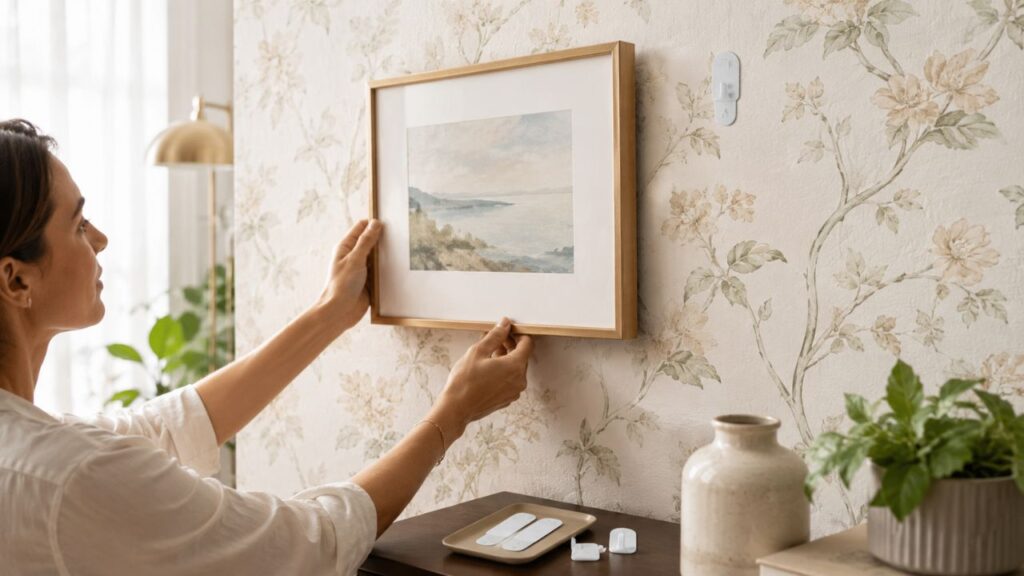
No Hole Does Not Automatically Mean No Damage
This is one of the biggest misconceptions around wallpaper.
A homeowner may refuse to make a 1 mm puncture because it sounds permanent, then cover several square inches of wallpaper with pressure-sensitive adhesive.
That can create the opposite of the intended result.
A tiny puncture may be almost invisible in a patterned surface. A peeled patch can expose the backing, stretch the print, tear fibers, or pull the wallpaper away from the substrate.
People often search for ways to hang pictures on wallpaper without damage, but “without damage” needs a more realistic definition.
There are three different goals:
- No visible hole
- No adhesive contact
- Completely reversible installation
Those goals are not interchangeable.
A picture rail may satisfy all three for the wallpaper itself.
A small picture hook may leave a tiny puncture but avoid surface adhesive.
An adhesive strip may leave no hole but carry a risk of surface damage.
The safest choice depends on which risk matters most.
A Practical Method Comparison
| Hanging Method | Wallpaper Contact | Wall Penetration | Best Use | Main Risk |
|---|---|---|---|---|
| Picture rail | None | Usually none in wallpaper area | Valuable wallpaper, flexible displays | Requires existing or installed rail |
| Picture ledge | Limited | Usually screws elsewhere | Multiple frames | Shelf installation |
| Fine picture hook | Small | Yes | Light to medium frames | Small puncture |
| Nail into stud | Small | Yes | Secure framed artwork | Permanent hole |
| Rated wall anchor | Small opening | Yes | Heavy artwork | Larger repair later |
| Drywall-specific mechanical hanger | Direct | Yes | Suitable drywall installations | Must suit substrate |
| Adhesive strip | High | No | Only where surface manufacturer permits | May peel wallpaper |
| Freestanding easel | None | None | Statement artwork | Uses floor space |
| Leaning artwork | None | None | Consoles, mantels, shelves | Must be stable |
The table explains why there is no single best answer for how to hang art on wallpaper without damage. Wallpaper preservation and structural safety sometimes point toward different mounting systems.
Are Command Strips Safe on Wallpaper?
This deserves its own section because online advice is surprisingly inconsistent.
Many blogs recommend command strips on wallpaper for lightweight frames.
The manufacturer’s own guidance is more restrictive.
3M’s current instructions for Command Picture Hanging Strips state: “DO NOT hang over beds or on wallpaper.” The company also warns against using the strips for valuable or irreplaceable items.
That means it would be misleading to describe standard Command Picture Hanging Strips as universally wallpaper-safe simply because they are marketed as removable from approved surfaces.
The issue is not necessarily whether the adhesive can stick.
The issue is what may happen to the wallpaper when the adhesive is removed.
Wallpaper consists of layers, coatings, inks, fibers, and adhesives that can respond differently from painted drywall.
For that reason, using adhesive strips on wallpaper should never be assumed safe unless the specific strip manufacturer explicitly approves the specific surface.
That distinction matters.
“Removable adhesive” does not mean “removable from every decorative material.”
Adhesive Products: Why Testing a Hidden Area Is Still Not a Guarantee
Testing is useful, but it has limitations.
Suppose an adhesive holds successfully on wallpaper behind a cabinet for 24 hours. That does not necessarily tell you how the same adhesive will behave after:
- six months;
- seasonal humidity changes;
- exposure to sunlight;
- normal indoor heat;
- aging wallpaper paste;
- repeated frame movement.
The bond between the wallpaper and wall may also be weaker than the bond between the adhesive strip and wallpaper.
In that situation, the strip can perform exactly as designed while the wallpaper fails underneath it.
So if someone asks whether adhesive strips on wallpaper are a safe universal shortcut, the responsible answer is no. Check both the wallcovering manufacturer’s instructions and the hanging-product instructions before using adhesive.
Where the manufacturer specifically prohibits wallpaper use, follow that guidance.
Best Options for Lightweight Art
Lightweight pieces give you the most flexibility.
Examples include:
- unframed prints;
- light wood frames;
- small photographs;
- postcards;
- thin canvas panels;
- lightweight textile art;
- small decorative plates with appropriate holders.
For these pieces, picture hooks for wallpaper usually means finding hardware that creates a minimal entry point while transferring the load into drywall, plaster, wood, or another suitable substrate.
Look for:
- fine picture-hanger nails;
- low-profile mechanical hooks;
- pin-style systems designed for the actual wall type;
- picture-rail hooks where rails are available.
The key word is rated. Do not judge strength from how substantial a hook looks.
A small engineered hanger can outperform a larger improvised nail when installed in the surface it was designed for.
What About Mechanical Drywall Hangers?
Mechanical drywall hangers can be useful when the wall beneath the wallpaper is drywall.
For example, 3M currently markets CLAW drywall picture hangers in rated capacities including 15, 25, 45, and 65 pounds. The system uses hardened-steel points that engage the drywall rather than an adhesive strip.
That does not mean every CLAW product is automatically approved for every wallpaper installation. Its stated application is drywall, and you should still follow the manufacturer’s directions and consider how the wallpaper will react where the fastener enters.
The broader lesson is useful: picture hooks for wallpaper should be selected according to the substrate beneath the wallpaper.
If the wall is plaster, masonry, concrete, wood paneling, or another construction, drywall-specific hardware may be the wrong choice.
How to Handle Medium-Weight Frames
Once a frame becomes substantial, your priorities should shift.
At this stage, avoiding every tiny mark is less important than making sure the artwork is properly supported.
Weight includes:
- the frame;
- glazing;
- backing board;
- matting;
- artwork;
- hanging wire and hardware.
Glass can make a frame much heavier than it looks.
Before mounting, weigh the complete framed piece rather than guessing.
A reliable approach to hanging pictures on wallpaper is to choose wall hardware with a comfortable capacity above the actual framed weight and verify that the fastener is intended for your substrate.
For valuable artwork, large glass-fronted frames, or uncertain wall construction, a professional art installer or competent adult tradesperson is a better choice than experimenting with improvised fixings.
Hanging Heavy Pictures on a Wallpapered Wall
The stakes rise quickly once the object becomes heavy.
For hanging heavy pictures on wallpaper, think structurally first and cosmetically second.
Lowe’s advises that heavy pictures on drywall or plaster may need wall studs or wall anchors designed for the wall and rated for the load.
That means the wallpaper is almost irrelevant to the load calculation. Its role is mainly to influence how carefully the fixing point should be created and how the area might be repaired later.
A heavy mirror or large glazed artwork should not depend on:
- wallpaper adhesive;
- removable putty;
- unverified sticky pads;
- tiny decorative pins;
- hardware without a known rating.
The goal is for the structure behind the wallpaper to carry the object.
This is also why hanging heavy pictures on wallpaper may justify professional installation when the frame is expensive, fragile, oversized, positioned high on a wall, or mounted over furniture people regularly use.
A More Reversible Option: The Wallpaper Flap Technique
A technique used by decorators involves preserving a tiny section of the wallpaper around the fixing point so it can potentially be repositioned later.
Several décor guides describe making a small flap in the wallpaper before placing the mechanical fastener into the wall behind it.
Because creating a clean cut in finished wallpaper requires a sharp tool and a mistake can permanently damage the pattern, this is better handled by a competent adult or professional installer, especially on expensive wallcovering.
The idea is simple: preserve rather than remove the decorative material around the fixing location.
When the picture is eventually taken down, the retained wallpaper section may help disguise the former mounting point.
It is not truly “damage free,” but it can make future restoration easier.
That distinction is important when researching hang pictures on wallpaper without damage techniques. A more realistic goal is controlled, repairable intervention.
Truly No-Hole Options
Sometimes putting any hole through the wallpaper is unacceptable.
Maybe the wallcovering is:
- hand-painted;
- discontinued;
- historic;
- extremely expensive;
- rented;
- part of a designer installation;
- difficult to patch because of a mural.
In those cases, rethink the display rather than the fastener.
1. Picture Rails
Picture rails are one of the strongest answers for people who want to hang pictures without nails going through the decorated wall area.
Artwork hangs from hooks and cords attached to the rail, allowing the arrangement to change without repeatedly puncturing the wallpaper.
This works especially well in traditional interiors, but the system can look modern with thin cable, discreet hooks, and simple frames.
2. Picture Ledges
A ledge allows several frames to overlap and lean naturally.
The ledge itself still needs secure installation, but you may be able to position it above, below, or outside the most precious area of wallpaper.
3. Console Tables and Mantels
Artwork leaned against the wall can look deliberate rather than unfinished.
Large framed prints, portraits, and abstract works often look especially good layered behind smaller objects.
4. Freestanding Easels
An easel can turn one large artwork into a room feature while leaving the wallpaper untouched.
5. Furniture-Integrated Displays
Bookcases, cabinets, media units, and shelving systems can carry framed art without using the wallpapered wall as the supporting surface.
These are the most dependable solutions when hang pictures without nails really means “do not physically alter this wallpaper at all.”
Wallpaper Type Matters More Than Most Guides Admit
Traditional Paper Wallpaper
Paper wallpaper can be particularly unforgiving when strong surface adhesive is removed.
Small controlled mechanical fixings may be easier to disguise than large areas of peeled paper.
Vinyl Wallpaper
Vinyl may be more resistant to normal cleaning and moisture than paper wallcovering, but that does not make every adhesive hanger safe.
The bond between the vinyl layer, backing, paste, and substrate still matters.
Non-Woven Wallpaper
Non-woven wallpaper is popular partly because of its handling characteristics, but a removable wallcovering is not automatically a reusable mounting surface.
Always check the product instructions.
Peel-and-Stick Wallpaper
This category deserves extra caution.
The wallpaper itself is already held by pressure-sensitive adhesive. Adding another adhesive layer on its surface creates two adhesive interfaces whose removal behavior may be unpredictable.
Grasscloth
Grasscloth has visible fibers and natural variations that contribute to its beauty.
That texture can make surface adhesives unreliable and repairs conspicuous.
For high-value grasscloth, a picture rail or professionally planned mechanical fixing is usually a more conservative approach.
Metallic and Foil Wallpaper
Surface marks, dents, creases, and scratches can be very visible.
Avoid casual experimentation.
Murals
Murals create another problem: pattern continuity.
A mark in a repeating floral wallpaper may disappear visually. A mark through a person’s face, architectural detail, or focal element in a mural may be much harder to hide.
Wallpaper Condition Checklist Before You Hang Anything
Before how to hang pictures on wallpaper becomes a hardware question, inspect the wall.
Do not mount directly through an area showing:
- lifted seams;
- bubbles;
- moisture marks;
- torn edges;
- loose paper;
- previous failed patches;
- crumbling plaster;
- soft drywall;
- visible mold or recurring dampness.
The Wallcoverings Association recommends a clean, dry, structurally sound surface for proper wallcovering performance.
If the wallpaper is already moving independently from the substrate, a hanger installed nearby may make the underlying weakness more noticeable.
Repair first. Decorate second.
Where Should Artwork Sit on Wallpaper?
Good installation is only half the job.
Hanging art over wallpaper is also a design problem.
The wall already has pattern, color, scale, movement, and visual texture. Your artwork is entering an existing composition rather than an empty field.
Recent UGallery guidance recommends considering scale, pattern intensity, frame choice, and negative space when combining artwork and wallpaper. Larger artwork can hold its own against large patterns, while generous matting can create visual separation between the artwork and a busy background.
That principle is much more useful than trying to “match” every color perfectly.
Think in terms of visual hierarchy.
Ask one question:
What should the eye notice first—the wallpaper or the art?
If the answer is art, strengthen it with:
- larger scale;
- wider matting;
- stronger frame contrast;
- simpler surrounding objects;
- more negative space.
If the wallpaper should remain dominant, choose:
- smaller art;
- quieter frames;
- related colors;
- subtle compositions;
- grouped pieces with controlled spacing.
Bold Wallpaper Usually Needs Confident Art
Tiny artwork can disappear on a large botanical, geometric, chinoiserie, or mural-style pattern.
The solution is not necessarily more artwork.
Often it is larger artwork.
UGallery suggests that oversized pieces can work effectively against bold, large-scale wallpaper patterns.
Houzz has made a similar point in its design guidance: when artwork competes with a bold backdrop, scale can help give the artwork enough visual presence.
This is one reason hanging art over wallpaper can look more sophisticated when one strong piece is used instead of many undersized objects.
Use Matting as Visual Breathing Room
One of the easiest ways to separate art from busy wallpaper is not to change the art or the wallpaper.
Change the mat.
A broad white, cream, warm gray, or carefully selected colored mat gives the eye a resting area between two patterned surfaces.
UGallery specifically recommends using negative space and wide matting to help artwork stand apart from strong wallpaper.
This technique works especially well with:
- photography;
- botanical prints;
- drawings;
- maps;
- etchings;
- typography;
- small original works on paper.
A narrow print in a wide mat often has more presence than a larger print squeezed into an undersized frame.
Should the Frame Match the Wallpaper?
Usually, not exactly.
Trying to match the background, artwork, and frame can flatten the whole composition.
Contrast is often more effective.
Examples:
- dark wood frame against pale botanical wallpaper;
- slim black frame against colorful geometric wallpaper;
- warm brass against deep blue;
- natural oak against muted grasscloth;
- simple white frame against a dark mural.
The frame can act as punctuation between the image and pattern.
A gallery wall on wallpaper often looks especially coherent when the frames share one visual feature—finish, color, thickness, mat style, or shape—even when the artworks differ.
How High Should Art Be Hung?
There is no magic measurement for every room, but 57 inches from the floor to the center of the artwork is a widely used starting point.
Lowe’s current hanging guide describes 57 inches as a common picture-hanging height and recommends using the center of the overall grouping when planning a gallery wall.
Treat it as a reference rather than a law.
Adjust for:
- ceiling height;
- furniture;
- headboards;
- mantels;
- consoles;
- eye level;
- artwork proportions;
- nearby architectural features.
Artwork above furniture should feel visually connected to the furniture rather than floating near the ceiling.
Planning a Gallery Wall on Wallpaper
A successful gallery wall on wallpaper requires more planning than a gallery wall on plain paint because every extra hole is more difficult to disguise.
Do not improvise frame by frame.
Lowe’s recommends planning arrangements with paper templates before installing picture hardware.
That method is particularly useful on wallpaper because it lets you evaluate spacing without committing to permanent fixing points.
Before installing anything:
- Measure every frame.
- Record its complete weight.
- Note the position of the wire, D-rings, or sawtooth hardware.
- Create paper templates.
- Arrange the templates.
- Check the group from across the room.
- Confirm that no fixing lands on a weak seam.
- Verify alignment.
- Only then mark mounting positions.
This simple planning stage can prevent the most frustrating wallpaper problem of all: making a hole, stepping back, and realizing the picture should have been three inches to the left.
A Better Gallery-Wall Strategy: Use Fewer Fixing Points
On painted walls, people often build a gallery one frame at a time.
Wallpaper encourages a smarter approach.
Consider systems that reduce the number of independent holes:
- picture rails;
- rail-and-wire hanging;
- long picture ledges;
- gallery tracks installed near the ceiling;
- shared support systems;
- carefully planned paired hooks.
Reducing the number of wall interventions also makes future redecoration easier.
This is an overlooked advantage of treating hanging art on wallpaper as a system rather than a collection of individual hanging tasks.
Avoid Wallpaper Seams When Possible
A seam is already a transition between two pieces of wallcovering.
It should not become your preferred fastening location.
ROMAN notes that wallpaper seams can loosen because of factors including poor substrate preparation, bubbles, aging, physical impact, installation issues, and humidity.
Place fixing points on stable areas of the wallcovering rather than directly through an edge whenever the wall construction and intended art position allow it.
That reduces the chance that the installation disturbs an already vulnerable part of the finish.
What If You Need to Reposition the Artwork Later?
This is where planning becomes valuable.
Ashley Vizzi Akridge of York Wallcoverings has advised that hanging art over wallpaper can feel stressful because nail holes remain, making it important to be confident about both the artwork and its placement.
Before installing:
- live with paper templates for a day or two;
- view them in daylight and evening light;
- sit in the room and look at the arrangement;
- photograph the wall;
- check reflections;
- open nearby doors;
- confirm sightlines from adjoining rooms.
A five-minute decision can create a mark that remains for years.
There is little benefit in rushing.
Worked Example 1: A Lightweight Print on Patterned Wallpaper
Imagine a 2-pound framed print on traditional patterned wallpaper over sound drywall.
The first temptation may be command strips on wallpaper because the frame is light and no hole sounds appealing.
But 3M’s current instructions specifically advise against using its Picture Hanging Strips on wallpaper.
A better decision process would be:
- confirm the drywall is sound;
- choose a small mechanical picture hanger rated for the weight and wall type;
- keep the fixing away from a wallpaper seam;
- verify placement with a template;
- create only the minimum intervention needed.
The result may technically include a small puncture, but it avoids bonding a larger adhesive area directly to the decorative surface.
Worked Example 2: A 25-Pound Framed Artwork
Now imagine a 25-pound glazed frame.
The goal changes.
The question is no longer “How do I avoid a tiny mark?”
The question becomes “What wall hardware can safely support this complete frame?”
Lowe’s recommends using appropriate studs or wall anchors for heavier artwork based on the wall construction.
Drywall-specific products also exist with published capacities. For example, 3M lists a 25-pound CLAW drywall hanger designed to lock into drywall without requiring a stud.
This does not replace checking product instructions or wall condition, but it illustrates the right decision logic.
For how to hang art on wallpaper, weight capacity should come from the wall/hardware relationship—not from the decorative paper.
Worked Example 3: Expensive Grasscloth
Consider an expensive natural grasscloth wallcovering behind a console.
The artwork is beautiful, but you expect to rotate pieces every few months.
Repeated mechanical holes would eventually become distracting.
Surface adhesive could also affect delicate fibers.
The better design decision may be to stop searching for a “perfect hook.”
Install or use a picture-rail system, display the art on the console, or use a freestanding support.
That approach turns how to hang art on wallpaper without damage into an interior-planning question rather than an adhesive-product question.
Sometimes the safest hanger is no hanger at all.
How to Repair Minor Wallpaper Damage
Even careful installations can eventually leave a visible mark.
The most important preparation happens before that day: keep spare wallpaper.
The Wallcoverings Association specifically notes that extra wallcovering is useful if installed wallpaper becomes damaged and requires repair.
For loose seams or small tears, use products intended for wallcovering repair rather than general-purpose glue.
ROMAN’s repair guidance recommends appropriate wallpaper adhesive and smoothing tools for loose seams and describes patching as an option when damage is too extensive for a small repair.
For valuable, historic, hand-painted, textile, metallic, or specialty wallcoverings, professional repair is the safer choice.
Why You Should Save the Wallpaper Label Too
Keeping leftover wallpaper is good.
Keeping its identifying information is even better.
Save:
- manufacturer;
- collection;
- pattern name;
- pattern number;
- colorway;
- batch or dye-lot information;
- installation instructions;
- spare material.
The Wallcoverings Association notes that extra material can help avoid problems associated with trying to obtain the same printing run later.
That can become extremely useful years after installation when one frame is moved and a repair suddenly becomes necessary.
Common Mistakes to Avoid
Mistake 1: Assuming “Removable” Means Wallpaper-Safe
It does not.
Always check surface exclusions.
Mistake 2: Guessing the Frame Weight
Glass, backing, mats, and heavy frame stock add more weight than people expect.
Weigh the finished frame.
Mistake 3: Using Hardware Rated Below the Actual Load
Hardware should match both the wall and the weight.
Mistake 4: Mounting Through a Loose Seam
Repair weak wallpaper first.
Mistake 5: Making the Hole Before Confirming Placement
Use templates.
Mistake 6: Treating Wallpaper Like Paint
A paint touch-up and a wallpaper repair are completely different jobs.
Mistake 7: Hanging Valuable Art From Adhesive Alone
Manufacturer restrictions and artwork value should influence the decision.
Mistake 8: Installing Heavy Art Above a Bed Without Extra Thought
Safety should outweigh aesthetics in areas where falling objects could injure someone. 3M’s Command instructions, for example, specifically warn against hanging with its Picture Hanging Strips over beds.
The Best Decision Framework
When choosing a method, ask these six questions in order.
1. What is the wallpaper made from?
Paper, vinyl, non-woven, grasscloth, textile, peel-and-stick, foil, or something else?
2. Is the wallpaper securely bonded?
Check seams, bubbles, edges, and the surrounding area.
3. What is behind the wallpaper?
Drywall, plaster, masonry, wood, paneling, or another surface?
4. What does the complete artwork weigh?
Do not estimate.
5. Is future repositioning likely?
A flexible display system may be more appropriate.
6. What kind of damage would be easiest to repair?
A microscopic puncture and an adhesive tear are not equivalent.
This is the practical answer behind searches for hang pictures on wallpaper without damage. Instead of asking which product claims “damage free,” ask which intervention creates the least difficult problem if it ever has to be reversed.
A Wallpaper-Safe Planning Checklist
Before mounting a frame:
- Confirm the wallcovering material.
- Read the wallpaper manufacturer’s care guidance.
- Inspect seams and bubbles.
- Identify the underlying wall type.
- Weigh the fully assembled frame.
- Check the hanging hardware rating.
- Avoid using wall products on excluded surfaces.
- Use templates before making permanent marks.
- Keep fixings away from vulnerable seams where possible.
- Consider a rail or ledge for frequently changing displays.
- Keep spare wallpaper for future repairs.
- Get professional help for valuable or heavy pieces.
Following that process makes hanging pictures on wallpaper far more predictable than choosing hardware based on convenience alone.
How Art and Wallpaper Can Actually Improve Each Other
So far, much of this guide has focused on protecting the wall.
It is worth remembering why you wanted the artwork there in the first place.
Wallpaper and art can create a depth that flat paint rarely achieves.
The wallpaper supplies rhythm.
The frame supplies structure.
The artwork supplies a focal point.
A wide mat can create visual silence between them.
A contrasting frame can create definition.
A repeated color can tie the composition together.
This layered approach is one reason designers continue using framed artwork over patterned walls rather than treating wallpaper as a finished surface that must remain empty.
The combination looks best when one element leads and the other supports.
Should Art Match the Wallpaper Colors?
Not perfectly.
A better approach is to repeat one or two colors while allowing contrast elsewhere.
For example, a wallpaper containing forest green, cream, rust, and blue does not require artwork containing all four.
A painting with a strong rust accent may be enough.
Or choose artwork that contrasts completely but use a frame that relates to another material in the room.
A room feels designed when elements communicate with one another.
It feels overly coordinated when everything matches literally.
Pattern on Pattern Can Work
There is no rule saying patterned wallpaper requires minimal artwork.
Pattern can sit against pattern successfully when scale changes.
For example:
- large botanical wallpaper + small geometric drawing;
- fine striped wallpaper + broad abstract painting;
- small floral wallpaper + oversized portrait;
- traditional damask + modern photography.
The separation can come from:
- scale;
- frame;
- mat;
- color;
- negative space;
- subject matter.
The goal is hierarchy, not avoidance.
Renters: Read This Before Mounting Anything
Renters face two separate issues:
- protecting the wallpaper;
- complying with the lease.
Even a technically repairable hole may violate a tenancy agreement.
Before installing hardware:
- review the lease;
- document the existing condition;
- ask for written permission when required;
- avoid assuming adhesive is safer;
- consider freestanding or furniture-supported displays.
If the lease prohibits penetrations and the wallpaper manufacturer does not approve adhesive mounting products, there may be no truly suitable wall-mounted method.
A ledge attached somewhere else, freestanding easel, or furniture display may be the practical answer.
Featured Snippet: What Is the Safest Way to Hang Art on Wallpaper?
The safest way to hang art on wallpaper is to choose a fixing based on the wall behind the wallpaper and the artwork’s weight. Avoid assuming removable adhesive is wallpaper-safe. For valuable wallpaper, picture rails, ledges, and freestanding displays offer the lowest surface risk. Heavy artwork needs properly rated structural hardware.
That is the shortest useful answer to how to hang pictures on wallpaper without pretending every wall behaves the same way.
FAQ: Hanging Art on Wallpaper
Can you hang pictures directly over wallpaper?
Yes. Hanging art on wallpaper is common, but the artwork should be supported by suitable wall hardware rather than by the wallpaper itself. Check the wall type, frame weight, wallpaper condition, and hardware instructions first.
What is the safest way to hang pictures on wallpaper?
If you are researching how to hang art on wallpaper, start with the least destructive method that still provides adequate structural support. Lightweight frames may suit fine mechanical hangers, while heavier frames may require studs or rated wall anchors. Picture rails avoid repeatedly penetrating the wallpapered display area.
Can you hang pictures on wallpaper without damaging it?
It may be possible to minimize damage, but no wall-mounted method should be described as universally risk-free. To hang pictures on wallpaper without damage, non-contact systems such as picture rails, shelves, consoles, and freestanding easels are the most conservative options.
Are Command Strips suitable for wallpaper?
3M currently tells users not to use its Picture Hanging Strips on wallpaper. If you are considering command strips on wallpaper, follow the manufacturer’s current surface instructions rather than assuming removability on painted walls applies to wallcoverings.
Can I use adhesive hooks on wallpaper?
Only when the specific product manufacturer explicitly approves your wallcovering surface. There are many wallpaper constructions, coatings, and adhesives, so generic “removable” claims should not automatically be interpreted as wallpaper-safe.
How do I hang pictures without nails on wallpaper?
If your goal is to hang pictures without nails, consider a picture rail, ledge, console, mantel, freestanding easel, or another display system that avoids fixing directly through the wallpaper.
What type of hook should I use for wallpaper?
The best picture hooks for wallpaper are actually hooks chosen for the substrate behind the wallpaper. Use hardware intended for drywall, plaster, masonry, or wood as appropriate and make sure its weight rating exceeds the load you intend to hang.
How do I hang a heavy frame over wallpaper?
For hanging heavy pictures on wallpaper, identify the underlying wall and use structural hardware designed for it. Studs, appropriate wall anchors, or rated mechanical systems may be necessary. Never expect the wallpaper layer itself to provide structural support.
Does artwork look good over patterned wallpaper?
Yes. A gallery wall on wallpaper or a single oversized artwork can look highly intentional. Use scale, frame contrast, matting, and negative space to prevent the artwork from visually disappearing into the pattern.
How can I repair wallpaper after removing artwork?
Small repairs depend on the wallpaper type and damage. Loose seams can often be repaired with wallcovering seam adhesive, while larger damage may require a matching patch. Keeping leftover wallpaper makes future repairs much easier.
Final Takeaway
Beautiful wallpaper should not force you to choose between an empty wall and permanent regret.
The smarter approach is to stop treating every hanging problem as a search for the strongest sticky strip.
Start with the wallpaper.
Then identify the wall behind it.
Weigh the artwork.
Decide how reversible the installation needs to be.
Choose hardware according to the structure rather than the decorative finish.
For lightweight work, controlled mechanical hangers may create a smaller repair problem than surface adhesive. For substantial frames, structural security comes first. For valuable wallcoverings, picture rails, ledges, and freestanding displays deserve serious consideration.
That is the practical philosophy behind how to hang art on wallpaper without damage: not chasing a mythical zero-risk product, but making the safest, most reversible decision for the specific wall in front of you.
Done well, the result feels layered rather than cluttered. The wallpaper creates atmosphere. The artwork establishes focus. The frame introduces structure.
And none of them have to compete.