
A wall sconce can be only a few inches too high and somehow make an entire wall feel off.
Too low, and you may stare directly into the bulb every time you walk past. Too high, and the fixture floats awkwardly above the furniture it was supposed to relate to. Beside a bathroom mirror, poor placement can throw shadows across your face. Beside a bed, it can put the reading light behind your head instead of over your book.
So, how high to hang sconces?
For many general residential applications, a useful starting range is 60 to 70 inches above the finished floor, measured around the center of the fixture or mounting point. Lightology recommends roughly 60–70 inches for general wall sconces, while Schoolhouse gives a broader 60–72-inch range for entry and hallway applications.
But that number is only the starting point.
A bathroom mirror, nightstand, tall ceiling, staircase, fireplace, oversized fixture, or exposed bulb can all change the correct placement.
The real goal is not to hit one universal number. It is to put the light source at a comfortable height while keeping the fixture visually connected to the architecture around it.
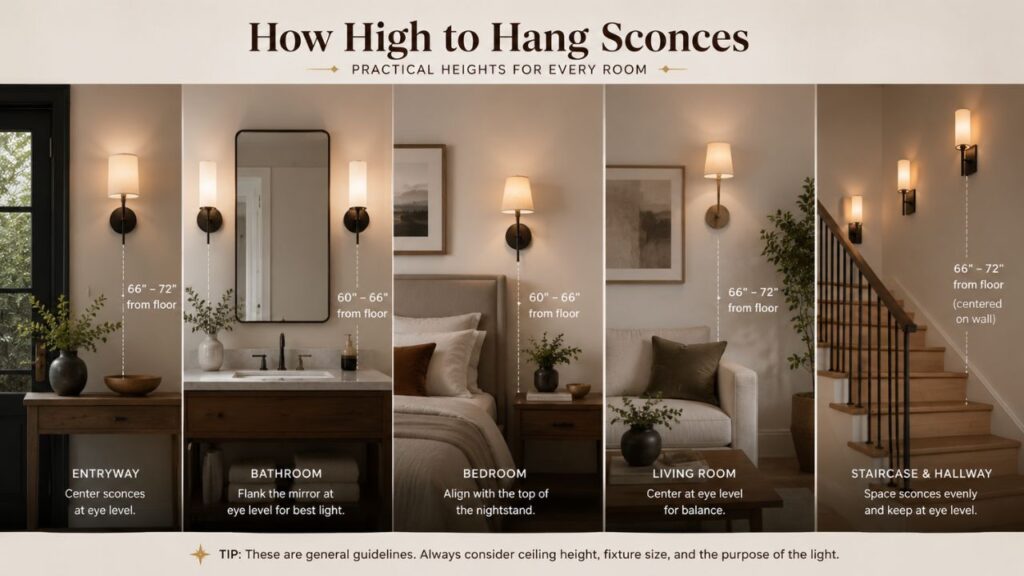
Quick Answer: How High Should Wall Sconces Be?
If you need a fast starting point, use this chart.
| Location | Practical Starting Height | Measure From |
|---|---|---|
| General wall | 60–70 in. | Floor to fixture/backplate center |
| Hallway | 60–66 in. | Floor to fixture center |
| Tall hallway | 66–72 in. | Floor to fixture center |
| Bathroom, beside mirror | 60–65 in. | Floor to backplate center |
| Bathroom, above mirror | 75–80 in. | Floor to bottom/base of fixture |
| Bedside reading sconce | About 60–65 in. | Floor to backplate center |
| Bedside relative to nightstand | About 20–30 in. | Nightstand top to fixture area |
| Fireplace sconces | 60–72 in. | Floor to fixture |
| Entryway | 60–72 in. | Finished floor to fixture |
| Stairway | Roughly eye level | Relative to each stair tread |
These are design ranges, not universal building-code requirements.
The right wall sconce height depends on fixture dimensions, where the bulb sits, the user’s eye level, and what the sconce is lighting.
Why There Is No Single Correct Sconce Height
People often search how high to hang wall sconces expecting a number like 64 inches.
That works until you compare two fixtures.
Imagine the first sconce is a compact 8-inch globe centered directly on its electrical box.
The second is a 30-inch vertical fixture whose junction box sits near the lower third of the body.
Install both boxes at exactly 64 inches and the finished fixtures could land at dramatically different visual heights.
This is why sconce mounting height should never be chosen from the junction-box location alone.
Before rough electrical work begins, check the manufacturer’s specification sheet.
You want to know:
- overall fixture height
- overall width
- projection from the wall
- backplate dimensions
- electrical-box location
- distance from box center to fixture top
- distance from box center to fixture bottom
- location of the actual light source
- whether the fixture points upward, downward, or both
That information can prevent an expensive electrical-box relocation later.
What Does “60 Inches High” Actually Mean?
This is where many lighting guides become confusing.
When someone gives a sconce height from floor, they may mean:
- floor to the center of the backplate,
- floor to the center of the fixture,
- floor to the bulb,
- floor to the bottom of the shade, or
- floor to the electrical junction box.
Those measurements are not interchangeable.
For a symmetrical fixture, the differences may be small.
For an asymmetrical swing-arm sconce, long vertical vanity light, or upward-facing shade, they can be substantial.
The safest measuring method
Start with the finished floor, not the subfloor.
Then identify the manufacturer’s actual mounting point.
Tape a paper outline of the fixture onto the wall before the electrician cuts or relocates a box. Some lighting companies even provide full-scale templates for this purpose; Visual Comfort, for example, offers actual-size fixture templates for certain products.
That simple mockup is often more useful than another half hour with a tape measure.
General Wall Sconce Height: Start Around Eye Level
For decorative sconces in living rooms, dining rooms, libraries, and other general spaces, the second useful reference for wall sconce height is human eye level.
Lightology recommends installing residential wall lights around 5 feet 6 inches to 6 feet above the finished floor and notes that fixtures mounted around eye level should avoid exposing a glaring bulb directly to the viewer.
A typical starting point of 60–70 inches works because it puts many fixtures roughly within an adult’s natural visual zone without forcing the light source directly into the eyes.
Still, ask one question before drilling:
What will people be doing beside this wall?
A person walking through a hallway experiences a sconce differently from someone seated on a sofa directly beside it.
Bathroom Sconce Height: Function Matters More Than Symmetry
Bathrooms are where placement becomes less forgiving.
The best bathroom sconce height usually puts light around face level rather than high above the head.
Why?
Side lighting can illuminate both sides of the face and reduce the strong under-eye, nose, and chin shadows created by a single overhead fixture.
Kohler recommends placing bathroom sconces beside a mirror with the midpoint of the backplate approximately 60–65 inches above the floor. Visual Comfort gives the same general 60–65-inch recommendation.
That is a far more useful starting point than simply centering a light between the countertop and ceiling.
How High to Hang Sconces Beside a Bathroom Mirror
For most adults, the first planning point for vanity sconce height is around eye level.
A 60–65-inch center height works in many bathrooms, but household height matters. In a home designed for particularly tall or short users, shifting the lights a few inches can improve facial illumination.
When installing sconces beside mirror edges, keep the pair symmetrical unless the architecture clearly calls for asymmetry.
Kohler recommends mounting the fixtures a few inches outside the mirror while keeping at least approximately 28 inches between the pair in its bathroom-lighting guide.
That number is useful, but mirror width and fixture size still come first.
A 24-inch mirror and a 60-inch double vanity obviously need different layouts.
Should the Sconce Be Centered on the Mirror?
Not necessarily.
The center of the sconce should relate to the face and the usable mirror area.
A very tall mirror can extend much higher than normal eye level. Centering the lights vertically on that mirror could put them too high.
This is why well-placed sconces beside mirror installations often look slightly lower than someone might expect when judging the mirror alone.
The person using the mirror is the real reference point.
How High Should Sconces Be Above a Bathroom Mirror?
If side space is limited, an above-mirror fixture is a practical alternative.
For sconces above mirror installations, Schoolhouse recommends roughly 75–80 inches above the floor, depending on the mirror position. Kohler also recommends leaving about 75–80 inches between the floor and the base of an above-mirror sconce.
Notice the change in measurement.
Beside the mirror, guidance often refers to the center of the backplate.
Above the mirror, guidance may refer to the bottom or base of the fixture.
That distinction matters.
A 6-inch bath bar and a 20-inch decorative fixture cannot be positioned correctly using the same centerline assumption.
Above-Mirror Width Matters Too
Height is only half the problem with sconces above mirror layouts.
Visual Comfort recommends that a linear vanity light above a mirror should generally be at least around three-quarters of the mirror’s width without extending beyond the mirror edges.
That rule is especially helpful on wider vanities.
A tiny light perched over a large mirror may technically sit at the right height and still look badly underscaled.
Vanity Lighting: A Better Way to Set the Height
Instead of blindly accepting one vanity sconce height, stand in front of the unfinished vanity and locate the eye level of the primary users.
Then check:
- where their faces appear within the mirror
- where the bulb or diffuser will sit
- whether the shade exposes a direct bulb
- whether the fixture throws light inward toward the face
- whether the mirror frame blocks part of the beam
- whether tall faucets or backsplash details interfere visually
For makeup, shaving, skincare, and grooming, even facial illumination matters more than a mathematically perfect relationship with the ceiling.
The second time you evaluate bathroom sconce height, do it with the actual fixture specification in hand.
A tall vertical light may work beautifully centered at 63 inches. A small shaded sconce whose bulb sits well above its backplate may need to move lower.
Bathroom Safety: Height Is Not the Only Requirement
A beautiful bathroom installation still needs appropriate electrical equipment.
Near tubs and showers, the National Electrical Code has specific rules concerning luminaires and bathtub/shower zones. Current NEC guidance discussed by the International Association of Electrical Inspectors describes a 3-foot horizontal and 8-foot vertical zone affecting certain suspended, track, and fan-mounted luminaires. Fixtures located within the actual tub or shower footprint up to the specified height must be suitable for damp locations, or wet locations where exposed to spray.
UL guidance distinguishes the two ratings:
- Damp location: areas periodically exposed to moisture or condensation.
- Wet location: areas where water may drip, splash, or flow onto electrical equipment.
Local electrical codes and adopted NEC editions vary, so bathroom wiring and hardwired fixture placement should be confirmed with a licensed electrician in your jurisdiction.
A design measurement is not a substitute for an electrical requirement.
Bedside Sconce Height: Measure the Person, Not Just the Bed
Bedrooms create another common measurement trap.
Lumens recommends a bedside sconce height of roughly 60–65 inches from the finished floor to the center of the backplate for many reading and swing-arm lights.
Rejuvenation approaches the same problem from a different reference point, recommending sconces roughly 20–30 inches above a nightstand.
These recommendations are not necessarily contradictory.
A typical nightstand may be somewhere around the mid-20-inch range in height. Add 20–30 inches and you arrive in roughly the same general part of the wall.
But real furniture varies.
The Seated Test Is Better Than a Fixed Number
Before finalizing bedside sconce height, sit in bed against the pillows as you normally would when reading.
The fixture should:
- direct light toward the page
- avoid shining directly into your eyes
- avoid shining into a sleeping partner’s face
- keep the switch within comfortable reach
- clear the top of the headboard
- allow an adjustable arm to move without hitting artwork or curtains
Lumens also notes that the bottom of a bedside shade should sit around shoulder level when seated for many applications.
That is often a better ergonomic test than treating 62 inches as sacred.
Hallway Sconce Height
Hallways benefit from repeated wall lighting because sconces create visual rhythm as well as illumination.
Lumens recommends a hallway sconce height of approximately 60–66 inches to the center of the fixture in many standard halls. For spaces with ceilings around nine feet or higher, it suggests considering 66–72 inches to maintain visual proportion.
Schoolhouse gives a broader 60–72-inch range for hallway and entry fixtures.
The difference tells you something useful: ceiling height matters.
A sconce at 60 inches in a compact eight-foot corridor can feel completely natural. The same fixture at the same height on a twelve-foot wall may look oddly low.
How Far Apart Should Hallway Sconces Be?
There is less agreement on spacing than many homeowners expect.
Schoolhouse references six feet as a traditional hallway spacing point but explicitly notes that architecture can change that recommendation. Lightology suggests that roughly 8–10 feet can work for many fixtures while emphasizing lumen output and room layout.
That is why hallway sconce height and spacing should be designed together.
Use doorways, wall openings, artwork, niches, and turns in the corridor to create a rhythm.
Do not force a six-foot grid across architecture that clearly wants something else.
Wall Sconces Near Doors and Entryways
Entry lights usually work well in the same 60–72-inch general zone.
Schoolhouse recommends placing wall sconces around 60–72 inches above the finished floor in entryways and illustrates maintaining clearance from nearby door trim.
Good wall sconce placement near a doorway also needs to consider the open door.
Check:
- door swing
- casing width
- artwork
- coat hooks
- sightlines from adjoining rooms
- fixture projection
- switch location
A sconce may look perfectly centered when the door is closed but become awkward once the door is open.
How High to Hang Sconces Around a Fireplace
Fireplace lighting usually works as a framing device.
Rejuvenation recommends placing hearth sconces approximately 60–72 inches from the floor and keeping the pair equally spaced from the center of the mantel.
This is one situation where how high to hang wall sconces cannot be answered without looking at the fireplace itself.
A low contemporary firebox with no mantel can support lower or more architectural lights.
A tall traditional mantel with artwork above it often requires the sconces to rise enough to frame the composition rather than visually cutting through it.
Before installation, tape the outline of the mantel artwork and sconces onto the wall at the same time.
You are designing one composition, not three unrelated objects.
Living Room and Dining Room Sconces
In living and dining rooms, 60–70 inches remains a dependable starting range, but seated sightlines deserve special attention.
A visible bare bulb that seems harmless while standing can become painfully bright when viewed from a sofa.
This is where wall sconce placement should respond to furniture.
Sit in:
- the sofa
- lounge chair
- dining chair
- reading chair
Then look directly toward the planned fixture.
If you can see straight into an exposed high-output lamp, either adjust the height or choose a fixture with better diffusion.
How High Should Kitchen Sconces Be?
Kitchen sconces are less standardized because they perform very different jobs.
A wall light might sit:
- above open shelves
- beside a window
- over a sink
- above a breakfast nook
- near a range
- over a small counter
- beside pantry cabinetry
Schoolhouse notes that kitchen sconce position often depends on existing architectural features rather than one fixed measurement.
For ambient sconces on an open kitchen wall, the familiar 60–70-inch range can be a reasonable starting point.
For task-oriented lights over a counter or shelf, design from the work surface upward. Make sure the shade does not block your sightline and the light reaches the counter without producing irritating glare.
Stairway Sconce Height
Staircases require a different reference point because the floor changes continuously.
Do not measure every staircase fixture from the lower-level floor.
Instead, maintain a consistent visual relationship to the adjacent stair tread.
Lumens recommends maintaining a consistent fixture height relative to each stair tread rather than referencing the distant floor below.
This creates a clean line that follows the staircase.
A laser level can help during layout, but remember that the goal may be a line parallel to the stair pitch rather than a conventional horizontal line.
Tall Ceilings: Should You Raise the Sconces?
Usually, yes—but not automatically.
A ten- or twelve-foot ceiling creates more wall area above the fixture, so a 60-inch mounting point can look visually low.
But raising every sconce to 78 inches simply because the ceiling is tall can disconnect the fixture from people and furniture.
Instead, increase sconce mounting height gradually while checking:
- fixture scale
- human eye level
- architectural molding
- door heights
- furniture
- wall art
- ceiling height
Large rooms often need larger fixtures as much as they need higher fixtures.
A tiny sconce installed very high does not suddenly become proportional.
Accessibility: Projection Can Matter as Much as Height
Residential homeowners do not usually need to apply commercial ADA requirements throughout a private home, but designers working on hospitality, public, multifamily, or other covered environments need another measurement.
The U.S. Access Board’s ADA Standards state that objects with leading edges more than 27 inches and no more than 80 inches above the finished floor generally cannot project more than 4 inches horizontally into a circulation path. Wall sconces are specifically illustrated as potential protruding objects in Access Board guidance.
That matters because many decorative sconces project six, eight, or even twelve inches from a wall.
In a covered circulation path, selecting a shallower fixture may solve a problem that changing the height does not.
The Biggest Mistake: Measuring the Electrical Box Instead of the Fixture
Suppose your electrician asks, “What height do you want the boxes?”
You answer, “Sixty-four inches.”
That sounds precise.
It may still be wrong.
The second sconce height from floor you need to calculate is the finished position of the fixture itself—not merely its wiring point.
Many sconces are not symmetrical around the box.
Some extend much farther upward.
Others hang below the backplate.
Swing-arm fixtures can move several inches in multiple directions.
Before rough-in, obtain the product’s technical drawing.
If you have not selected the actual fixture yet, you are making an educated guess.
A Practical Sconce-Height Formula
Use this five-step method rather than memorizing a single number.
Step 1: Identify the Lighting Job
Is the sconce providing:
- ambient light
- vanity light
- reading light
- accent light
- hallway illumination
- artwork lighting
- architectural decoration?
Function comes first.
Step 2: Choose the Human Reference Point
Standing face level matters in a bathroom.
Seated shoulder and eye level matter beside a bed.
Walking eye level matters in a hallway.
Step 3: Identify the Fixture’s Mounting Point
Read the technical drawing.
Do not assume the junction box is centered.
Step 4: Mock Up the Fixture
Cut a piece of cardboard to the fixture dimensions and tape it to the wall.
Stand across the room.
Sit down.
Open nearby doors.
Look in the mirror.
Step 5: Adjust for Architecture
Check trim, windows, headboards, mantels, art, mirrors, ceilings, and furniture.
Only then mark the final electrical position.
A Real-World Bathroom Example
Imagine a 42-inch bathroom vanity with a 34-inch-wide mirror.
The mirror begins 41 inches above the floor and reaches 73 inches.
You are using two 14-inch vertical sconces.
Start with the backplate center around 62–64 inches.
Now stand in front of the mirror.
If the light source lands near face level and the shades clear the mirror frame comfortably, the layout is probably working.
If the occupants are tall and the bulb sits below the backplate center, moving the box two inches higher may improve the result.
That two-inch adjustment is exactly why generic measurement charts should be treated as starting points.
A Real-World Bedroom Example
Imagine a nightstand 26 inches tall.
A Rejuvenation-style 20–30-inch-above-nightstand guideline gives you a broad fixture zone around 46–56 inches and upward, depending on what part of the fixture is being referenced. A floor-based 60–65-inch backplate-center recommendation from Lumens may place the same fixture somewhat higher.
Which is right?
Sit in the bed.
If the lamp is adjustable and the switch is easy to reach, the higher position may work perfectly.
If the light is fixed and shines above the book, lower it.
This is why ergonomic testing beats blindly averaging two published numbers.
Common Sconce Placement Mistakes
1. Hanging Every Fixture at Exactly 60 Inches
Rooms and sconces vary.
A range is more useful than a rule.
2. Ignoring the Bulb
A visible bulb near eye level can create glare even when the fixture itself is beautifully positioned.
3. Centering Vanity Lights on an Oversized Mirror
Center the lighting around the user’s face, not simply the mirror rectangle.
4. Roughing In Electrical Boxes Before Choosing Fixtures
This can leave a tall sconce several inches higher or lower than expected.
5. Installing Bedside Lights While the Room Is Empty
Mattress thickness, headboard height, and nightstand height all change the relationship.
6. Forgetting Door Swing
Swing-arm sconces and projecting shades can interfere with doors, cabinets, curtains, or artwork.
7. Ignoring Fixture Projection
Projection affects glare, circulation, and—in some nonresidential situations—accessibility compliance.
8. Treating Code and Design Advice as the Same Thing
A common design height is not automatically a legal requirement.
Designer’s Pre-Installation Checklist
Before approving the final holes or junction boxes, check:
- Finished floor height is known.
- Actual fixture dimensions are confirmed.
- Technical drawing has been reviewed.
- Backplate and junction-box location are known.
- Bulb or LED light-source position is known.
- Fixture projection has been checked.
- Glare has been considered from standing and seated positions.
- Mirror, mantel, headboard, artwork, and trim are accounted for.
- Door and cabinet swings clear the fixture.
- Bathroom or exterior location rating is appropriate.
- Local electrical requirements have been checked.
- A full-size cardboard or paper mockup has been tested.
That checklist is more reliable than choosing a number from an inspiration photo.
Featured Snippet Answer
How High Should Sconces Be Hung?
Most wall sconces are hung about 60–70 inches above the finished floor, measured near the center of the fixture or backplate. Bathroom sconces beside mirrors are commonly centered around 60–65 inches, while above-mirror lights often sit with their base about 75–80 inches from the floor. Bedside and hallway sconces should be adjusted for furniture, eye level, fixture size, and glare.
Frequently Asked Questions
Is 60 inches too low for a wall sconce?
Not necessarily.
Sixty inches is within several commonly recommended ranges, particularly for bathroom and general wall lighting. A tall ceiling or unusually large fixture may justify raising it.
Is 72 inches too high for a sconce?
It depends on the room.
Seventy-two inches can work well in entryways, tall hallways, fireplace compositions, and rooms with higher ceilings. It may be too high for facial vanity lighting or certain bedside reading fixtures.
Should wall sconces be above eye level?
Many decorative sconces work best at or slightly above average eye level, especially when an exposed light source could create glare.
Bathroom side lighting often lands close to face level because the goal is useful facial illumination.
Where should bathroom sconces sit next to a mirror?
A common starting point is about 60–65 inches from the finished floor to the center of the backplate, with fixtures positioned symmetrically outside the mirror.
How far should a sconce be from a bathroom mirror?
There is no universal edge distance because fixture and mirror widths vary.
Kohler suggests positioning fixtures a few inches outside the mirror while preserving approximately 28 inches between them in appropriate installations.
How high should a light be above a bathroom mirror?
A common recommendation is to place the base of an above-mirror fixture around 75–80 inches above the finished floor.
How high should bedside sconces be?
About 60–65 inches from the floor to the backplate center is a useful starting point for many bedside reading lights. Another method is to position them around 20–30 inches above a nightstand and then adjust for seated reading height.
Should bedroom sconces line up with the headboard?
They should relate visually to the headboard, but they do not need to line up with its top.
Reading comfort, shade position, switch accessibility, and mattress height matter more.
How high should hallway wall sconces be?
About 60–66 inches to the fixture center works for many standard hallways. In spaces with nine-foot or taller ceilings, 66–72 inches may look more proportional.
How high should fireplace sconces be?
Rejuvenation recommends a general 60–72-inch range and equal spacing from the center of the mantel.
Should sconces point up or down?
It depends on the lighting job.
Upward light creates softer ambient illumination and can visually emphasize ceiling height. Downward-facing fixtures provide more directional light for counters, reading areas, art, or architectural features.
Do bathroom sconces need to be damp-rated?
The answer depends on their exact location and local electrical rules. Fixtures in damp or wet environments need appropriate listings, and areas near tubs and showers have specific NEC requirements. Confirm the fixture rating and installation with a qualified electrician.
Can I move an existing wall sconce higher?
Usually, but hardwired fixtures may require relocating the electrical box and wiring.
Because electrical work must comply with applicable local codes, consult a licensed electrician rather than extending concealed wiring casually.
The Number Matters Less Than the Relationship
The best lighting installations rarely look as if someone followed a formula.
They look inevitable.
The sconce relates to the mirror.
The bedside light relates to the person reading beneath it.
The hallway fixture relates to the door frames and ceiling.
The fireplace pair frames the mantel instead of fighting it.
That is the useful answer to how high to hang sconces: start with tested measurement ranges, then adjust for the actual fixture, architecture, human eye level, and job the light needs to perform.
A tape measure gets you close.
A full-size mockup gets you right.