
A natural garden is not a yard you simply stop maintaining. The best examples are edited ecosystems: plants are chosen for the site, layers are planned, water is slowed down, soil is protected, and some seasonal mess is deliberately left because it has ecological value. The result feels loose and alive, yet there is a clear hand behind it.
There is a practical reason this style has moved beyond a niche gardening trend. Gardeners are looking for outdoor spaces that cope better with heat, drought, heavy rain, rising input costs, and declining insect habitat. A good nature-led garden can answer several of those needs at once without asking you to recreate a wilderness outside the kitchen door.
The Real Idea: Designed Wildness, Not Neglect
The biggest mistake is treating natural garden design as a visual style made from random grasses and wildflowers. Appearance comes second. First, decide what the site already wants to do. A sunny, dry bank, a damp low point, a windy corner, and a shaded wall should not receive the same plant palette. When plants fit their conditions, they are more likely to establish well and require fewer rescue operations later.
That is also why a wildlife-friendly garden should be planned as habitat rather than decorated with a few “bee plants.” Food matters, but so do nesting spaces, shelter, host plants for caterpillars, water, undisturbed stems, leaf litter, dead wood, and patches of bare soil. The Xerces Society describes high-quality pollinator habitat in much the same way: abundant flowers, shelter and nesting sites, plus protection from pesticides.
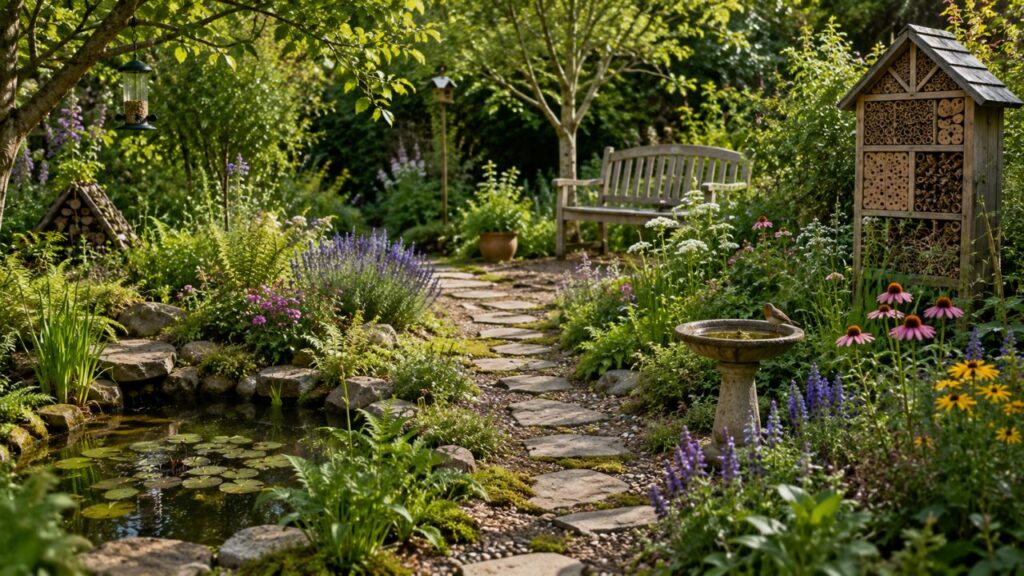
A useful design rule is simple: make the ecological parts obvious enough that they read as intentional. Mown paths through tall grass, repeated plant groups, a crisp edge beside a loose border, a bench at the end of a view, or a simple gravel path can make an exuberant planting feel cared for. This “frame the wildness” approach is one of the easiest ways to keep a nature-led garden acceptable in a suburban setting.
Start With a Site Audit Before Buying a Single Plant
Spend a week observing the garden before redesigning it. Note where sun falls in the morning and afternoon, where rainwater gathers, which areas dry first, where wind funnels through, and where existing plants already thrive. Dig small inspection holes in several places. Soil can change dramatically across one property, especially around newer homes where construction has moved and compacted subsoil.
Good sustainable landscaping begins with reducing unnecessary work. Instead of forcing moisture-loving plants into a dry slope or constantly watering sun lovers in shade, match plant traits to the site. The old horticultural phrase “right plant, right place” sounds basic, but it is one of the most effective ways to reduce water use, replacement planting, fertilizer, and pest stress.
Check soil texture, drainage, and pH when plant choice depends on them. If you are in the United States, a local Cooperative Extension office can guide soil testing; in other countries, use a reputable local horticultural service. Do not improve every bed automatically. Many wildflowers perform poorly in soil that has been made excessively rich, while woodland plants may appreciate more organic matter.
Build the Garden in Layers, Like a Small Ecosystem
A visually convincing garden rarely depends on flowers alone. Think in vertical layers: canopy trees, smaller trees, shrubs, tall perennials, mid-height flowers, grasses or sedges, groundcovers, bulbs, climbers, and the soil surface. Even a small plot may use only four or five layers, but that is enough to create depth and multiple habitat niches.
This layered approach is one of the strongest ways to increase garden biodiversity without making the garden visually chaotic. A shrub can offer flowers in spring, nesting structure in summer, berries later in the year, and shelter in winter. The herbaceous layer may feed insects, while stems and leaf litter protect overwintering invertebrates. One square metre can do more than one job.
Structure also keeps the garden attractive when flowers are gone. Seed heads, bark, evergreen foliage, ornamental grasses, dried stems, and branching silhouettes become the winter composition. That matters because a nature-first garden should not depend on a twelve-week flowering peak to look good.
Choose Plants by Ecological Role, Not by Label Alone
Start with native plants that are genuinely native to your region, not merely native somewhere in the same country or continent. Regional fit matters because local insects, soils, rainfall patterns, and seasonal timing vary. Xerces publishes region-specific plant lists in the United States and notes that native species can provide nectar, pollen, caterpillar host plants, nesting materials, and resources for specialist bees.
That does not mean every non-native ornamental must be removed. The Royal Horticultural Society’s four-year Plants for Bugs research found that a mix can support pollinators, while plantings biased toward British natives were particularly useful for the wider invertebrate community. The practical lesson is more nuanced than “native good, exotic bad”: prioritize locally useful plants, keep flower supply broad and long, and judge non-invasive ornamentals by what they contribute.
When shopping, look for pollinator-friendly plants that provide accessible nectar or pollen rather than assuming every colorful bloom is valuable. Some highly doubled flowers have reproductive parts converted into petals, which can make food harder for insects to reach. Plant several of the same species together so foraging insects can move efficiently through a visible patch.
Repeat native plants in groups rather than scattering one of everything. Repetition gives the garden rhythm, helps a small space feel calmer, and can make useful food plants easier for insects to locate. It also simplifies maintenance because you learn how a few reliable species behave instead of managing dozens of unrelated one-offs.
Design a Flowering Calendar, Not a Flower Show
A garden can look spectacular in June and still fail wildlife for the rest of the year. Make a bloom chart for your climate and mark early, middle, and late season. Aim to have several useful flowering species active in each period, including shrubs and trees as well as perennials.
This is where pollinator-friendly plants earn their place. Xerces recommends continuous bloom because different pollinators are active at different times, with early flowers especially useful to emerging bumble bee queens and late flowers supporting insects preparing for winter.
The calendar also improves human enjoyment. A succession of small peaks gives you more reasons to walk the garden through the year. Spring bulbs can hand over to early perennials, then to summer flowers, grasses, late asters or equivalent regional species, and finally to seed heads and colored stems.
Replace Some Lawn Without Declaring War on Grass
Lawns are useful where people actually walk, play, sit, or need open sightlines. The problem is not grass itself; it is lawn in places where it serves no purpose. Start by widening borders, softening corners, planting under trees, or turning a difficult mowing strip into taller vegetation.
A meadow garden works best when you match the method to soil fertility and climate. Sowing a generic “wildflower mix” into an existing, vigorous lawn often disappoints because grasses outcompete many flowering species. In some soils, success requires reducing fertility, removing existing turf, using locally suitable seed, or introducing plug plants over time.
For a small property, a full meadow may be unnecessary. A meadow garden can be a narrow strip along a fence, a sunny island around a fruit tree, or a matrix of grasses and perennials beside a path. Clear edges are especially helpful here; they tell the eye that the taller growth is deliberate.
Feed the Soil, but Stop Treating It Like Potting Mix
Healthy soil is not simply dirt plus fertilizer. It is a living system with roots, fungi, bacteria, invertebrates, pores, water, air, and organic matter. Routine deep cultivation can break soil structure and disturb biological habitat; USDA NRCS soil-health guidance recommends minimizing disturbance because tillage can reduce organic matter, damage structure, and increase runoff and erosion.
For many beds, organic gardening can be as straightforward as keeping soil covered, returning plant material where appropriate, using compost thoughtfully, and choosing targeted pest responses instead of broad-spectrum chemical routines. Garden Organic’s no-dig guidance centers on surface-applied organic mulches such as homemade compost, leaf mould, well-rotted manure, or peat-free products.
Compost is valuable, but “more” is not always “better.” Use it where soil structure or fertility needs support, especially in intensively grown beds. The U.S. Environmental Protection Agency reports that compost can increase soil organic matter, improve water infiltration and retention, reduce compaction, and support beneficial soil organisms.
If you buy growing media, choose peat-free compost when a suitable product is available. Peatlands are major carbon stores and wildlife habitats; the RHS notes that keeping peat in bogs avoids releasing carbon that has been stored for very long periods.
Treat Rain as a Resource, Not a Drainage Problem
Watch your garden during a downpour. Roof water may rush from a downspout, cross paving, cut through a bed, and disappear into a drain. That is a design opportunity. Slow water, spread it, and let suitable areas absorb it before thinking only about pipes and hard drainage.
A rain garden is a shallow planted depression that receives runoff from roofs, driveways, paths, or similar hard surfaces. Penn State Extension describes these gardens as stormwater features that capture runoff and let it soak into the ground, reducing rapid off-site flow while creating habitat. Site, soil infiltration, overflow routes, and distance from buildings all need proper assessment before installation.
Other options include rain barrels, permeable paths, swales, deeper planting beds, and more tree or shrub cover. These choices turn sustainable landscaping into a working water system rather than a collection of eco-themed products.
A rain garden is not a permanent pond. It should drain after storms, and plant selection needs to reflect the wet-to-dry gradient from the lowest point to the edges. If water regularly remains for long periods, correct the drainage or design rather than hoping plants will solve a structural problem.
Use Fewer Pesticides by Designing for Balance
One of the uncomfortable signs of a successful habitat garden is leaf damage. Caterpillars chew. Leaf miners make trails. Aphids appear. A sterile leaf is not the ecological gold standard. Xerces points out that the vast majority of insects are not pests and that visible feeding can be part of a functioning food web.
That does not mean ignoring serious infestations. Organic gardening works best when it uses observation and thresholds: identify the organism first, decide whether damage is actually increasing, check for predators, improve plant health, remove affected material if needed, and use the least disruptive control that fits the problem.
Avoid routine spraying of flowering plants, especially when pollinators are active. When buying nursery stock specifically for habitat, ask how the plants were treated; Xerces warns that some plants marketed for pollinators may have been exposed to pesticides harmful to bees and other beneficial insects.
Leave Some Habitat Standing Through Winter
Autumn cleanup is where many good intentions disappear into bags. Hollow and pithy stems can become nesting or overwintering sites. Fallen leaves can protect soil and shelter small organisms. Seed heads feed birds and create winter structure. Dead wood can host fungi, beetles, and cavity-nesting species.
A wildlife-friendly garden does not require leaving every fallen branch where it lands. Keep paths, entrances, patios, and high-visibility areas tidy, then designate quieter habitat zones where leaves, stems, logs, and brush can remain. That compromise is easier to live with and easier to explain to neighbors.
Delay major perennial cutback until late winter or early spring where your climate and plants allow it. Cut stems at varying heights, move some cut material loosely to a habitat pile, and avoid shredding everything immediately. The goal is not mess for its own sake; it is continuity of shelter.
A Natural-Looking Garden Still Needs Editing
The phrase low-maintenance garden is often misunderstood. Nature-led planting can reduce mowing, watering, staking, fertilizer, and seasonal replanting, but it is not maintenance-free. The work changes. You spend more time editing seedlings, removing invasive plants, dividing aggressive clumps, watching water flow, and deciding what to leave.
This is where natural garden design proves its value. A repeated edge, limited material palette, clear circulation, and a few strong structural plants let the looser planting fluctuate without making the whole space feel accidental. Piet Oudolf’s naturalistic planting work is often admired for exactly this reason: the planting may be expressive, but the composition is disciplined.
Keep a short “intervention list” rather than a traditional chore list. Ask: What is threatening diversity? What is blocking a path? What is smothering a slower plant? What is creating a safety issue? What can be left alone? This question-based approach reduces unnecessary work.
Natural Garden vs. Conventional Ornamental Garden
| Decision | Nature-Led Approach | Conventional Ornamental Approach |
|---|---|---|
| Plant choice | Site-adapted, regionally useful, multi-season | Often chosen mainly for appearance |
| Soil | Covered, minimally disturbed, biologically active | Frequently cultivated or fed on schedule |
| Lawn | Kept where it has a function | Often the default groundcover |
| Water | Captured, slowed, infiltrated where safe | Often moved away quickly |
| Insects | Many are treated as part of the food web | Visible damage may trigger control |
| Winter | Stems, seed heads, leaves partly retained | Beds often cut back hard |
| Aesthetic | Structured looseness | Stronger emphasis on neatness |
| Maintenance | Editing, monitoring, selective intervention | Mowing, clipping, feeding, replacing |
Neither approach has to be absolute. A family may want a tidy lawn near the house, a formal terrace, productive vegetable beds, and a looser habitat zone at the back. Good gardens are allowed to serve more than one purpose.
How to Keep Wild Planting From Looking Messy
The fastest route to an attractive low-maintenance garden is not planting fewer species; it is creating clearer visual rules. Use repetition. Group plants in drifts or recurring clusters. Keep one or two path materials. Echo the same shrub form in several places. Let a mown or clipped edge contrast with softer vegetation.
Think about viewing distance too. Fine-textured planting looks rich up close but can read as visual noise from a window. Strong seed heads, grasses, shrubs, and repeated masses help the composition hold together at a distance.
Common Mistakes That Cost Time and Money
1. Buying Plants Before Reading the Site
A cart full of fashionable species cannot fix poor matching between plant and place.
2. Using a Generic Seed Mix
A seed packet marketed for “wildlife” may contain species unsuited to your climate, soil, or local ecology. Check the species list rather than trusting the picture on the packet.
3. Making Every Square Metre Equally Wild
People need paths, places to sit, safe sightlines, and usable space. Habitat improves when it is designed around real life rather than competing with it.
4. Improving Soil Everywhere
Some flowering plants need leaner soil. Fertilizing them can produce floppy growth and more competition rather than better flowering.
5. Removing Every Leaf
Leaves are not automatically waste. Keep them where they can decompose safely, especially beneath shrubs and trees.
6. Planting Invasive Species
“Natural-looking” is not the same as ecologically safe. Check local invasive-species guidance before introducing vigorous plants.
7. Assuming One Bee Hotel Solves Habitat
A few drilled holes cannot replace season-long flowers, appropriate nesting material, pesticide avoidance, and connected vegetation.
A Practical 12-Month Approach
You do not need to remake the whole property in one weekend. Better results usually come from staged change.
Late winter to early spring: Map sunlight, drainage, and existing plants. Cut back selected old stems only when appropriate for your local climate. Order regionally suitable plants and seed.
Spring: Plant shrubs, perennials, sedges, grasses, and groundcovers while conditions are mild. Mulch bare soil where needed. Start documenting insects and birds with a notebook or tools such as iNaturalist.
Early summer: Watch which plants establish strongly and which areas dry out. Water new plants deeply rather than giving frequent shallow splashes.
Late summer: Record gaps in flowering. These notes are more useful than memory when you choose next year’s plants.
Autumn: Plant suitable trees, shrubs, bulbs, or perennials according to local conditions. Reduce hard cleanup. Collect leaves for leaf mould or move them beneath woody plants.
Winter: Review structure from windows and paths. Decide where an evergreen, shrub, grass, or retained seed head would improve the view.
This gradual method builds garden biodiversity while protecting your budget. It also lets you see how the site responds before committing to large earthworks or expensive planting schemes.
A Realistic Small-Garden Scenario
Imagine a 90-square-metre suburban back garden dominated by lawn, a narrow flower border, and a paved patio. Instead of replacing everything, the owner removes one unused lawn corner, widens the border, and plants a small native shrub, long-flowering perennials, grasses, and groundcovers. A mown path remains through the center.
Roof runoff is redirected into a planted depression only after checking levels, infiltration, utilities, and building clearances. Leaves are kept under the shrub, a small log pile sits behind the planting, and one sunny patch of soil is left lightly covered rather than buried under thick mulch. The patio stays crisp and usable.
That relatively small redesign creates more flower continuity, more shelter, greater root depth, and stronger visual interest without turning the property into a restoration project. For many homeowners, this staged approach is more realistic than attempting a complete ecological makeover in a single season.
Evidence Worth Knowing: What Research Says About “Wild” Gardens
The RHS Plants for Bugs project is especially useful because it tested assumptions gardeners often repeat. Conducted at RHS Garden Wisley over four years, it compared plant origin and invertebrate use. The broad takeaway was not that only one plant category works; it was that gardens support invertebrates well when they include plenty of native-biased, dense vegetation while retaining habitat details such as some bare soil.
The soil story is just as practical. EPA guidance reports that compost can improve water holding, infiltration, soil organic matter, and beneficial soil organism populations. Those are not decorative benefits: they influence how well plants cope between rains and how much water runs off the property.
This is why peat-free compost is a better default purchase when the product is appropriate for your plants. The point is not that one bagged product makes a garden environmentally responsible. Sourcing, soil management, plant choice, water, habitat, and long-term maintenance all need to work together.
The Deeper Principle: Design for Relationships
A successful garden is not a catalogue of objects. A tree shades a shrub. Fallen leaves feed soil organisms. Caterpillars feed birds. Deep roots slow water movement. Flowers feed insects that may pollinate fruit. A path gives people access without compacting planted soil. Every decision changes several relationships at once.
That is the real strength of sustainable landscaping: one intervention can solve more than one problem. A shrub belt might screen a neighbor, shelter birds, cool a seating area, intercept rain, and provide flowers or fruit. A groundcover can suppress weeds, protect soil, soften a path edge, and create habitat.
The best nature-led gardens also accept change. Plants move. Weather shifts. Some species fail. Others thrive unexpectedly. Your job is to guide the system toward the conditions you want rather than freeze it at the moment it looked perfect in a photograph.
Quick Checklist: What Makes a Nature-Led Garden Work?
- Match plants to light, soil, moisture, and climate.
- Favor regionally appropriate species with clear ecological value.
- Keep flowers available across the growing season.
- Build several vegetation layers.
- Reduce unnecessary lawn rather than removing useful lawn.
- Protect soil with roots, organic matter, or suitable mulch.
- Capture rain where it can safely infiltrate.
- Avoid routine pesticide use.
- Leave selected stems, leaves, logs, and seed heads.
- Use paths, edges, repetition, and focal points to show intent.
- Monitor invasive plants and aggressive spreaders.
- Change the garden gradually and learn from each season.
Frequently Asked Questions
What is the difference between a natural garden and a wild garden?
A natural-style garden is usually intentionally designed to imitate ecological patterns while still serving people. A wild garden may be managed more loosely. In practice, the terms overlap, but design cues such as paths, repeated planting, boundaries, and focal points often make the difference between “naturalistic” and simply unmanaged.
Does a Nature-Friendly Garden Have to Use Only Native Species?
No. Native species often offer strong habitat value, especially for specialist insects, but well-chosen, non-invasive plants from elsewhere can also provide nectar, pollen, structure, and seasonal interest. The best mix depends on your region and goals. RHS research supports a mixed approach for pollinators, with a useful bias toward native planting for broader invertebrate support.
How Can I Make a Nature-Led Garden Look Tidy?
Use visible structure: defined paths, clear edges, repeated plant groups, a limited hardscape palette, and intentional focal points. Keep the most public areas more edited and allow looser habitat in secondary zones.
Is a Nature-Led Garden Cheaper to Maintain?
It can be, especially when reduced mowing, watering, seasonal bedding, and chemical inputs offset the cost of establishment. Savings are not automatic. Dense perennial planting and trees can cost more upfront, and the first two years often need regular watering and weed control.
What Should I Do With Fallen Leaves?
Keep clean, disease-free leaves beneath trees, shrubs, or in designated beds where they can break down naturally. Avoid blocking drains, smothering delicate plants, or leaving slippery layers on paths. You can also compost leaves separately to produce leaf mould.
Do I Need a Pond to Attract Wildlife?
No. A pond can be valuable, but even a dish of clean water, damp soil, dense planting, exposed ground, logs, and varied vegetation can add habitat. If you construct a pond, include safe access and escape slopes for wildlife.
How Quickly Will I See More Insects and Birds?
Some insects may appear during the first flowering season, while a more complex community can take several years to develop. Plant maturity, surrounding habitat, pesticide exposure, water availability, and connections to nearby green spaces all affect the pace.
What Is the Best First Project for a Beginner?
Convert one low-use patch of lawn or widen one existing border. Plant it densely with site-matched species that offer several seasons of interest, then observe the area for a year before expanding.
Final Takeaway
The best nature-led gardens are not copies of wilderness. They are collaborations with the site. You choose where people move, where water goes, which plants get room, and which kinds of “mess” are allowed to stay because they are doing useful work.
Start small, make the structure clear, favor plants that earn their space, and watch what happens. A garden becomes richer when every decision is not aimed at making it look untouched, but at making it function more like a living place.