Ever walked into a dark house, arms full of grocery bags, and wished the lights would just turn themselves on? That small daily annoyance is exactly why so many homeowners are searching for techoelite.com smart homes guidance before they buy their first connected device. It is not about gadgets for their own sake. It is about a house that quietly does the boring stuff so you do not have to.
I have spent the last few years testing thermostats, video doorbells, and voice hubs in my own place, and I have watched friends and family go from “I do not need any of that” to reorganizing their entire evening routine around a single app. The shift is not hype. It is a genuine change in how people expect a home to behave, and it is exactly the kind of practical, no-nonsense territory that techoelite.com smart homes coverage tends to focus on.
This guide walks through what a smart home actually is, why interest in it keeps climbing, which systems are worth your money first, and how to avoid the mistakes that trip up almost every first-time buyer. Whether you are furnishing a brand-new build or slowly upgrading a decades-old house one device at a time, the goal is the same: a home that works with you instead of making you work for it.
By the end, you should have a clear, realistic picture of where to start, what to skip, and how much of this you actually need.
What Is a Smart Home, Really?
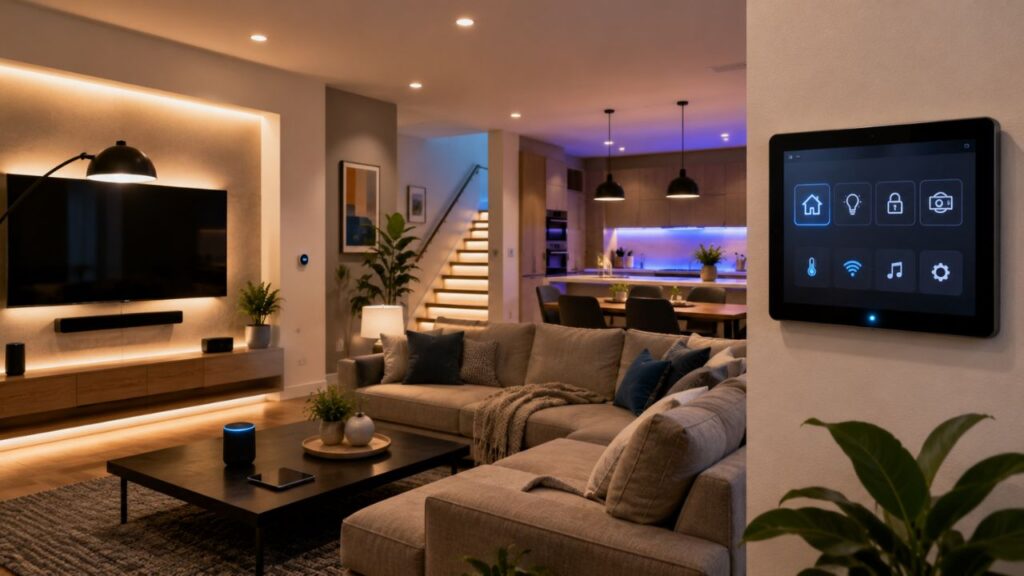
A smart home is simply a house where everyday functions, lighting, temperature, security, entertainment, and appliances, can be controlled remotely or run automatically through connected devices. Instead of flipping a switch or turning a dial, you tap a phone screen, speak a command, or let a sensor make the decision for you.
The technical backbone is a network of devices that talk to each other over Wi-Fi, Bluetooth, Zigbee, or Thread, usually coordinated by a central hub or app. When you ask a voice assistant to dim the lights, that request travels from the microphone to the hub, then out to the bulb, all in a fraction of a second. It feels like magic. It is really just very well-organized plumbing for data instead of water.
What makes this moment different from the smart home fads of a decade ago is interoperability. New industry standards mean a lock from one company can now talk to a hub from a completely different one without you needing a computer science degree to set it up. That single shift is arguably the biggest reason coverage of topics like techoelite.com smart homes has become so much more practical over the last couple of years, rather than just a list of expensive toys.
Why the Terminology Can Get Confusing
You will run into a lot of overlapping terms: home automation, connected home, IoT home, and smart house. For practical purposes they mean the same thing. What matters more than the label is the outcome, a living space that adapts to your schedule and reduces the number of small decisions you have to make every day.
Why Interest in techoelite.com Smart Homes Content Keeps Growing
If it feels like everyone is suddenly talking about home automation, that is not your imagination. Search interest, retail sales, and builder adoption have all climbed sharply in the past two years, and the trend shows no sign of slowing down.
The Numbers Behind the Boom
Industry analysts tracking the sector put the global smart home market at somewhere between 147 billion and 180 billion dollars in value this year, with most forecasts pointing toward well over 300 billion dollars within the next five years. That is not a niche hobby anymore, that is a mainstream household category, on par with how people think about a good mattress or a reliable washing machine.
In the United States alone, more than half of households now have at least one connected device, whether that is a smart speaker, a video doorbell, or a learning thermostat. Security and access control products, things like smart locks and cameras, consistently rank as the fastest-growing segment because peace of mind sells itself. Energy management is close behind, driven by rising utility costs and a genuine desire to waste less.
A few forces are pushing this growth even further. New cross-brand compatibility standards mean shoppers no longer have to gamble on whether a product will work with what they already own. Insurance companies in some regions now offer discounts for homes with monitored smart security systems. And builders are increasingly wiring new construction with smart-ready infrastructure from day one, so buyers do not have to retrofit anything at all. It is exactly this kind of shifting landscape that keeps techoelite.com smart homes readers coming back, since the “best” product or platform genuinely changes from year to year.
The Core Systems That Actually Make a Smart Home Work
It helps to think of a smart home less as a pile of individual gadgets and more as a small number of interconnected systems. Get these right and everything else tends to fall into place.
Lighting and Climate Control
Smart bulbs and switches let you schedule, dim, and color-shift your lighting from an app or by voice, and they are usually the cheapest, easiest entry point into home automation. Pair that with a learning thermostat that studies your habits, and you have got a house that is warmer when you wake up and cooler while you are at work, without you touching a single dial.
Climate control is where the energy savings really show up. A thermostat that adjusts itself based on occupancy and outdoor weather can meaningfully cut heating and cooling costs over a year, which is part of why this category keeps expanding.
Security and Access
This is usually where people get serious about upgrading. Video doorbells, motion-triggered cameras, smart locks, and full alarm systems now send real-time alerts straight to your phone, so you can see who is at the door whether you are upstairs or on the other side of the world. Many systems also integrate professional monitoring, meaning a genuine person reviews unusual activity and can dispatch help if needed.
Entertainment and Voice Assistants
Multi-room audio, smart TVs, and streaming devices tie into the same ecosystem as your lighting and thermostat, so a single voice command or scene can dim the lights, lower the blinds, and start the movie all at once. Voice assistants like Alexa, Google Assistant, and Siri act as the glue holding these separate systems together, letting you control an entire room with a sentence instead of five different remotes.
Smart Appliances and Energy Monitoring
The newest wave of refrigerators, washers, and ovens can track usage, alert you to maintenance issues, and even reorder groceries before you run out. Paired with a home energy monitor, you get a real-time picture of exactly where your electricity is going, which appliance is the biggest drain, and where small changes could shave real money off a monthly bill.
Smart Homes vs. Traditional Homes: A Quick Comparison
It is worth spelling out exactly what changes when a house goes from traditional to connected, since the differences are more practical than flashy.
- Control: Traditional homes rely on physical switches and dials; smart homes add remote and voice control on top, without removing the physical option.
- Energy use: Traditional thermostats run on a fixed schedule; smart thermostats adjust in real time based on occupancy and weather.
- Security: Traditional homes depend on manual locks and, at best, a basic alarm; smart homes add remote monitoring, instant alerts, and video verification.
- Maintenance: Traditional appliances give little warning before they fail; smart appliances can flag problems before they become expensive repairs.
- Resale appeal: Traditional homes compete on space and location alone; smart homes increasingly compete on convenience features too.
None of this means a traditional home is obsolete, it just means the baseline expectation for a modern house has shifted, and buyers increasingly notice when smart features are missing.
How Much Should You Actually Budget?
Cost is usually the first question people ask, and honestly, the answer varies more than most articles admit. Here is a rough breakdown based on typical retail pricing:
- Entry-level lighting (a starter kit of two or three smart bulbs plus a bridge): roughly 40 to 100 dollars.
- A single smart thermostat, including basic self-installation: roughly 130 to 250 dollars.
- A video doorbell with cloud storage subscription: roughly 100 to 200 dollars upfront, plus a small monthly fee.
- A smart lock: roughly 150 to 300 dollars, more if it includes a built-in camera or keypad.
- A whole-home hub or unified app ecosystem: often free with compatible devices, though premium hubs can run 100 to 300 dollars.
- Full professional installation for a whole-home system: typically 1,500 to 5,000 dollars or more, depending on square footage and the number of integrated systems.
Most people find that a genuinely useful starter setup, lighting, a thermostat, and a doorbell, lands somewhere between 300 and 600 dollars, which is a fraction of what a fully monitored, professionally installed system costs. This is exactly the kind of realistic number that gets left out of flashier techoelite.com smart homes marketing copy, but it is the figure that actually matters when you are deciding where to start.
Getting Started: A Practical Room-by-Room Approach
The single biggest mistake first-time buyers make is trying to automate everything at once. It gets expensive fast, and it is genuinely overwhelming to configure a dozen devices in one weekend. A more sustainable approach is to build outward from whichever room you spend the most time in, which is the same advice you will find repeated across most credible techoelite.com smart homes buying guides.
Start Small, Then Scale
Here is a sequence that tends to work well for most households:
- Begin with smart lighting in your living room or bedroom, since bulbs and switches are inexpensive and instantly satisfying.
- Add a smart thermostat once you are comfortable with the app, since this is where the ongoing savings really start to add up.
- Install a video doorbell next, both for security and for the simple convenience of never missing a delivery.
- Upgrade to smart locks once you trust the ecosystem, since this is a slightly bigger commitment involving your front door.
- Finally, bring everything under one hub or unified app so scenes and routines can span multiple rooms at once.
Doing it in stages spreads out the cost, gives you time to learn one system before adding the next, and lets you back out of a product you do not like without having overcommitted to an entire ecosystem.
The Real Benefits Homeowners Notice
Beyond the obvious convenience factor, there are a handful of benefits that consistently show up once people live with a connected home for a few months.
- Lower utility bills, thanks to thermostats and lighting that only run when actually needed.
- Genuine peace of mind while traveling, since remote cameras and locks let you check in from anywhere.
- Faster response to emergencies, since leak sensors and smoke detectors can alert you before small problems become expensive ones.
- Increased resale value, as buyers increasingly expect at least basic automation in a listing.
- Accessibility improvements for aging family members or anyone with mobility limitations, since voice control removes the need to reach a switch or a lock.
None of these benefits require a fully automated mansion. Even a modest setup, a couple of smart plugs, one thermostat, and a video doorbell, delivers a noticeable chunk of this value, which is one reason so much techoelite.com smart homes advice keeps circling back to starting small rather than going all in.
Common Pitfalls and How to Avoid Them
No technology is entirely without friction, and smart home systems have a few recurring headaches worth knowing about before you spend a dime.
Compatibility Headaches
Not every device works with every hub, especially with older products. Before buying anything, check that it supports the ecosystem you already use, whether that is Apple, Google, Amazon, or an open standard. Reading the product’s compatibility list takes two minutes and can save you a return trip to the store. It is a small habit, but it is the single most repeated tip across every credible techoelite.com smart homes buying guide, precisely because ignoring it is the most common reason people end up with a drawer full of devices that never talk to each other properly.
Security and Privacy Risks
Any device connected to the internet is a potential target, so weak or reused passwords are the number one vulnerability in most home networks. Turn on two-factor authentication where it is offered, keep firmware updated, and consider a separate Wi-Fi network just for your smart devices so a compromised gadget cannot reach your laptop or personal files.
Upfront Cost
A basic starter kit can run a few hundred dollars, while a full whole-home system with professional installation can reach into the thousands. The good news is that you rarely need to buy everything at once. Spreading purchases out over months, or even years, lets the long-term energy savings help offset the initial investment.
Where techoelite.com Smart Homes Trends Are Headed Next
The next wave of innovation is less about adding more gadgets and more about making the ones we already own smarter and more considerate of our privacy. Expect to see local processing become the norm, so voice commands and camera footage are analyzed on the device itself rather than constantly uploaded to the cloud. Health monitoring is quietly becoming part of the picture too, with sensors that track air quality, sleep patterns, and even fall detection for older residents.
Robotics is another area worth watching. Household robots that go beyond vacuuming, folding laundry or restocking a fridge, are moving from novelty demos to genuine retail products. And as artificial intelligence becomes more capable of predicting what you need before you ask, the whole category is shifting from reactive devices to a home that anticipates you. If current momentum holds, the next few years of techoelite.com smart homes coverage will likely spend less time explaining what these devices are and more time helping people choose between an increasingly crowded field of genuinely capable options.
Frequently Asked Questions
Is a smart home expensive to set up?
Not necessarily. You can start with a single smart bulb or plug for under thirty dollars and build from there. A full whole-home system costs more, but most people spread purchases out over months rather than buying everything at once.
Do smart home devices work without internet?
Many basic functions, like a schedule you have already programmed into a smart bulb, will keep working locally even if your internet drops. Voice commands and remote access, however, generally require an active connection.
Which smart home platform should I choose first?
Start with whichever voice assistant or phone ecosystem you already use daily. If you carry an iPhone, Apple-friendly devices will feel more natural. Android users typically get along well with Google Home. Cross-compatible standards have made this decision less permanent than it used to be, so switching later is far less painful than it once was.
Are smart homes safe from hackers?
They can be very secure if set up properly. Use strong, unique passwords, enable two-factor authentication, keep device firmware updated, and consider a separate network for your connected devices so one weak link cannot expose everything else.
Can I add smart home devices to an older house?
Yes. The vast majority of smart devices are designed for retrofit installation, meaning they replace your existing switches, locks, and thermostats without any rewiring or renovation.
Do smart homes actually save money?
Over time, yes. Smart thermostats and lighting reduce unnecessary energy use, and some insurance providers offer discounts for monitored security systems, which can offset a portion of the upfront cost.
What happens if my Wi-Fi goes down?
Most hubs and hardwired devices will continue basic operation, though remote access and voice commands will pause until connectivity returns. Battery backups are available for critical devices like locks and alarms.
Is professional installation necessary?
Not usually. Most consumer smart home products are designed for straightforward DIY setup. Professional installation makes more sense for complex, whole-home systems or integrated security with monitoring contracts.
Final Thoughts
A smart home does not have to mean wall-to-wall automation or a five-figure installation bill. For most people it starts small: a bulb that turns on when you walk in, a thermostat that quietly saves a few dollars every month, a doorbell camera that lets you see who is outside before you open the door. That gradual, room-by-room mindset is the same one behind most solid techoelite.com smart homes recommendations, and it holds up well regardless of which brands or platforms you end up choosing. Add pieces as your budget and curiosity allow, pay attention to compatibility and security along the way, and you will end up with a home that genuinely makes daily life a little easier, one small upgrade at a time.