
There’s a particular kind of regret that comes from spending a whole Saturday on a yard project, only to look at it that evening and feel like something is off. Maybe the lights are too harsh, or the new bench looks lonely against the fence. If you’ve been collecting decoration ideas from DecoratorAdvice, Decoration Ideas, and Decoradyard boards for months without pulling the trigger on anything, you’re not alone, and you’re not doing anything wrong. Backyard styling is one of those projects that looks simple from the outside and turns out to have a hundred small decisions hiding inside it.
This guide is meant to cut through that overwhelm. Instead of another endless scroll of inspiration photos, it walks through what actually changes a yard from “fine” to “the place everyone wants to sit,” and why. Some of it is about materials and layout. A lot of it is about restraint — knowing when to add one more lantern and when to stop.
Whether you’re working with a wraparound deck or a strip of concrete behind a rental, the same principles apply. Good outdoor decorating isn’t really about budget, even though budget matters. It’s about intention — choosing a handful of elements that work together instead of a pile of things that were each a good idea on their own.
Think of the sections below as a working checklist rather than a rigid style guide. You don’t need to apply every idea at once, and you certainly don’t need to buy everything in the same weekend. Pick the one or two areas that feel most overdue in your own yard — lighting, seating, greenery — and start there. The rest tends to fall into place once the space starts functioning the way you actually want to use it.
Why a Little Yard Decoration Goes a Long Way
It’s easy to treat the backyard as an afterthought, something you get to once the inside of the house is finished. But outdoor space carries a strange amount of emotional weight. It’s where morning coffee happens, where kids play until the streetlights come on, where a slow Sunday turns into an impromptu dinner with neighbors. A yard that feels good to be in gets used. A yard that feels like storage for a grill and a folding chair usually doesn’t.
There’s also a practical case for paying attention here. Real estate agents have said for years that outdoor living space adds measurable value to a home, and that’s held up even as buyer preferences shift. But resale value aside, the more immediate payoff is simpler: you get more hours of daylight and evening time back, because the space actually invites you to stay in it.
It’s worth saying plainly that there’s no single “right” style here. A cottage-style yard full of overflowing planters and a minimalist courtyard with three well-placed pots and a single tree can both be considered finished and successful, as long as the space matches how the household actually lives. The rest of this guide leans practical rather than trend-driven, because trends fade and a well-built lounge chair doesn’t.
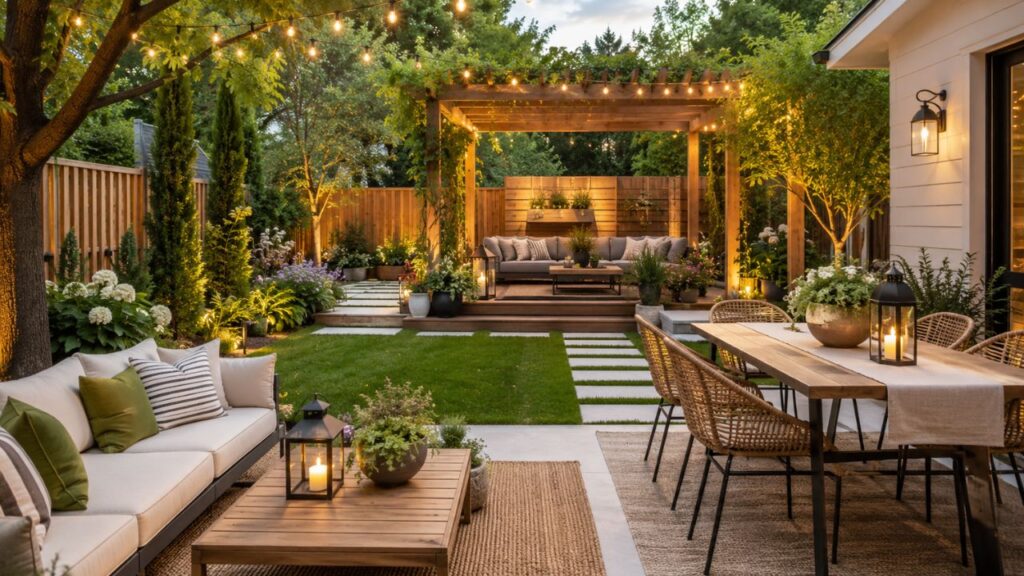
Getting Started: Decoration Ideas from DecoratorAdvice, Decoration Ideas, and Decoradyard for Every Budget
Before buying anything, it helps to walk your yard at three different times of day — morning, midafternoon, and dusk. Note where the sun actually lands, where the wind funnels through, and where you naturally end up standing. Most decorating mistakes come from designing a space based on how it looks on a floor plan rather than how it’s actually used.
Small Yards, Big Impact
A compact yard or patio benefits from decisions that do double duty. A bench with storage underneath. A planter that also blocks a view of the neighbor’s bins. Vertical elements — trellises, wall-mounted planters, tall narrow lanterns — matter more here than in a sprawling yard, because they add visual interest without eating into the square footage you need for actually moving around.
Color also behaves differently in small spaces. A single strong accent color, repeated two or three times, reads as intentional. Five different colors scattered across cushions, pots, and rugs reads as clutter, even if each individual piece is attractive.
Budget-Friendly Wins
- Repaint or restain existing furniture instead of replacing it — a weekend project that changes the whole tone of a seating area.
- Buy one or two higher-quality anchor pieces (a good outdoor rug, a solid dining table) and fill in around them with less expensive accessories.
- Shop end-of-season sales for planters, string lights, and cushions, which are often marked down 40 to 60 percent once summer inventory clears.
- Propagate plants from cuttings rather than buying full-grown specimens for every pot.
None of this requires a big reveal or a total teardown. Most of the best-looking yards accumulate slowly, one or two additions at a time, which also happens to be far easier on a budget than trying to do everything in one weekend.
Lighting That Changes Everything After Dark
If there’s one category of yard decoration that consistently gets underused, it’s lighting. A yard that looks pleasant at noon can feel flat and uninviting by 8 p.m. if the only light source is a single porch fixture. Layered lighting — several small sources at different heights rather than one bright overhead light — is what makes an outdoor space feel like an extension of the living room instead of a parking lot.
Solar and Low-Voltage Options
Solar lighting has improved considerably. The washed-out, flickering plastic path lights of a decade ago have mostly been replaced by warmer, steadier LED options that actually hold a charge through cloudy stretches. Solar lanterns along a walkway, or a solar-powered string set along a fence line, give you ambient light without adding an electrical project to your weekend.
For anything more permanent, low-voltage landscape lighting kits are worth the extra effort. They run on a transformer plugged into an outdoor outlet, and the fixtures themselves are unobtrusive during the day — a real advantage over solar units, which are often visibly bulky.
String Lights, Lanterns, and Candlelight
String lights remain popular for a reason: they’re inexpensive, forgiving of imperfect installation, and instantly change the mood of a space. The trick is hanging them with some slack rather than pulling them taut — a gentle catenary curve reads as intentional, while a straight line reads as an afterthought. Pair them with a few lanterns or flameless candles at table height, since overhead light alone can leave faces and tabletops in shadow.
Furniture and Seating: Building a Space People Actually Sit In
Furniture is where a lot of yards either come together or fall apart. The instinct is often to buy a matching patio set and call it done, but the most comfortable outdoor spaces usually mix pieces — a built-in bench along one wall, a couple of lounge chairs that don’t quite match, a low table that can hold drinks without anyone needing to lean.
Choosing Materials That Hold Up
Climate should drive material choice more than aesthetics alone. Teak and other dense hardwoods weather to an attractive silver-gray and hold up well in most conditions. Powder-coated aluminum resists rust and works well in humid or coastal areas. Wicker and rattan look wonderful but need to be genuine all-weather resin wicker if they’re staying outside year-round — the natural fiber versions are better suited to covered porches.
Arranging for Conversation, Not Just Symmetry
A common layout mistake is lining furniture up against the perimeter of a patio, which leaves an empty, unused middle and forces people to shout across the space to talk. Angling seating slightly inward, in loose clusters, encourages conversation and makes even a modest patio feel fuller and more considered.
It also helps to think in terms of clusters rather than one giant arrangement. A small yard might comfortably hold a two-seat conversation nook near the door and a separate single lounge chair tucked by the garden bed, rather than one oversized sectional dominating the whole footprint. This kind of zoning is one of the more consistent themes among decoration ideas from Decoratoradvice, Decoration Ideas, and Decoradyard style boards — smaller, purposeful groupings almost always function better than one large, undifferentiated seating block.
Planting and Greenery: The Decoration That Grows With You
Plants do more decorating work than almost anything else in a yard, and they’re often the last thing people budget for. Greenery softens hard edges, adds seasonal change, and — unlike furniture — actually improves over time instead of wearing down.
Raised Beds and Containers
Raised beds solve a lot of problems at once: better drainage, less bending, and a clear visual boundary between planted areas and open lawn. For renters or anyone unsure about a long-term layout, large containers offer nearly the same benefit without the commitment, and they can be rearranged as the space evolves.
Vertical Gardens and Trellises
Climbing plants — clematis, climbing roses, jasmine, or even a fast-growing annual vine — turn a bare fence or wall into a backdrop instead of a boundary. A simple grid trellis, paired with soft, slightly unruly planting around its base, tends to look more natural than an overly manicured version of the same idea.
- Herbs in a tiered planter near the kitchen door, for both scent and easy cooking access
- Native perennials mixed into borders to reduce watering needs and support local pollinators
- A single dramatic potted specimen — a Japanese maple, an olive tree, a large fern — as a focal point near the entrance
Pathways, Patios, and Hardscaping Details
Hard surfaces are the bones of a yard, and they’re worth getting right even though they’re less exciting than lighting or furniture. A path doesn’t need to run in a straight line from the door to the gate — a gentle curve, or a path that disappears briefly behind planting, slows people down and makes a small space feel larger than it is.
Material continuity matters here too. Repeating the same stone, brick, or paver style across a patio and a connecting path ties the whole yard together, while mixing three or four different materials in one small area tends to feel chaotic rather than eclectic.
If you’re pulling together a moodboard, it’s worth noticing how often the same handful of surface materials show up across otherwise very different projects — reclaimed brick, natural stone, and simple poured concrete with a clean edge. That repetition isn’t a lack of imagination; it’s a sign that these materials are genuinely durable and easy to build around, which is exactly why they keep turning up in decoration ideas from Decoratoradvice, Decoration Ideas, and Decoradyard collections year after year.
Water Features and Fire Elements as Focal Points
A yard rarely needs more than one dramatic focal point, and a water feature or fire element is often the strongest candidate. A small recirculating fountain adds ambient sound that helps mask street noise, which matters more in denser neighborhoods than people expect. A fire bowl or simple in-ground fire pit, meanwhile, extends the usable season of a patio well into cooler months and gives a seating area a natural center of gravity.
The key with both is placement — keeping enough distance from seating, plantings, and structures for safety and comfort, and positioning the feature so it can actually be seen and enjoyed from the main gathering spot rather than tucked into a corner no one faces.
Seasonal Decoration Ideas from DecoratorAdvice, Decoration Ideas, and Decoradyard Worth Repeating Every Year
A yard that only looks good for eight weeks in the middle of summer is a yard that’s underperforming for its owner. A few seasonal swaps, done consistently, keep the space feeling cared for year-round.
Spring Refresh
Spring is the moment to swap out winter-worn cushions, clean and reseal any wood furniture, and get early bulbs and cool-season annuals into containers before the heat arrives. It’s also the easiest time to evaluate what didn’t survive winter and adjust the planting plan accordingly.
Cooler-Weather Coziness
As temperatures drop, heavier textiles — wool throws, denser cushion covers, an outdoor rug with more texture — do a lot to keep a patio feeling usable. Adding a fire element or a couple of patio heaters can genuinely extend outdoor time by a month or two on either end of the season, which is often the highest-value seasonal upgrade available.
DIY and Upcycled Decor Worth Trying
Some of the most memorable yards include at least one piece that couldn’t be bought off a shelf. Upcycling old furniture, containers, or building materials into something new tends to read as more personal and more interesting than an all-new matching set.
- Old wooden crates stacked as an asymmetrical planter display
- A cracked terracotta pot deliberately broken further and planted to look like a small cascading scene
- Reclaimed pallet wood built into a simple bench or vertical planter
- Vintage metal tubs or troughs repurposed as raised planting beds
These projects also tend to be the most budget-friendly items in a yard, since the main cost is time rather than materials.
Choosing a Cohesive Style Instead of Chasing Every Trend
One of the quieter reasons some yards feel put-together while others feel scattered is that the owner picked a direction early on and stuck with it, at least loosely. That doesn’t mean rigidly following one design category. It means noticing what you’re naturally drawn to — warm and rustic, clean and modern, lush and cottage-like — and letting that preference guide the small decisions, from the color of a planter to the finish on a light fixture.
A useful exercise is to save ten or fifteen photos that genuinely appeal to you, without worrying yet about budget or feasibility, then look for the pattern. Most people find they’re drawn to a narrower range of colors, materials, and shapes than they expected. That pattern becomes a simple filter for future purchases: does this new item fit the direction I already have, or is it just appealing in isolation?
Blending Indoor and Outdoor Comfort
Many of the most livable yards borrow cues directly from interior design — a proper rug underfoot, layered textiles, a side table within reach of every seat. This is part of what shows up repeatedly in decoration ideas from Decoratoradvice, Decoration Ideas, and Decoradyard: the outdoor space is treated as a real room with a floor, walls, and a ceiling, even if those boundaries are a patio surface, a hedge line, and open sky. Once a yard is framed that way, decorating it stops feeling like a separate, more complicated project and starts feeling like an extension of choices you’re already comfortable making indoors.
Common Mistakes That Undercut a Good Yard
A few patterns show up again and again in yards that don’t quite come together, even when the individual pieces are nice on their own.
- Buying furniture before measuring the space, which leads to seating that’s either too cramped or awkwardly scattered
- Relying on a single light source instead of layering several smaller ones
- Choosing too many accent colors or materials, which fights against a sense of cohesion
- Ignoring maintenance needs — a beautiful material that requires constant upkeep often ends up neglected within a year
- Skipping a focal point entirely, leaving the eye with nowhere natural to land
Frequently Asked Questions
How much does it typically cost to decorate a backyard?
Costs vary enormously depending on scope. A simple refresh using lighting, cushions, and a few planters can often be done for a few hundred dollars, while a full hardscaping and furniture overhaul can run into the thousands. Starting with lighting and greenery tends to give the best visual return for the lowest cost, which is a point echoed consistently across decoration ideas from Decoratoradvice, Decoration Ideas, and Decoradyard budget guides.
What’s the easiest way to make a small backyard feel bigger?
Curved paths, vertical planting, and a single unifying color palette all help. Mirrors mounted on a fence, angled to reflect greenery, are another trick that adds a surprising sense of depth to a tight space.
Do solar lights actually work well anymore?
Modern solar fixtures with quality LED bulbs and decent battery capacity perform far better than older models. Placement in genuine direct sunlight for at least four to six hours a day still matters for consistent performance through the evening.
How do I choose furniture that survives rain and sun?
Look for materials rated for outdoor use specifically — powder-coated metal, teak or eucalyptus hardwood, and all-weather resin wicker are reliable choices. Cushion covers should be labeled fade- and water-resistant, and it helps to have a storage bin or cover on hand for the harshest weather.
What plants are lowest maintenance for a backyard border?
Native perennials suited to your specific climate zone are almost always the lowest-maintenance option, since they’re adapted to local rainfall and soil without extra intervention. A local extension office or nursery can usually point to a reliable regional list.
Is it worth adding a fire feature to a small patio?
Often yes, as long as clearance requirements are respected. Even a compact tabletop fire bowl extends usable evening hours into cooler months and gives a small seating area a clear focal point.
How often should yard decor be updated?
A light seasonal refresh — cushions, planting, a few accessories — twice a year keeps a yard feeling current without requiring a full redesign. Larger structural elements like furniture or hardscaping typically hold up for five to ten years before needing replacement.
Can renters make meaningful backyard changes without permanent work?
Yes — container gardens, freestanding lighting, portable furniture, and outdoor rugs can transform a rented yard just as effectively as permanent changes, and everything can move with you when the lease ends.
Bringing It All Together
None of this requires turning a weekend into a full landscaping project. The yards that end up feeling the most finished usually got there through a series of small, considered choices — a lighting layer added one month, a planter swapped the next, a bench repainted before it was truly necessary. What matters most is paying attention to how the space is actually used, then decorating around that reality rather than around a photo saved from somewhere else.
Start with whatever feels most overdue, whether that’s better lighting, a seating area that finally invites people to stay, or a border of plants that’s been on the list for a year. The rest tends to follow once the space starts to feel like somewhere worth spending time. If you keep gathering decoration ideas from Decoratoradvice, Decoration Ideas, and Decoradyard along the way, use them as a rotating source of inspiration rather than a checklist to complete all at once — the yards that age well are almost always built one good decision at a time.