Picture this: you wake up, and before your feet even hit the floor, the blinds have already parted, the coffee maker is halfway through a fresh pot, and the thermostat has nudged itself to the exact temperature you like. That’s the everyday reality inside techoelite smart homes, and it’s a lot closer to your own front door than most people realize. What used to sound like a gadget-lover’s fantasy has quietly turned into a practical, affordable way to run a household.
This matters because the way we live at home has genuinely changed. Energy bills keep climbing, break-ins and package theft worry a lot of families, and most of us are juggling more than we used to. A connected home isn’t about chasing the newest toy anymore. It’s about buying back a bit of time, tightening up security, and trimming the fat off a monthly utility bill. That’s the appeal behind techoelite smart homes, and it’s why so many homeowners are taking a serious look at what automation can actually do for them.
In the next few minutes, we’ll walk through what these systems really are, how they work room by room, what they cost to set up, and the mistakes people commonly make when they jump in too fast. By the end, you should have a clear, honest picture of whether this kind of setup fits your own home.
What Exactly Are Techoelite Smart Homes?
At the most basic level, a smart home is any residence where devices talk to each other and can be controlled from a single app, hub, or voice command instead of being operated one by one, by hand. Techoelite smart homes take that idea and build it into a full ecosystem rather than a pile of separate gadgets. Instead of a smart bulb here and a video doorbell there, everything sits on one network and follows rules you set once and then mostly forget about.
The term itself has become shorthand for a particular way of thinking about home automation: fewer standalone gadgets, more coordinated systems. Rather than treating lighting, climate, security, and entertainment as separate projects, the whole point is to let them share information and act on it together.
The Core Idea Behind the System
The philosophy is simple: a house should respond to the people living in it instead of the other way around. Sensors notice when a room is empty and switch off the lights. A hub learns that nobody is usually home between 9 a.m. and 5 p.m. and adjusts the heating accordingly. None of this requires you to think about it every day, which is really the whole point.
How It Differs From a Regular Smart Device Collection
Plenty of households already own a smart speaker or a single smart plug, and that’s a fine starting point. What separates a fully connected setup is that every device is aware of the others. A motion sensor in the hallway can tell the lighting system, the thermostat, and the security camera to act at the same time, instead of each device operating in its own little bubble.
Why More Homeowners Are Turning to Techoelite Smart Homes
Rising Energy Costs
Utility prices have been unpredictable for years, and heating and cooling alone can eat up a huge chunk of a household budget. Smart thermostats and automated lighting trim that waste by learning patterns instead of running on a fixed schedule that ignores whether anyone is actually in the house. Over a full year, that kind of small, constant correction tends to add up to real savings rather than a one-time discount.
Security Concerns
Video doorbells, motion sensors, and smart locks give people a way to check on their property from anywhere, which matters a great deal for anyone who travels for work or simply wants peace of mind while at the office. Instant alerts mean a homeowner finds out about an unexpected visitor within seconds instead of hearing about it secondhand.
The Convenience Factor
There’s also a simpler reason people like these setups: they just make daily life easier. Locking the front door, dimming the lights for a movie, or checking whether the oven got left on can all happen with a tap instead of a trip back home. For busy households juggling work, kids, and everything in between, that small convenience adds up over the course of a week.
A Long-Term Investment in the Property Itself
Beyond day-to-day comfort, buyers increasingly look for homes that already come wired for automation. Real estate listings that mention smart thermostats, integrated security, or automated lighting tend to catch more attention, which is part of why some homeowners view the upgrade as adding resale value rather than just a personal convenience.
Key Features That Define Techoelite Smart Homes
Below are the features that show up again and again in a well-built setup.
- A central hub or app that controls every connected device from one place
- Voice assistant compatibility, usually with Alexa, Google Assistant, or Siri
- Adaptive lighting that adjusts based on time of day, occupancy, or mood
- Smart climate control that learns household routines
- Layered security including cameras, sensors, and smart locks
- Energy monitoring tools that flag which appliances use the most power
- Custom “scenes” that adjust several devices at once for a specific activity
Centralized Control Hub
This is the backbone of the whole system. Rather than juggling a dozen apps, one dashboard lets you see and adjust everything, from the porch light to the upstairs thermostat.
Voice Assistant Integration
Being able to say “turn off the kitchen lights” instead of walking over and flipping a switch sounds small, but it adds up over the course of a busy week. Voice control is often the feature that wins over skeptical family members who were on the fence about the whole idea in the first place.
Adaptive Lighting and Climate Control
Instead of static settings, the system reads patterns. Lights dim automatically in the evening, and the thermostat nudges itself down a few degrees once everyone’s asleep. Some setups even adjust color temperature throughout the day, leaning toward brighter, cooler light in the morning and warmer tones in the evening to match the body’s natural rhythm.
Scene-Based Automation
A single tap or voice command can trigger a whole sequence: dimming the lights, lowering the blinds, switching the TV to a streaming app, and setting the thermostat to a comfortable movie-night temperature. Building a handful of these scenes for common routines is often what makes a system feel genuinely useful rather than just novel.
The Technology Powering Techoelite Smart Homes
IoT and Connectivity Protocols
Every device relies on some form of wireless communication, whether that’s Wi-Fi, Bluetooth, Zigbee, or the newer Matter standard, which was built specifically to help devices from different brands actually talk to one another without constant workarounds. Choosing devices that support a shared protocol tends to save a lot of headaches down the road.
Artificial Intelligence and Predictive Automation
This is where things get genuinely interesting. Rather than just reacting to a command, AI-driven systems start noticing habits: what time you usually get home, which rooms stay empty most of the day, and how you like your house heated in January versus July. Over time the system starts anticipating instead of waiting to be told, which is a meaningful shift from the first generation of programmable thermostats and timers.
Cloud Computing and Data Security
All of that data has to live somewhere, and most systems rely on encrypted cloud storage so you can check your cameras or adjust the thermostat from your phone no matter where you are. It’s worth asking any provider directly about their encryption standards and how long they retain footage, since not all companies handle this the same way. A little research up front goes a long way toward avoiding an unpleasant surprise later.
Room-by-Room Benefits
Living Room and Entertainment
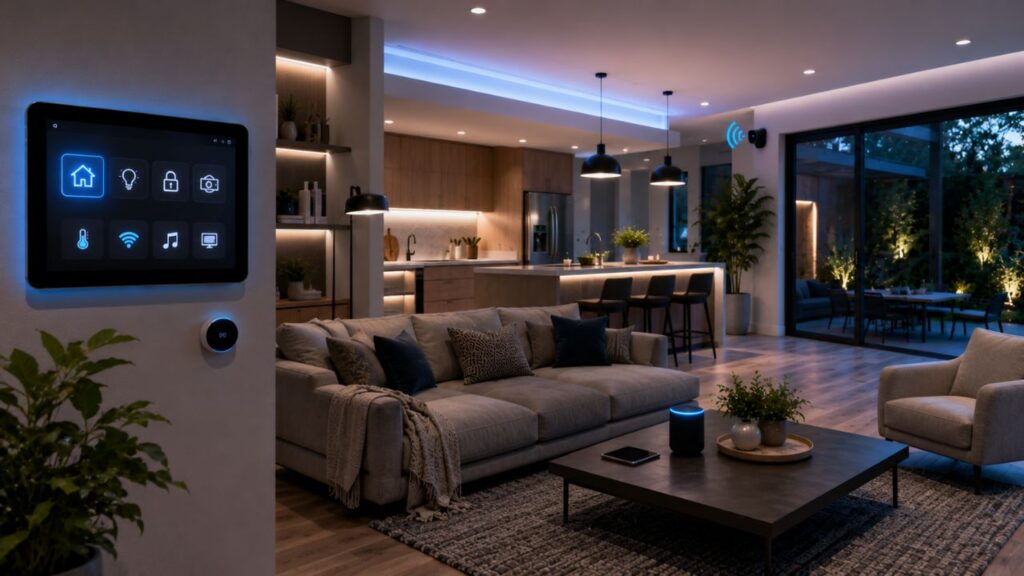
Multi-room audio, voice-controlled entertainment centers, and lighting scenes built for movie night turn an ordinary living room into something closer to a small home theater, without rewiring the whole house.
Kitchen
Smart refrigerators that track what’s inside, ovens you can preheat from the driveway, and leak sensors under the sink all shave a few minutes and a few headaches off daily cooking routines. A notification that the milk is running low before you even leave for the grocery store is a small thing, but it’s the kind of small thing that adds up.
Bedroom
Automated blinds that open gently with the sunrise, smart alarms tied to actual sleep cycles, and climate control that keeps a bedroom cool at night and warm in the morning all add up to genuinely better rest.
Outdoor Spaces
Motion-activated floodlights, smart sprinklers that check the weather forecast before watering the lawn, and video doorbells that catch package deliveries round out the picture outside the front door. Automated irrigation alone can meaningfully cut down on wasted water during dry spells, since the system skips watering days when rain is already in the forecast.
Keeping the System Running Smoothly
Routine Maintenance
Even a well-designed setup needs occasional attention. Firmware updates should be installed as they come out rather than ignored, since many of them close security gaps rather than just adding features. Batteries in door sensors and standalone cameras tend to need replacing roughly once or twice a year, and it’s worth keeping a simple checklist so nothing gets forgotten during a busy season.
When to Call in a Professional
Most day-to-day upkeep is something any homeowner can handle, but a few situations are worth bringing in outside help: a hub that keeps dropping connection to half the house, a security system that needs rewiring after a renovation, or an integration between two brands that simply won’t cooperate no matter how many times you’ve tried resetting it. A short visit from a certified technician is often faster and cheaper than hours of trial and error.
Ongoing Costs to Budget For
Beyond the upfront purchase, some features come with a modest subscription fee, particularly cloud video storage for security cameras or advanced AI-based monitoring. It’s worth reading the fine print before buying a camera system specifically for that reason, since the monthly cost can add up over a few years more than the hardware itself did.
Setting Up Your System: What to Expect
Planning and Budgeting
Most homeowners start small, usually with lighting or a video doorbell, and expand from there. A modest starter kit can run under two hundred dollars, while a full whole-house build with professional installation can climb into the thousands, depending on how many rooms and devices are involved. It’s usually smarter to treat this as a gradual project rather than a single weekend purchase.
Choosing Compatible Devices
This is where a lot of people run into trouble. Buying gadgets from five different brands without checking whether they actually work together often ends with five separate apps and a house that feels more complicated, not less. Checking for shared standards like Matter or Zigbee before buying saves a lot of frustration later.
Professional Installation vs DIY
Simple additions like smart bulbs or plugs are genuinely a plug-and-play job. Anything involving wiring, like in-wall switches or hardwired security cameras, is usually worth having a licensed electrician or a certified installer handle, both for safety and to keep any warranty intact.
Techoelite Smart Homes vs. Traditional Home Setups
It helps to see the contrast side by side. A traditional home relies on manual switches, fixed thermostat schedules, and security that mostly means a deadbolt and maybe a doorbell camera bought separately. Techoelite smart homes replace that patchwork with a single coordinated system, where the lighting, climate, and security all draw on the same data and respond together instead of independently. The difference shows up most clearly in the little frictions of daily life: not wondering whether you locked the door, not manually resetting the thermostat every time the season changes, and not needing five different apps just to check on the house while you’re away. None of this makes a traditional home unlivable, of course, but it does explain why so many people, once they’ve tried an automated setup, find it hard to go back to flipping switches by hand.
Is the Investment Worth It?
The honest answer is that it depends on how you use the system. Households that lean on the energy-saving and security features tend to see a return over time, both in lower bills and in the kind of peace of mind that’s harder to put a number on. Households that buy a pile of gadgets and never really use half of them get a lot less out of the same investment. The difference usually comes down to planning: deciding what problem you’re actually trying to solve before shopping for devices, rather than buying first and figuring out the use case later.
Common Mistakes to Avoid
- Buying incompatible devices across different ecosystems without checking for shared standards
- Ignoring internet bandwidth, since a shaky connection makes even the best hardware unreliable
- Over-automating every single function until the house feels more complicated than helpful
- Skipping firmware updates, which often patch real security holes
- Forgetting to set up a guest network to keep smart devices separate from personal computers and phones
- Underestimating how many devices a single Wi-Fi router can comfortably support
The Future of Techoelite Smart Homes
The next wave looks less like new gadgets and more like smarter thinking behind the ones we already have. Expect systems that predict a need before anyone asks for it, climate control that factors in local weather forecasts and electricity pricing at the same time, and health-focused sensors that quietly track air quality, humidity, and sleep patterns in the background. As more devices adopt shared standards like Matter, the headache of mixing brands should keep shrinking too, which will make it easier for more households to get started without needing to commit to one single company’s ecosystem.
Solar integration is another area worth watching. Pairing rooftop panels with an automated system that shifts heavy appliance use to the middle of the day, when solar production peaks, is becoming a much more common way to squeeze extra value out of both technologies at once.
Frequently Asked Questions
Are techoelite smart homes expensive to set up?
Not necessarily. A basic setup with a smart speaker, a few bulbs, and a video doorbell can cost less than a nice dinner out, while a full whole-house build with professional installation runs considerably higher depending on scope.
Do I need to replace my entire home network?
Usually not. Most systems work fine on a standard home Wi-Fi router, though a mesh network helps in larger houses where a single router struggles to reach every room.
What happens if the internet goes down?
Many local functions, like a smart bulb responding to a physical switch, still work without an internet connection. Features that rely on remote access or voice assistants, though, generally need connectivity to function.
Are these systems safe from hackers?
No connected device is completely immune to risk, but strong passwords, a separate guest network for smart devices, and regular firmware updates cut that risk down significantly.
Can renters set up a smart home too?
Yes. Plug-in devices like smart bulbs, plugs, and portable cameras don’t require any permanent changes and can move with you to the next apartment.
How long does installation typically take?
A few individual devices can be set up in an afternoon. A full whole-house system with professional installation typically takes anywhere from a day to a few days, depending on the number of rooms involved.
Do these systems work with existing appliances?
Many older appliances can be retrofitted using smart plugs or add-on sensors, though built-in smart appliances usually offer deeper integration and more detailed data.
Which voice assistant works best with these systems?
Most major systems support Amazon Alexa, Google Assistant, and Apple Siri, so the better question is usually which assistant you already use most, since that’s the one worth building around.
How do I know if my current house is even suitable?
Almost any house can be adapted, whether it was built last year or fifty years ago. Older homes might need a bit more planning around wiring and Wi-Fi coverage, but plug-in devices and battery-powered sensors make it possible to bring techoelite smart homes into nearly any layout without major renovation.
Conclusion
There’s no single reason people end up choosing this kind of setup. For some it’s the lower energy bill at the end of the month. For others it’s the quiet reassurance of checking a camera feed from an airport gate. What ties it together is a simple shift: a house that used to sit there passively now responds to the people living in it. Whether that means starting with a single smart bulb or planning a full room-by-room rollout, the technology has reached a point where it’s no longer reserved for early adopters with deep pockets. It’s just a practical way to make an ordinary house run a little more smoothly, one connected device at a time.